SAN JOSE DEL MONTE, BULACAN — The discovery of another suspected pet dumping site in Bulacan has deepened a disturbing controversy involving a cremation business accused of mishandling animals entrusted to it by grieving families.
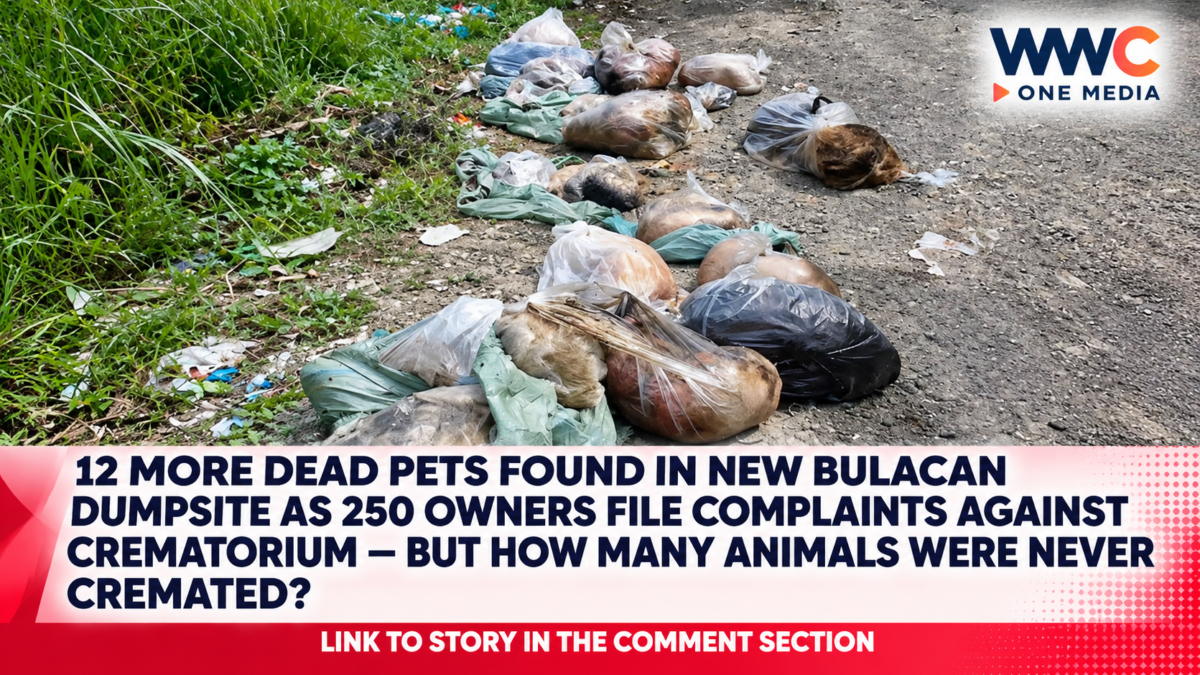
Animal welfare volunteers recovered 12 additional dog and cat remains on Saturday, November 7, from a heavily vegetated area in Barangay Gaya-Gaya, San Jose del Monte City.
The latest discovery came just one day after volunteers reported finding approximately 16 more animal remains near an access road.
Some of the bodies appeared to have been discarded recently, while others were in advanced stages of decomposition.
According to GMA News, the volunteers searching for the animals have now encountered so many remains across multiple locations that they no longer have a reliable overall count.
The discoveries have intensified a National Bureau of Investigation (NBI) probe into the alleged improper disposal of pets connected to cremation services.
At least 250 pet owners have filed complaints involving Ahjay Paws Aftercare Pet Crematorium, a business based in Bacoor, Cavite.
Some complainants believe their pets were never cremated despite paying for the service.
Others want to establish whether the ashes they received actually came from their animals.
The NBI has initiated complaints involving alleged estafa and waste-management violations against four individuals.
But the full scale of the suspected misconduct remains unclear.
As more animal remains emerge from vacant lots and roadside areas, investigators face a troubling question: How many grieving families may have paid for cremations that were never performed?
Another 12 Pet Remains Discovered in Barangay Gaya-Gaya
The latest discovery was made on November 7 in a densely vegetated part of Barangay Gaya-Gaya.
Animal welfare volunteers searching the location found the remains of dogs and cats concealed in plastic bags.
The animals were in different stages of decomposition.
Some appeared relatively recent.
Others had deteriorated so severely that identifying them would be difficult.
The condition of the remains underscores the urgency of preserving possible evidence.
As decomposition progresses, visual identification becomes less reliable.
Investigators may need to rely on photographs, labels, transport records, veterinary documentation and other available information.
GMA News reported that the group recovered 12 remains from the newly discovered location.
The figure is separate from the approximately 16 remains reported on November 6.
However, the search group has not established a verified cumulative total covering every identified site.
Volunteers Receive Information About Previously Unknown Dumpsites
The search effort has been supported by information from individuals who claim to know where animal remains were abandoned.
Chris Taylor, founder of the animal welfare group involved in the search, told GMA News that informants had directed volunteers toward particular locations.
Taylor said some informants preferred not to coordinate with the local government.
The volunteers checked fields, access roads and other areas based on the information they received.
The discovery of additional remains has raised concerns that the dumping may have continued over an extended period.
However, the reliability of each informant’s account must still be evaluated.
Investigators have not established that every identified site was used by the same individuals or business.
The search group said it would turn over its collected evidence to the NBI.
Barangay officials and San Jose del Monte police also inspected the newly discovered location.
The barangay captain declined to comment because the investigation remains ongoing.
Evidence Collected Before More Remains Become Unrecognizable
The volunteers have been photographing and recording the remains they recover.
The documentation is intended to help investigators and potentially affected owners identify individual animals.
In some earlier discoveries, plastic bags contained names or other identifying details.
Such information may help connect remains with veterinary records, collection receipts or cremation transactions.
But a handwritten name on a bag is not by itself conclusive proof of an animal’s identity.
The evidence must be evaluated alongside other records.
The group is trying to complete its search quickly because decomposition can make identification more difficult.
Its findings may eventually help investigators establish where individual animals came from and how they reached the dumping locations.
How the Bulacan Pet Cremation Scandal Began
The controversy began with the discovery of 29 animal remains along a roadside in Barangay Minuyan Proper, San Jose del Monte.
The October 31 GMA report identified 26 dogs and three cats.
Residents had noticed a strong odor before the abandoned animals were discovered.
Several remains were wrapped or sealed inside plastic bags.
Photographs and information circulated online, prompting worried pet owners to examine whether the animals could be theirs.
Some families said they recognized their deceased pets even though they had previously paid for cremation services.
The discoveries prompted complaints involving Ahjay Paws Aftercare Pet Crematorium.
As WWC ONE MEDIA reported in its November 4 investigation of 250 pet owners filing complaints against Ahjay Paws, families began questioning whether cremation services had actually been performed.
The owner, Jonathan Legaspi, has denied responsibility for the alleged dumping.
His denial is an important part of the record.
The accusations remain subject to investigation and judicial proceedings.
More Suspected Sites Had Already Been Reported
The November 7 discovery was not the first indication that the alleged dumping extended beyond the original roadside location.
SPOT.ph reported that volunteers had already identified other suspected dumping sites in Barangays Minuyan IV and Minuyan V.
One location involved an abandoned septic tank containing sacks of animal remains.
The Philippine Animal Welfare Society (PAWS) reportedly examined that site on November 3 and found 31 deceased dogs inside eight sacks.
Another location had previously been documented by volunteers.
A paraveterinary worker from the San Jose del Monte City Veterinary Office also said she had encountered remains in the abandoned septic tank in November 2025.
That account raises questions about whether improper disposal had been taking place before the current controversy became public.
However, the dates, origins and connections between the various discoveries have not been fully established.
Estimates suggesting thousands of animals may have been affected are based on unverified informant allegations.
They should not be reported as confirmed findings.
NBI Pursues Estafa and Waste-Management Complaints
The National Bureau of Investigation has expanded its inquiry as the number of complainants increases.
On November 6, NBI Director Melvin Matibag said investigators were pursuing complaints involving alleged estafa and violations of the Ecological Solid Waste Management Act.
GMA News reported that complaints were filed against four individuals allegedly connected with the improper disposal of pet remains.
The bureau also requested an immigration lookout bulletin order involving three individuals under investigation.
An immigration lookout bulletin is not equivalent to an arrest warrant or a final finding of guilt.
Authorities must still follow the applicable legal process.
The NBI’s inquiry covers possible consumer deception, the operational capacity of cremation facilities and compliance with waste-management requirements.
Investigators are examining whether customers paid for services that were not provided as represented.
They are also considering whether the handling and disposal of remains violated relevant environmental regulations.
The outcome will depend on the evidence.
NBI Examines Possible Links Between Two Crematoriums
According to Matibag, investigators have identified Ahjay Paws Aftercare Pet Crematorium in Bacoor as a facility allegedly involved in sending animal remains to another cremation business in San Jose del Monte.
This possible arrangement is an important part of the investigation.
Investigators need to determine how the animals were collected, transported, stored and processed.
They must also establish which business had custody of the remains at each stage.
Relevant evidence may include customer transaction records, transport logs, employee statements, surveillance footage and cremation documentation.
The NBI previously said its investigation would assess whether the facilities possessed sufficient equipment and operating capacity.
The existence of a business relationship or transfer arrangement does not automatically establish criminal wrongdoing.
Prosecutors must show how each suspect was allegedly involved and what laws may have been violated.
At Least 250 Pet Owners Demand Answers
The growing number of complainants shows how widely the controversy has affected pet-owning families.
At least 250 pet owners had filed complaints against Ahjay Paws, according to reports cited by GMA News.
The number reflects complaints from customers.
It is not a confirmed count of fraudulent cremations.
Nor does it mean that 250 distinct animals have been positively identified among the recovered remains.
Some owners have reported recognizing their animals.
Others have questioned the contents of urns returned after purported cremations.
Investigators are also examining documentary evidence from customers.
For many families, the uncertainty is especially painful.
They entrusted their pets to an aftercare provider during a period of grief, expecting the promised service to be performed respectfully.
The possibility that their pets’ bodies were abandoned instead has prompted demands for accountability.
What Happened to the Ashes Given to Pet Owners?
One of the most serious questions concerns ashes returned to families after cremation services.
Some owners have reported receiving urns despite later believing they recognized their pets among the dumped remains.
These accounts raise concerns about whether the contents of the urns correspond to the animals entrusted to the service provider.
The Philippine National Police Forensic Group has been examining submitted materials as part of the investigation.
However, the latest reporting does not provide a conclusive forensic result establishing the identity of every sample.
Scientific examination may face limitations, especially when materials have been exposed to intense heat.
Investigators may therefore need additional documentary and testimonial evidence.
The question is not merely whether an urn contains ash.
It is whether the business delivered the particular service promised to the customer.
PAWS Calls for Accountability and Stronger Oversight
The Philippine Animal Welfare Society has urged affected owners to preserve records relevant to their transactions.
These may include receipts, cremation certificates, messages, photographs and documents identifying the animal.
PAWS has emphasized that alleged deception involving pet aftercare services may raise issues under criminal and consumer-protection laws.
The group has also encouraged investigation of sanitation and environmental compliance.
An important legal distinction is that the discovery of deceased animals does not automatically prove a violation of the Animal Welfare Act.
PAWS has explained that the alleged deception and improper disposal may raise different legal questions.
The applicable offenses depend on what investigators establish.
Stronger oversight of animal-related businesses is also an international concern.
As WWC ONE MEDIA reported in its coverage of Japan’s nationwide investigation into animal cafés, regulators are examining how commercial establishments handle animals and whether existing standards provide adequate protection.
The Japanese case concerns living animals and is unrelated to the Bulacan dumping investigation, but it illustrates the importance of clear regulatory standards.
Environmental and Public Health Concerns Grow
The abandonment of decomposing animal remains can create sanitation and environmental concerns.
Improper disposal may produce offensive odors and expose nearby communities to contaminated material.
The actual health risk depends on the circumstances, including the condition of the remains and the surrounding environment.
Authorities should therefore ensure that recovered animals are handled using appropriate safety procedures.
Local health, environmental and veterinary personnel may have roles in determining suitable treatment and disposal.
The current investigation must establish whether particular waste-management rules were violated.
The fact that the remains were discovered in multiple locations makes documentation and evidence preservation especially important.
It also raises questions about whether local authorities received earlier warnings and how those reports were handled.
Why Animal Welfare Enforcement Matters
The controversy has drawn attention to the broader responsibility of businesses and individuals involved in animal care.
In another animal welfare case, WWC ONE MEDIA reported that a Singapore man was jailed after 71 cats were abandoned in a flat.
That prosecution involved living animals and proven neglect, making it legally different from the Bulacan investigation.
But both incidents illustrate the importance of documenting what happened to animals entrusted to a person’s care.
For pet aftercare services, an effective system should ensure clear identification, proper handling and accurate records.
Customers should be able to understand where their pets will be taken, whether another facility will perform the cremation and what documentation is available.
The standards ultimately required in the Philippines will depend on applicable laws and any future regulatory reforms.
The Broader Debate Over Responsible Pet Services
Philippine businesses are increasingly expected to explain the rules governing animal-related services.
As WWC ONE MEDIA reported after Pizza Hut Philippines clarified its policies following a pet dog being placed in a restaurant baby high chair, public discussion has grown around sanitation, animal handling and business responsibilities.
That restaurant incident is not connected to the Bulacan case.
But it demonstrates why clear procedures matter when businesses serve pet owners.
For crematoriums, the stakes are especially sensitive because customers are grieving.
They are paying not merely for the physical disposal of remains but for a specific service they expect to be carried out with dignity.
Accurate documentation, transparent procedures and honest communication are therefore essential.
What Pet Owners Should Do if They Suspect They Were Affected
Pet owners who used a cremation service involved in the investigation can preserve relevant evidence and coordinate with the proper authorities.
Useful records may include payment receipts, cremation certificates, transaction confirmations, messages with the service provider, collection details and photographs identifying the animal.
Owners who received an urn and have concerns about its contents should avoid discarding potentially relevant materials before receiving guidance from investigators.
The NBI has encouraged complainants to submit information that may help establish the facts.
Affected customers may also seek legal advice regarding possible consumer or criminal complaints.
However, not every customer who used the establishment has been confirmed to be a victim of fraud.
The investigation must distinguish substantiated complaints from unresolved suspicions.
What Happens Next in the Bulacan Investigation?
The NBI is expected to examine the evidence gathered from the newly identified locations.
Investigators will need to determine whether the animal remains are linked to customers of the cremation facilities under scrutiny.
They must also establish how the remains reached different dumping sites and identify who was responsible for transporting or discarding them.
The November 7 discovery may provide additional evidence, but it does not yet establish a final count of affected animals.
The reported involvement of multiple locations may require coordination among law enforcement agencies, local governments and environmental authorities.
Meanwhile, the complaints already initiated against four individuals will be subject to further legal proceedings.
No final determination of guilt has been reported.
The Bottom Line: More Remains Found, but the Full Truth Is Still Unknown
The discovery of 12 additional animal remains in Barangay Gaya-Gaya has intensified the investigation into the alleged improper disposal of deceased pets in Bulacan.
The latest find followed approximately 16 more remains reported a day earlier.
Earlier discoveries included 29 dogs and cats in Barangay Minuyan Proper and additional remains at other suspected dumping locations.
At least 250 pet owners have filed complaints against Ahjay Paws Aftercare Pet Crematorium.
The NBI is pursuing allegations of estafa and waste-management violations involving individuals allegedly connected to the case.
However, the total number of animals affected remains unverified.
The investigation must still determine the role of each suspected individual, establish whether promised cremations were performed and identify the origin of remains recovered across the city.
For grieving pet owners, the issue goes beyond refunds or business permits.
It is about trust, accountability and the dignity of animals they considered members of their families.
And as volunteers uncover more abandoned pets in Bulacan while hundreds of owners question the cremation services they paid for, one haunting question remains: How many families may have taken home an urn believing it contained their beloved pet—when their animal’s body had actually been discarded somewhere else?