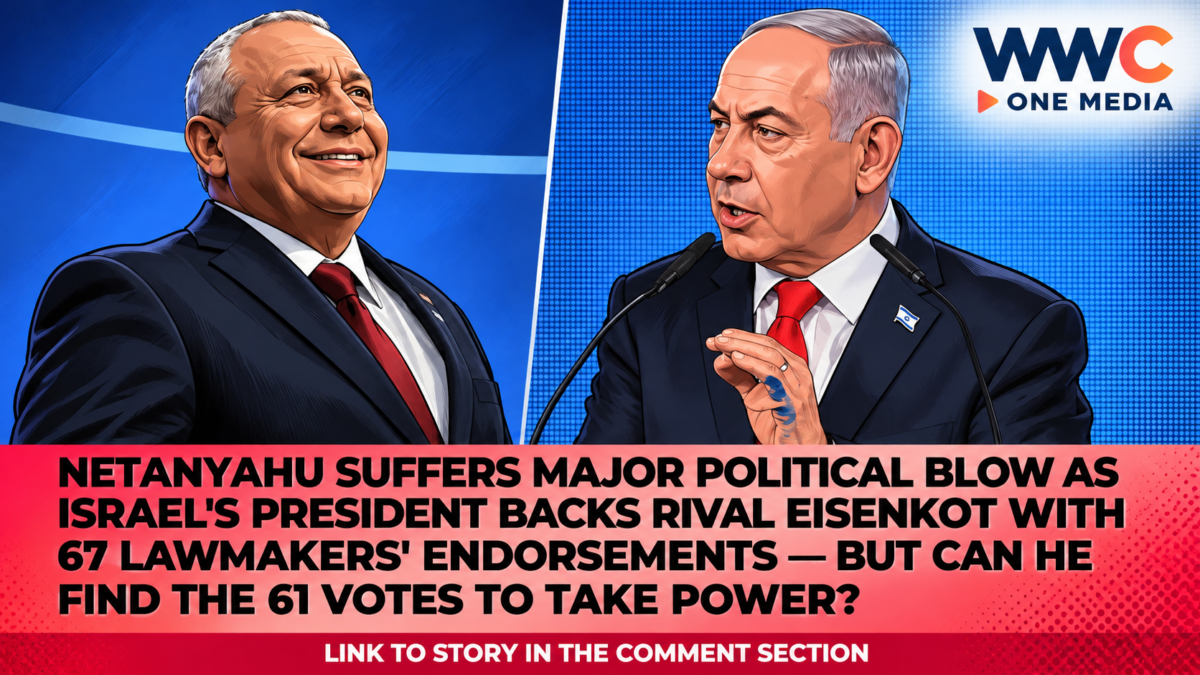
JERUSALEM, ISRAEL — Israeli Prime Minister Benjamin Netanyahu is facing one of the most serious threats to his political survival after President Isaac Herzog selected former military chief Gadi Eisenkot to attempt forming the country’s next government.
The decision, announced on Saturday, November 7, follows a deeply divided national election in which Netanyahu’s governing alliance lost its parliamentary majority.
But the opposition also failed to win enough seats to govern on its own.
Now, Israel faces weeks of negotiations that could either end Netanyahu’s long-running dominance of Israeli politics or hand the veteran leader another unexpected opportunity to remain in power.
Eisenkot received recommendations from political factions representing 67 members of Israel’s 120-seat parliament, compared with only 46 supporting Netanyahu.
That gives the former army chief a significant initial advantage.
But there is a major complication.
Eisenkot’s own four-party alliance controls just 48 seats.
He needs a coalition capable of commanding sufficient support in the Knesset, where 61 seats constitute a majority.
The missing votes could come from Arab-led parties, ultra-Orthodox factions or a broader arrangement involving political rivals.
And each possibility carries serious political consequences.
The question confronting Israel is no longer simply whether Netanyahu lost his parliamentary majority. It is whether the opposition can agree on enough issues to replace him.
President Herzog Gives Eisenkot the First Opportunity to Form a Government
Herzog’s announcement followed days of consultations with the parties elected to Israel’s 26th Knesset.
Under Israel’s parliamentary system, the president asks a lawmaker believed capable of assembling a government to begin coalition negotiations.
The decision does not automatically make that person prime minister.
The selected politician must still negotiate a workable arrangement and secure the necessary parliamentary support.
On November 5, Herzog revealed that factions representing 67 lawmakers had recommended Eisenkot.
Parties representing 46 lawmakers backed Netanyahu.
The remaining seven members belonged to a faction that chose not to endorse either candidate.
The president acknowledged that Eisenkot had received more recommendations but emphasized that forming a government was still far from guaranteed.
Political parties supporting the former army chief’s nomination disagree sharply on issues involving security, religion and the role of Arab citizens in Israeli politics.
After further discussions, Herzog announced on November 7 that Eisenkot would receive the first opportunity.
The formal mandate was scheduled to be handed over at the president’s residence in Jerusalem on November 8.
It represents a major political setback for Netanyahu.
But it does not mean that a transfer of power has occurred.
Israel’s Election Results Reveal an Extraordinary Deadlock
The October 27 parliamentary election produced a sharply divided Knesset.
Netanyahu’s Likud party secured 27 seats, making it the largest individual party.
His wider religious-nationalist alliance won 53 seats.
Eisenkot’s Yashar party won 21 seats, becoming the second-largest individual party.
The four-party opposition alliance led by Eisenkot secured 48 seats.
Meanwhile, two Arab-led parties won a combined 19 seats.
The results created a difficult political situation.
Neither major Jewish-led bloc holds the 61 seats required for an outright majority.
Netanyahu’s alliance is eight seats short.
Eisenkot’s alliance is 13 seats short.
However, the 19 Arab-party lawmakers could change the parliamentary balance.
If Eisenkot’s 48-seat alliance cooperated with all 19, it would have the support of 67 lawmakers.
The arithmetic appears straightforward.
The political negotiations are anything but simple.
Why 67 Endorsements Do Not Guarantee Eisenkot Becomes Prime Minister
One of the most important distinctions in the election is the difference between recommending a candidate and agreeing to join that candidate’s government.
During the presidential consultations, lawmakers were asked whom Herzog should select to attempt forming a coalition.
Some parties supported Eisenkot because they wanted Netanyahu removed.
That does not mean they have agreed on a common policy programme.
Political groups may be willing to recommend the same candidate while refusing to participate together in a government.
Some Jewish-led opposition parties have expressed strong objections to relying on Arab-led parties.
The Arab-led parties, meanwhile, want greater political influence and changes affecting their communities.
The negotiations must therefore resolve fundamental disagreements before a stable government can emerge.
As WWC ONE MEDIA previously reported in its analysis of the 67 recommendations and Netanyahu’s weakened position, Eisenkot’s apparent numerical advantage may prove insufficient if political partners refuse to cooperate.
The president’s decision opens the door to a possible change in leadership.
It does not guarantee one.
Arab-Led Parties Become Potential Kingmakers
One of the election’s biggest developments was the strong performance of Arab-led political parties.
The Joint List secured 11 seats, while Ra’am won eight.
Together, they control 19 seats.
Both parties recommended Eisenkot during consultations with Herzog.
That gives lawmakers representing Palestinian citizens of Israel substantial influence over the coalition-formation process.
Some Arab leaders have indicated they could support efforts to replace Netanyahu without necessarily entering the government.
Such an arrangement could involve supporting an opposition-led administration from outside the governing coalition.
Others have expressed openness to participating more directly.
As WWC ONE MEDIA reported in its coverage of Arab parties backing Eisenkot’s attempt to unseat Netanyahu, the election has created an unusual opportunity for Arab political representatives to influence who governs Israel.
But their role remains controversial.
Netanyahu and his allies argue that relying on parties they consider hostile to Israel’s national-security interests would create an unstable government.
Arab-party representatives reject the suggestion that their participation in democratic politics makes them illegitimate political partners.
The disagreement could become decisive.
Avigdor Liberman Could Block Eisenkot’s Most Obvious Path
Among Eisenkot’s potential partners is Avigdor Liberman, leader of the secular nationalist Yisrael Beiteinu party.
Liberman strongly opposes Netanyahu’s continued leadership.
But he has also objected to forming a government dependent on Arab-led political parties.
That position creates a serious obstacle.
Eisenkot cannot simply combine the 48 seats of his alliance with all 19 Arab-party seats and assume that his current partners will accept the arrangement.
Liberman’s concerns involve security policy, national identity and political cooperation.
The former defense minister has also been a prominent critic of exemptions from military service for ultra-Orthodox men.
However, recent reporting suggests he may show some flexibility toward an arrangement involving an ultra-Orthodox party.
That could create another negotiating route.
But it would require difficult compromises over religious and military obligations.
For Eisenkot, the challenge is finding an arrangement acceptable to enough lawmakers without alienating the parties already supporting him.
Ultra-Orthodox Parties Could Hold the Deciding Votes
Israel’s ultra-Orthodox political parties may also determine the next government’s composition.
United Torah Judaism, which holds seven seats, declined to recommend Netanyahu or Eisenkot during the presidential consultations.
That decision weakened Netanyahu’s position.
It also raised the possibility that the party might negotiate with Eisenkot.
Another ultra-Orthodox party, Shas, could also become relevant to coalition discussions.
An alliance involving Eisenkot’s 48 seats and the seats held by both ultra-Orthodox parties could potentially produce a narrow majority.
But substantial disagreements remain.
One of the most sensitive issues concerns military service.
Many Israelis believe military obligations should be shared more equally, particularly following years of conflict and repeated reserve deployments.
Ultra-Orthodox political representatives have resisted efforts to require many religious students to serve in the military.
Eisenkot has supported a broader obligation to perform military or national service.
Negotiations over that issue could determine whether a coalition agreement becomes possible.
Who Is Gadi Eisenkot?
Gadi Eisenkot, 66, is a former chief of staff of the Israel Defense Forces.
He served as Israel’s military chief from 2015 to 2019.
His career spans several decades in the country’s defense establishment.
He entered national politics in 2022 and later emerged as a major opposition figure.
Eisenkot is the leader of the Yashar party, which became one of the strongest political challengers to Netanyahu.
His public appeal combines military experience with criticism of Netanyahu’s leadership.
Eisenkot has called for greater accountability over the failures surrounding the Hamas-led attacks of October 7, 2023.
He has also criticized the influence of far-right politicians in Netanyahu’s governing alliance.
However, Eisenkot is not a conventional anti-military or pacifist political figure.
His security positions remain hawkish in several areas.
He has defended strong military responses to security threats.
A government led by Eisenkot would therefore not automatically represent a complete reversal of Israel’s defense policies.
Eisenkot’s Family Has Paid a Heavy Price in the Gaza War
The former military chief’s political profile is also shaped by personal tragedy.
His son and two nephews were killed while fighting in Gaza following the October 7 attacks.
Eisenkot briefly served in Netanyahu’s wartime cabinet before returning to the opposition.
He later criticized the prime minister’s management of the military campaign and the government’s broader decision-making.
His experience has made him a prominent voice in debates about security, military accountability and national leadership.
But personal losses do not determine the viability of a political coalition.
Eisenkot still needs to persuade parties with competing priorities that they can work under his leadership.
The difficulties involve both policy and political trust.
Netanyahu Calls for a National Unity Government
Netanyahu has responded to the political deadlock by calling for a broad unity government.
The prime minister argues that Israel needs stability in the face of continuing regional security challenges.
He has cited threats involving Iran and other regional developments.
A unity government could theoretically bring together political forces that currently oppose one another.
However, the question of who would lead such an administration remains unresolved.
Netanyahu wants to preserve his position.
Eisenkot has opposed serving under him and has insisted that the country needs new leadership.
That creates a major political barrier.
The two leaders could potentially negotiate a different arrangement.
But no agreement has been announced.
A unity government should therefore be described as a possibility rather than an emerging certainty.
Netanyahu’s Political Future Depends on Coalition Mathematics
Netanyahu has dominated Israeli politics for much of the past two decades.
He is the country’s longest-serving prime minister.
His political strength has often rested on his ability to build alliances among parties representing different sections of the Israeli electorate.
But the October 27 election weakened that position.
His religious-nationalist bloc secured only 53 seats.
Even though Likud remained the largest party, his alliance fell short of a parliamentary majority.
The president’s decision to give Eisenkot the first opportunity creates a further setback.
However, Netanyahu has survived difficult political circumstances before.
If Eisenkot fails to assemble a government, Netanyahu or another lawmaker may receive the next opportunity.
That possibility means the incumbent prime minister remains a serious participant in the negotiations.
His political future is under threat, but his departure is not yet assured.
The Gaza Conflict and October 7 Remain Central Political Issues
Israel’s political crisis is unfolding after years of warfare and deep disagreements about national security.
The October 7, 2023, Hamas-led attacks killed approximately 1,200 people in Israel and led to the taking of hostages.
Israel’s subsequent military campaign in Gaza caused extensive destruction and a very large number of Palestinian deaths, according to reported health-authority figures.
The war has generated international criticism, legal disputes and sustained demands for civilian protection.
Inside Israel, political debate has focused on the government’s military decisions, security failures and responsibility for the events leading up to October 7.
Eisenkot has criticized aspects of Netanyahu’s leadership.
He has also advocated an independent investigation into security failures.
Netanyahu and his supporters maintain that Israel must continue protecting itself against armed threats.
The differences over military strategy and political accountability have become important elements of the election aftermath.
West Bank Violence Adds Another Challenge
The situation in the occupied West Bank has also influenced Israeli political debate.
Violence involving Israeli forces, Palestinian armed groups and settlers has increased tensions.
International organizations and several Western governments have raised concerns about attacks on Palestinian civilians and the expansion of settlements.
Eisenkot has criticized violence by settlers against Palestinians.
He opposes some of Netanyahu’s far-right coalition partners.
As WWC ONE MEDIA reported in its coverage of a major Israeli military operation in the West Bank shortly before the October election, the security situation was already influencing the campaign.
The Israeli military said that operation targeted security threats following a deadly attack on soldiers.
Critics warned about the effects of large-scale military actions on Palestinian communities.
The separate October operation does not establish what policies an Eisenkot government would adopt.
But it highlights the difficult environment any new Israeli administration would inherit.
Election Interference Accusations Add to the Tension
Netanyahu has also raised allegations involving possible foreign interference in Israel’s election.
The accusations have included claims concerning Arab countries and efforts to influence the electoral process.
However, the Associated Press reported that Israel’s Central Elections Committee found no basis for allegations that the election had been systematically compromised.
That distinction matters.
Political accusations do not establish election fraud.
The current parliamentary seat distribution remains the basis for coalition negotiations.
Any individual allegations should be examined through appropriate procedures.
But claims of widespread manipulation should not be treated as proven without credible evidence.
What Could Eisenkot’s Leadership Mean for US-Israel Relations?
The outcome of Israel’s government-formation process could also influence its relationship with Washington.
The United States remains one of Israel’s most important strategic partners.
Security cooperation, military assistance and diplomatic coordination are central to the relationship.
Recent debate has included President Donald Trump’s proposal to end nearly US$4 billion in annual American assistance to Israel earlier than expected.
As WWC ONE MEDIA reported in its examination of that proposal, the existing assistance framework extends through September 2028.
That makes the timing and legal implementation of any proposed change important.
Eisenkot has criticized how the potential policy shift was communicated.
But his selection to attempt forming a government does not alter existing US-Israel agreements.
Nor does it establish that Washington would adopt a different relationship with Israel under a new prime minister.
Those developments would depend on actual government decisions.
Eisenkot Has 28 Days, With a Possible Two-Week Extension
Once the mandate is formally delivered, Eisenkot has 28 days to attempt forming a government.
The president may grant an extension of up to 14 additional days.
That creates a potential six-week negotiating period.
During that time, political parties may discuss cabinet positions, legislative priorities and agreements on contentious issues.
Among the most difficult questions are whether Arab-led parties can support the administration, whether ultra-Orthodox parties will join, and whether Eisenkot’s existing partners will accept the compromises required.
If the negotiations fail, Israel’s government-formation procedures allow additional attempts.
Netanyahu could receive another opportunity.
Continued deadlock could eventually result in another election.
Israel experienced repeated elections between 2019 and 2022 because of similar coalition difficulties.
The latest vote could therefore produce either a new government or another period of political uncertainty.
What Happens Next?
Several developments will determine whether Eisenkot can become prime minister.
The first is the formal transfer of the mandate.
The second is whether Arab-led parties can reach an acceptable arrangement with members of the Jewish-led opposition.
The third concerns negotiations with ultra-Orthodox factions.
The fourth is whether Netanyahu and Likud remain open to a unity arrangement under conditions other parties could accept.
The final test is parliamentary confidence.
A presidential nomination alone is insufficient.
Eisenkot must establish that an administration can take office and survive in a deeply divided legislature.
For foreign governments, the negotiations will be closely watched because Israel’s leadership influences regional security and diplomatic policy.
For Israeli voters, the question is whether the election will produce change or another prolonged political stalemate.
The Bottom Line: Netanyahu Has Lost the First Round, but the Battle for Power Is Far From Over
Israeli President Isaac Herzog has selected Gadi Eisenkot to attempt forming the country’s next government following the October 27 election.
Eisenkot received recommendations from parties representing 67 lawmakers.
Netanyahu received 46.
But neither politician commands a straightforward majority.
Eisenkot’s four-party opposition bloc holds 48 seats, while Netanyahu’s alliance holds 53.
The 19 seats won by Arab-led parties could prove decisive.
So could negotiations involving ultra-Orthodox factions.
The former military chief now has the opportunity to negotiate a new governing coalition.
But deep disagreements concerning military service, national security, religious policy and political representation remain unresolved.
Netanyahu continues serving as prime minister while the process unfolds.
And if Eisenkot fails, the veteran leader could receive another opportunity to form a government.
As Israel’s president gives Netanyahu’s strongest rival the first chance to take power, one question now hangs over the country’s political future: Can Gadi Eisenkot turn 67 endorsements into a government capable of surviving—or will bitter divisions among Netanyahu’s opponents hand Israel’s longest-serving prime minister yet another political comeback?