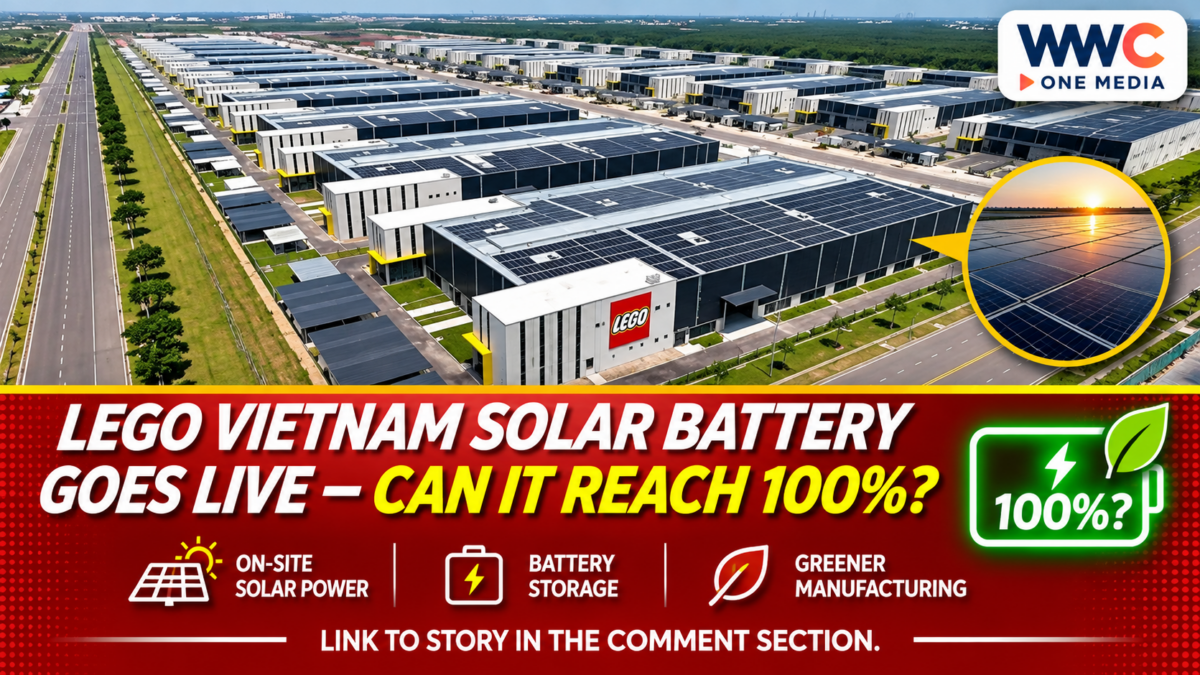
HO CHI MINH CITY, Vietnam — Nov. 21, 2026. The LEGO Group has put a battery energy storage system into operation at its Vietnam manufacturing facility, marking a new phase in a renewable-electricity arrangement with Vietnam–Singapore Industrial Park (VSIP). The company announced the commissioning on Nov. 18 and said the combined solar-and-storage arrangement is forecast to meet about 75% of the factory’s electricity demand during its first five years.
The milestone changes what is operating at the site, but it does not establish that the factory already runs entirely on renewable electricity. LEGO is still exploring additional power purchase agreements for the remaining 25%, making delivery and measured performance the next tests of its energy strategy.
LEGO Vietnam Solar System: What Started Operating?
The newly activated component is an integrated battery energy storage system operated by VSIP, alongside VSIP rooftop solar generation. Electricity moves to LEGO Manufacturing Vietnam through a dedicated transmission line under a direct power purchase agreement, or DPPA. The arrangement complements 12,400 solar panels already installed on the LEGO factory’s rooftops.
The battery can store electricity when solar output exceeds immediate demand and supply it later as required. That matters for factories that need electricity beyond the hours when solar panels produce most strongly. However, storage does not generate additional energy by itself; it shifts when electricity can be used.
LEGO describes the arrangement as the first industrial renewable-energy solution of its scale in Vietnam. That is the company’s characterisation, not an independently established comparison of all energy-storage installations nationwide.
Why 75% Is Not the Same as 100%
The company’s Nov. 18 release forecasts that on-site solar panels and the renewable supply supported by battery storage will cover approximately 75% of its total electricity demand during the first five years of operation. LEGO also projects approximately 20,000 tonnes of carbon-dioxide-equivalent emissions avoided annually during that period, using a Vietnam grid emissions factor of 0.561 tonnes per megawatt-hour.
Both numbers are projections, rather than readings from five years of operation. They also describe the combined contribution of the factory’s existing rooftop solar and the new supply arrangement, not the battery alone.
LEGO says it is investigating additional power purchase agreements to account for the remaining quarter of demand. Its release also says renewable energy certificates will be used until all residual energy requirements can be addressed through power purchases. Certificates and direct renewable supply should not be represented as identical physical electricity arrangements.
WWC has examined similar implementation questions in its report on Vietnam’s green-finance and power-grid investment challenge, where planned renewable capacity and operating infrastructure are treated separately.
The Agreement Behind the Battery
The operating system follows a September 17, 2025 DPPA between LEGO Manufacturing Vietnam and VSIP. At the time, LEGO announced that solar electricity from VSIP would be supplied through a battery-integrated system, with the arrangement expected to begin delivering power in early 2026.
The November 2026 activation is therefore a documented delivery milestone following an earlier contract. It should not be described as a newly signed power purchase agreement. The change is from a planned energy solution to a battery system that the company says is operating.
VSIP is a Vietnam–Singapore industrial-park venture linked to Becamex IDC and Sembcorp Development. Its involvement shows how an industrial-park developer can provide shared infrastructure rather than requiring every manufacturer to build an entirely separate renewable-energy system.
Analysis: That approach may be relevant to other industrial tenants, but one operating project does not demonstrate its financial suitability for every factory. Electricity demand, site layout, contracting rules and storage costs differ from one location to another.
A $1 Billion Factory With an Energy Challenge
LEGO’s Vietnam factory opened in April 2025, following an investment described by the company as US$1 billion. The site occupies 44 hectares and includes manufacturing, packing and warehousing functions. Its Nov. 18 statement listed 1,350 employees.
The complex forms part of the group’s strategy to serve regional markets through manufacturing closer to customers. Its sustainability features include paper-based packaging bags and buildings with LEED Platinum and Gold certifications, as documented in LEGO’s corporate announcements.
The manufacturing scale also explains why electricity supply matters. High-precision production requires dependable operations, but the company’s public statement does not provide hourly battery discharge data, annual electricity purchases or independently audited post-commissioning energy shares.
WWC’s coverage of Southeast Asia’s grid and electrification challenges offers regional context for why renewable generation, transmission and storage must be considered together. The broader regional programme is separate from LEGO’s commercial arrangement.
What This Could Mean for Industrial Energy Buyers
Analysis: The project demonstrates one possible route from a corporate renewable-power target to an operating industrial supply arrangement. A manufacturer has combined generation at its own facility with renewable electricity procured from an industrial-park partner, using batteries to help manage timing differences between generation and demand.
Yet the headline forecast still leaves a material electricity gap. A fully renewable supply claim would require evidence that the remaining demand is covered on the relevant accounting basis, together with clear explanations of purchased electricity and certificates.
This distinction also matters outside Vietnam. WWC has reported on solar and battery initiatives involving the Philippines, Indonesia and Vietnam. Those initiatives serve different types of electricity systems, but similarly require operating evidence before projected gains can be described as achieved.
What Happens Next
The most informative next disclosures would be measured electricity output from the solar installations, battery performance, the factory’s purchased-electricity mix and the status of further power purchase agreements. Those records could test whether the forecast 75% coverage is being achieved and how quickly the remaining share can be addressed.
For now, the verified development is specific: the VSIP-supported battery system was switched on. LEGO’s ambition of supplying the factory fully with renewable electricity remains a target, not an accomplished outcome established by the Nov. 18 release.
Frequently Asked Questions
When did LEGO activate its Vietnam battery energy storage system?
LEGO announced on Nov. 18, 2026 that the battery energy storage system developed with VSIP had been powered on.
How much factory electricity is expected to come from renewable energy?
The company forecasts approximately 75% coverage over the first five years from the combined rooftop solar and battery-supported renewable supply arrangements.
Does the battery alone avoid 20,000 tonnes of emissions each year?
No. The company’s projected annual avoided emissions figure covers the combined renewable-energy solution, including the existing 12,400 factory rooftop solar panels.
Is the LEGO Vietnam factory already using 100% renewable electricity?
The Nov. 18 announcement does not establish that. LEGO says it is exploring additional power purchase agreements for the remaining 25% of electricity demand.