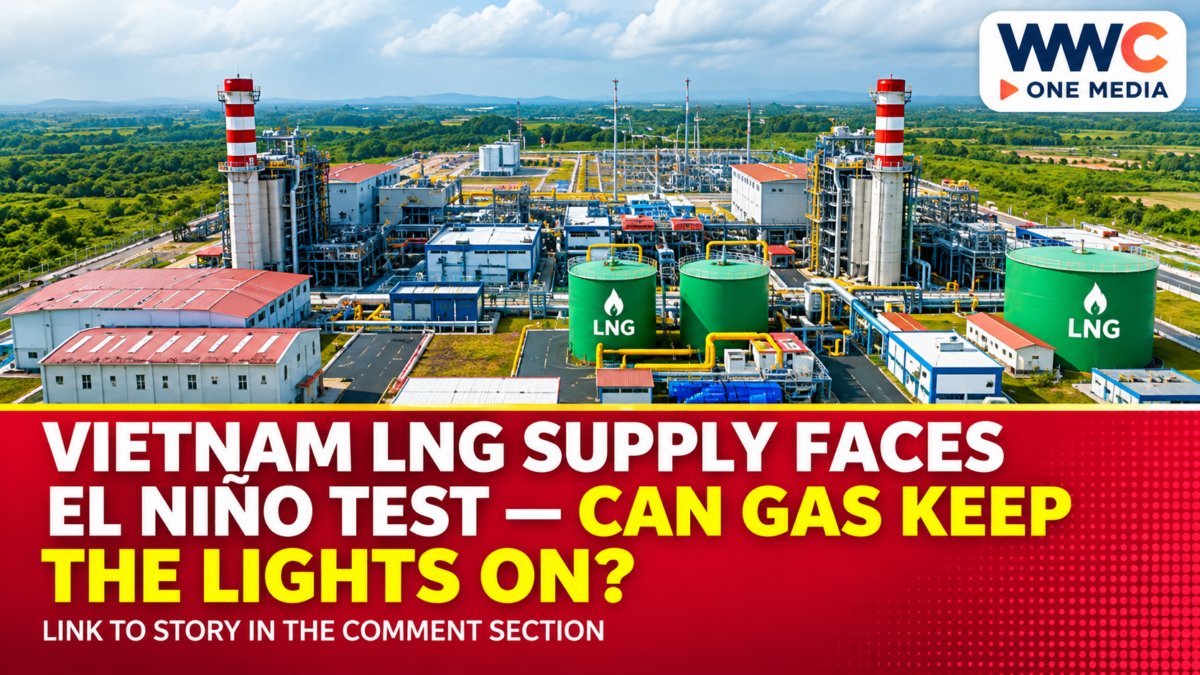
HANOI — Nov. 19, 2026. Vietnam is increasing its reliance on available gas and liquefied natural gas (LNG) generation as El Niño disrupts hydropower operations and raises concerns about electricity supplies during the 2027 dry season. Its Ministry of Industry and Trade says inflows into hydropower reservoirs have fallen to around 80% of the long-term average and estimates that 2026 hydropower output will be about 18.5 billion kilowatt-hours below the 2025 level.
The government has ordered more careful reservoir management while mobilising other electricity sources. The central challenge is to secure enough dependable power without making consumers and businesses excessively vulnerable to imported fuel prices.
Vietnam LNG Supply Becomes Part of the Dry-Season Response
The ministry’s November power-system briefing outlines a coordinated response: mobilise coal, gas and LNG generation; adjust planned maintenance; increase electricity imports; and retain more water in hydropower reservoirs for the months ahead. It also directs agencies to strengthen fuel-supply planning and accelerate infrastructure connecting LNG import facilities.
That is evidence of a more prominent operational role for LNG, but not proof that the volume of LNG imported has tripled. The official documents reviewed do not provide a like-for-like customs series establishing that particular increase. Import volumes, contract commitments and electricity generated from LNG are three different measurements.
The ministry also agreed with the agriculture and environment authorities to extend water retention beyond the usual year-end horizon into the first quarter of 2027. This is intended to protect both electricity production and downstream water supplies in a potentially difficult dry season.
Why El Niño Is Straining Hydropower
Hydropower depends on water arriving in reservoirs, not merely the installed capacity of dams and turbines. When inflows decline, operators must decide how much water to release now and how much to preserve for later electricity demand, irrigation and household use.
The ministry’s estimate of an 18.5-billion-kilowatt-hour year-on-year drop is a projection for 2026, not a final audited generation total. Its finding that inflows reached roughly four-fifths of the long-term average illustrates the practical problem: an installed plant may have the machinery to produce electricity yet lack enough usable water at the required time.
Electricity demand adds to that challenge. Ministry data show electricity produced and imported during the first nine months of 2026 reached 266.58 billion kilowatt-hours, an increase of 9.65% from the corresponding period of 2025. Falling hydropower availability and growing consumption create simultaneous pressures on dispatch decisions.
LNG Power Plants Are Already Operating
PV Power reported that its Nhon Trach 3 and Nhon Trach 4 plants started commercial generation in 2026. The company says an LNG purchase arrangement covers 20.7 million million British thermal units annually for 2027–2031, providing a basis for future fuel planning rather than a record of LNG already imported this year.
PV Power also says an August amendment to the plants’ electricity purchase agreement established a minimum contracted output ratio of 65%. The arrangement links gas procurement to expected plant operations and helps manage the risks of paying for fuel without predictable electricity offtake.
For comparison, WWC has previously examined Vietnam’s broader energy transition, including the challenge of combining gas, renewables and dependable grid supply. The new issue is how that infrastructure performs when weather-driven hydropower availability falls.
Imported Gas Brings a Price and Contracting Test
Vietnam’s industry ministry issued Decision 2972/QĐ-BCT on Nov. 9, setting the 2026 generation-price framework for combined-cycle LNG power plants at zero to VND 3,453.72 per kilowatt-hour, excluding value-added tax. The calculation uses an assumed imported LNG price of $13.4099 per million British thermal units and separately accounts for gas transport and handling.
This figure is a maximum generation-price framework, not a newly announced retail electricity tariff for households. The decision provides a basis for negotiated power purchase agreements; it does not mean that all LNG-generated electricity is sold at the ceiling.
Imported fuel also exposes buyers to overseas supply disruptions and changing contract prices. A separate WWC report on Indonesia’s natural-gas export restrictions and Singapore’s electricity exposure illustrates the regional importance of reliable gas supply, although that case involves different markets and contractual arrangements.
What this could mean: LNG can provide dispatchable power during periods when reservoir levels are low, but flexibility has a financial cost if imported gas becomes expensive. Procurement discipline and transparent electricity contracts matter as much as importing more fuel.
Why This Matters for the Philippines and Southeast Asia
Vietnam’s power planning has implications beyond its borders because neighbouring economies are also balancing growing electricity needs with climate-related disruptions. Vietnam’s choices may influence regional expectations about LNG terminals, gas supply contracts and the commercial value of alternative generating capacity.
The alternatives need not be framed as LNG versus renewables. Grid upgrades, energy storage, demand management and diversified generation can serve different purposes in a resilient system. WWC’s coverage of Philippine–Indonesian–Vietnamese cooperation on island solar and batteries shows one separate approach for remote communities where fuel deliveries are costly.
For Vietnam, the relevant test is whether every additional generation project is matched by fuel access, transmission capacity, realistic contracts and operational readiness. Announcing investment does not itself create dependable electricity.
What Happens Next
Before the 2027 dry season, authorities plan to preserve reservoir water, finalise gas procurement arrangements and improve connections between the Cai Mep and Thi Vai LNG terminals. The ministry also intends to coordinate other fuel stocks and maintenance schedules so plants remain available when demand rises.
The figures worth monitoring are actual LNG cargo imports, reservoir levels, electricity generated by fuel source and any revisions to demand forecasts. A public import series with comparable dates would be needed before asserting that LNG shipments have tripled.
Frequently Asked Questions
Has Vietnam officially confirmed that LNG imports tripled?
Not in the primary records reviewed for this article. Those documents confirm stronger LNG mobilisation and procurement planning but do not establish a tripling of actual cargo imports.
How much could Vietnamese hydropower generation decline in 2026?
The Ministry of Industry and Trade projects output approximately 18.5 billion kilowatt-hours below the 2025 level. This is a forecast, not a final annual result.
Are Nhon Trach 3 and 4 already generating electricity?
Yes. PV Power reports that the LNG-fired plants began commercial generation in 2026, with longer-term fuel supply and electricity offtake arrangements supporting their operations.
Does the LNG price ceiling mean household power tariffs will rise?
No automatic retail tariff change follows from the generation-price framework. The ministry’s ceiling applies to a category of electricity generation contracts, not directly to household bills.