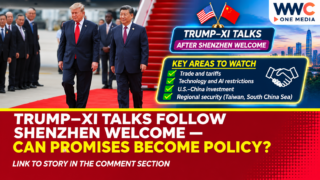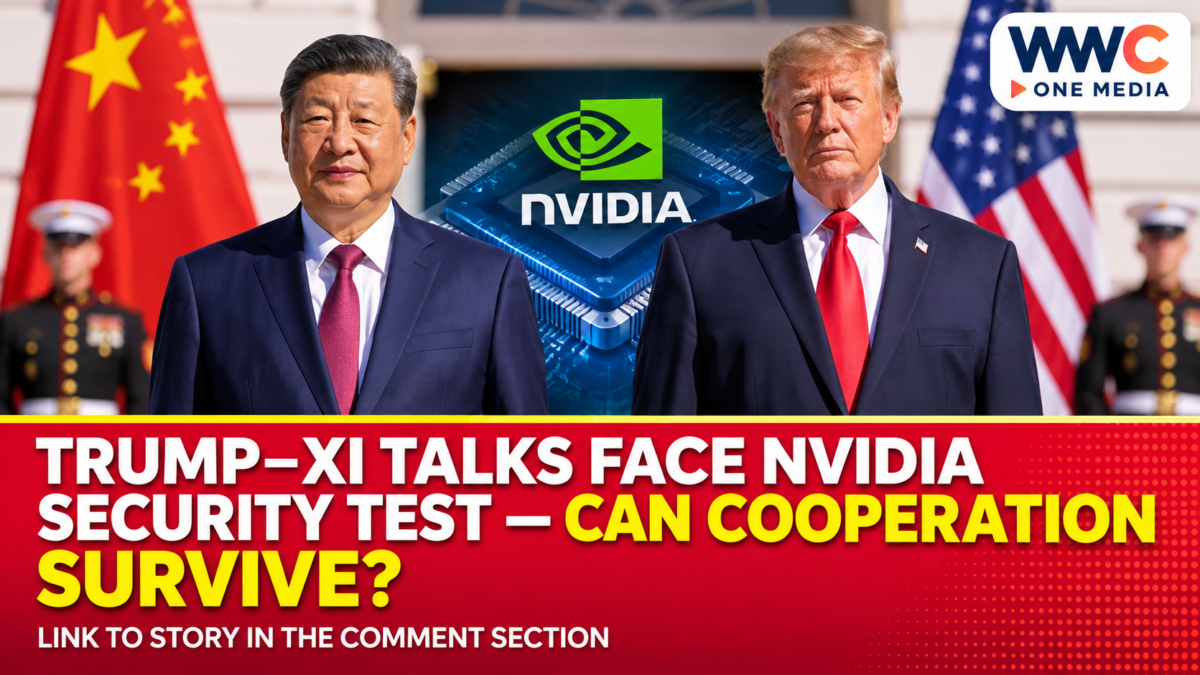
US President Donald Trump and Chinese President Xi Jinping exchanged friendly remarks during an official airport welcome in Shenzhen on Nov. 18, 2026, before further talks during the Asia-Pacific Economic Cooperation gathering. The diplomatic show of goodwill coincided with a separate US government investigation involving Singapore-based technology company Megaspeed and possible violations of semiconductor export controls, according to a Nov. 17 joint agency statement.
The Trump Xi talks therefore present two different tests of policy: whether Washington and Beijing can keep dialogue open, and whether governments and companies can apply technology restrictions consistently. A cordial greeting neither resolves an investigation nor confirms a new agreement on advanced artificial-intelligence chips.
Trump Xi talks: what the diplomatic record confirms
China’s Nov. 18 official account records Xi welcoming Trump at Shenzhen Bao’an International Airport. The ceremony included an honour guard and national anthems, with both leaders speaking positively about the encounter and the relationship between their countries.
The record says Xi looked forward to exchanges on bilateral relations, Asia-Pacific cooperation and the international landscape. Trump thanked his host and expressed confidence that the visit could advance relations. Those words establish the leaders’ public diplomatic positions, not a settled tariff schedule or change to export licensing.
China separately announced that Xi would hold a summit with Trump and Russian President Vladimir Putin on Nov. 19. A scheduled summit is a verified diplomatic plan; the outcome of its discussions requires a subsequent authenticated statement.
WWC has already documented Xi’s formal welcome to Trump in Shenzhen. The present question is what security enforcement and semiconductor rules mean beyond the arrival ceremony.
What Trump said about Nvidia before travelling
The record of Trump’s remarks to reporters before leaving Washington captures his preference for maintaining communication with China. During the Nov. 16 departure exchange, reported in the presidential press-pool record, he said relations with China were good and discussed competing views inside his administration about restrictions on technology trade.
He also said he did not know whether the woman discussed in allegations surrounding Nvidia’s former leader was a Chinese spy. That uncertainty must not be converted into an assertion of espionage, wrongdoing or guilt.
The president’s comments are political and diplomatic assessments. They are not an official finding about any individual’s conduct, a determination by prosecutors or an exemption from federal export-control law.
Analysis: Leaders may favour stable relations while enforcement agencies continue their investigations. That is not inherently inconsistent. The test is whether any eventual decision is made under published law and supported by documented evidence.
The Megaspeed investigation has a specific official history
On Nov. 17, the US Justice and Commerce departments issued a joint statement addressing the investigation of Singapore-based Megaspeed. They said Commerce initiated an investigation in 2024 after detecting suspicious activity involving potential diversion of sensitive semiconductors.
The agencies said Commerce investigators sought Nvidia records concerning direct or indirect sales to Megaspeed in May 2025. Nvidia placed Megaspeed on its no-sell list in June 2025, while Commerce enforcement officers and Singaporean law-enforcement officials conducted an on-site end-use check that month.
The departments said Justice later assumed the lead role in a criminal investigation. They described possible export-control violations, not a final judicial finding that Megaspeed or any particular person committed a crime.
That distinction matters for corporate customers, banks and data-centre operators. A regulator’s investigation can affect compliance decisions even before a court reaches a result; it does not eliminate the presumption of innocence.
WWC’s earlier examination of congressional scrutiny of Nvidia export licensing covers separate requests for government records. Congressional oversight, agency investigations and proven offences are different categories and should not be reported as interchangeable.
Why AI chip rules still matter to commercial cooperation
Advanced semiconductors support artificial-intelligence training, data-centre processing and other computing workloads. For businesses, the central compliance question is whether an actual item, buyer, destination and end use fall under applicable US export restrictions.
The administration has announced additional rules addressing certain overseas access to advanced computing. The distinction between exporting physical chips and allowing remote access to computing capacity matters because a customer can potentially use a server without possessing it.
WWC’s report on the new overseas-computing restrictions explains the regulatory framework. The existence of new restrictions does not mean every Nvidia product is banned from China or that every regional data-centre customer has breached US law.
Analysis: A constructive meeting between presidents may encourage commercial dialogue, but implementation requires concrete regulations, valid licences and compliant transactions. None follows automatically from a diplomatic exchange.
What Beijing’s public economic agenda adds
In his Nov. 18 address to the APEC business summit, Xi called for more open trade, stable industrial supply chains and deeper cooperation in digital technologies and artificial intelligence. Those priorities reflect China’s publicly stated economic agenda as the country hosts regional leaders.
The speech did not announce that Washington had withdrawn its semiconductor controls. Nor did it provide an American commitment to approve a particular Nvidia product or customer.
The competing concerns are clear: businesses value predictable access to technology and supply chains, while governments may restrict selected items over national-security risks. The practical outcome turns on published measures, not simply on whether leaders express optimism.
For Philippine technology companies, the distinction is relevant to regional cloud infrastructure and cross-border services. But no official record reviewed establishes a particular increase in Philippine data-centre revenue, a guaranteed chip supply or a change in domestic technology prices caused by the welcome ceremony.
What happens next
The next meaningful evidence will be official summaries of the leaders’ discussions, any formally issued trade or export-control measures, and updates from enforcement authorities. Public Nvidia disclosures can also clarify which shipments are authorised or expected, but a company forecast is not proof that a government licence has been granted for every future sale.
As of Nov. 19, the authenticated record supports friendly diplomatic language alongside a continuing US semiconductor-diversion investigation. It does not prove the personal espionage accusations, guarantee an easing of export restrictions or establish that an AI trade deal has been completed.
FAQ
Did Trump and Xi meet in Shenzhen?
China’s official record confirms that Xi welcomed Trump at Shenzhen airport on Nov. 18, before further high-level engagements. The ceremony alone does not establish a completed trade agreement.
Is the Nvidia-related investigation over?
No closure was announced in the Nov. 17 joint statement from the US Justice and Commerce departments. It described ongoing investigative activity involving Megaspeed.
Has the US government proved the espionage allegations?
The primary records reviewed do not establish such a finding. Investigations, suspicions and public commentary must not be presented as proof of espionage.
Did the talks lift US restrictions on AI chips?
No verified official record reviewed announces a general lifting of semiconductor export controls. Actual shipments remain subject to the applicable rules and licensing requirements.