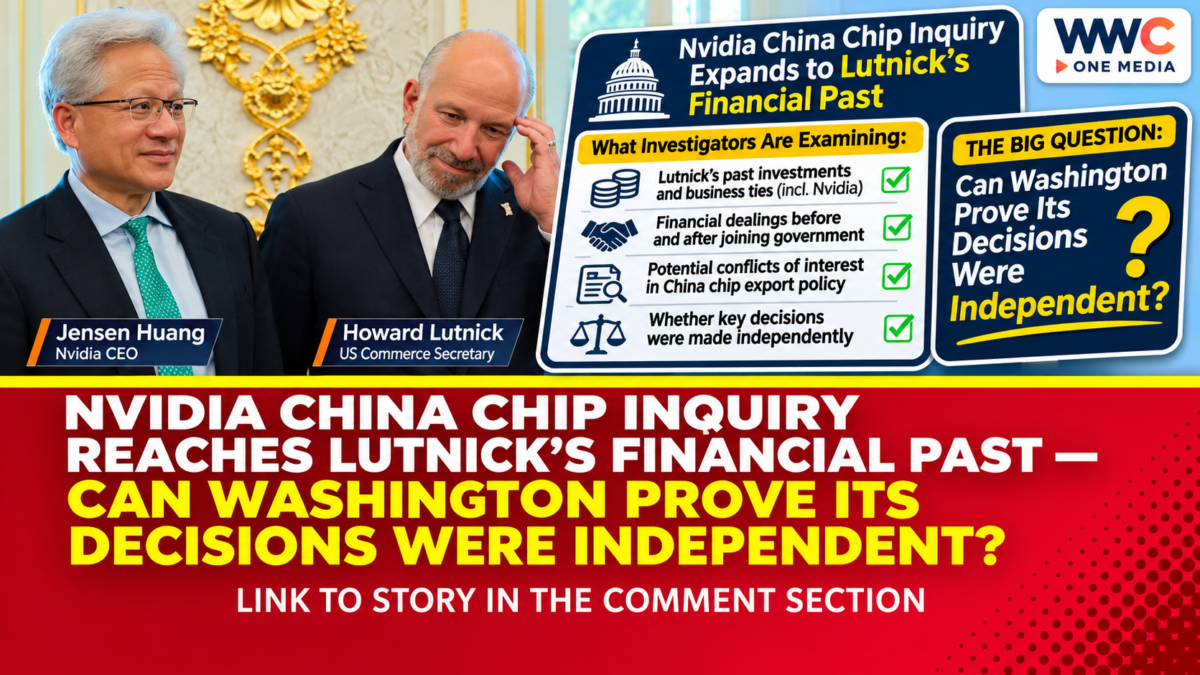
MANILA, Philippines — Nov. 14, 2026. Two senior US congressional Democrats have requested records of Commerce Department decisions on Nvidia’s advanced chip exports to China, putting a documented regulatory process and Commerce Secretary Howard Lutnick’s past financial interests under renewed scrutiny. A Nov. 12 congressional letter, Lutnick’s government ethics disclosures and federal export-control rules establish the questions that can be investigated, but they do not establish that the secretary improperly influenced an Nvidia licence or personally benefited from one.
Nvidia China Chip Inquiry: What Congress Requested
The Nov. 12 letter, signed by Senator Ron Wyden and Representative Richard Neal in their capacities as ranking members of congressional tax-writing committees, asked Lutnick to preserve documents relating to three categories: the Commerce Department’s semiconductor import investigation and resulting tariffs, Nvidia export-licence decisions, and communications with Nvidia or Huang and their representatives.
The lawmakers described an investigation into the administration’s handling of advanced-chip sales. Their letter raises concerns about potential security and tariff issues, but it is a request for information and an expression of legislative scrutiny, not proof that the allegations it discusses are correct.
WWC has separately reported on questions surrounding an earlier Nvidia-related export investigation. The present inquiry has a different documentary centre: written congressional demands and the secretary’s filed ethics obligations.
What Lutnick’s Cantor Fitzgerald Records Actually Show
Lutnick’s Jan. 21, 2025 ethics agreement committed him to leave his positions at Cantor Fitzgerald and its listed subsidiaries on confirmation as commerce secretary. It also established restrictions on participation in certain matters involving the firm and outlined arrangements to dispose of partnership interests.
His later Office of Government Ethics periodic transaction report records sales on Oct. 6, 2025 of interests in Cantor Fitzgerald, CF Group Management and BGC Group, each in the report’s over US$50 million disclosure band. The filing explains that the agreements were entered into on May 16, 2025 and completed after regulatory approvals.
The ethics agreement says Lutnick would consult agency ethics officials if an actual or potential conflict arose, with recusal or divestiture among the available responses. It separately addresses certain interests attributable under federal ethics rules. Those obligations are more informative than assuming a violation simply because his former firm operates in financial markets.
What SEC Filings Can—and Cannot—Tell Investors
Cantor Fitzgerald, L.P. filed institutional holdings reports with the US Securities and Exchange Commission for reporting periods including June 30, 2026. The filings identify a separate institutional investment manager, not Lutnick’s personal portfolio.
A Form 13F is a snapshot of certain securities held by an institutional manager at a quarter-end. It does not report every derivative exposure, cash transaction, client relationship or trade executed after that date. Nor does it determine whether a public official directed an investment or influenced a regulation.
A comparison of holdings also requires checking the correct filer and the actual security entries. Cantor Fitzgerald, L.P. and Cantor Fitzgerald Investment Advisors L.P. file separately; combining their reports without accounting for manager and reporting relationships can overstate an economic position.
Analysis: The proper oversight question is not whether a former employer bought or sold shares. It is whether any particular government matter produced an actual financial conflict under the applicable rules and, if so, whether the required safeguards were followed. No finding to that effect was established in the original documents examined.
What Commerce Changed in Nvidia Export Licensing
On Jan. 13, 2026, the Bureau of Industry and Security announced that applications involving Nvidia H200 chips, AMD MI325X chips and similar processors destined for China would receive case-by-case reviews, subject to conditions. The agency did not announce unconditional approval for every purchaser.
The requirements include purchaser compliance procedures, independent third-party US testing and assurances about semiconductor capacity available to American customers. A general policy permitting applications does not certify that a specific shipment was approved or identify every ultimate buyer.
A separate May 31 guidance document confirms that restrictions can apply when an advanced-computing customer is headquartered in certain restricted jurisdictions, or controlled by a parent headquartered there, even when the immediate recipient is based elsewhere.
That cross-border question matters to Southeast Asia’s expanding data-centre industry. WWC has examined Malaysia’s response to AI-chip re-export concerns. The presence of data centres in the region is not, by itself, evidence of illegal diversion.
Why an Export Licence Is Not a Finding of Favouritism
A licence decision involves technical characteristics, destination, end user and applicable security conditions. The Commerce Department’s published policy makes those elements relevant to its review; it does not disclose the full confidential record of each individual application.
The distinction also applies to procurement. WWC previously covered a Chinese university’s reported purchase of Nvidia H200 processors. A purchase record can establish an acquisition without identifying the original export route or proving that an unlawful shipment occurred.
The Nov. 12 congressional letter seeks documents that could narrow these gaps. It does not certify the truth of every reported allegation it cites. A transparent public response would distinguish disclosed policy choices from individual licensing determinations and explain which records must remain confidential under applicable law.
What Happens Next
Analysis: Meaningful oversight would compare the licensing decisions with the applicable rules, test whether relevant officials complied with ethics requirements and distinguish policy disagreements from evidence of misconduct. The inquiry could also clarify how semiconductor tariffs and licensing conditions interacted.
Responses to the preservation request, any published congressional findings, formal ethics determinations and original Commerce enforcement documents will matter more than speculation about personal relationships or motives. No public record examined for this article establishes a completed congressional finding against Lutnick.
For now, the verified story is a formal records demand against a documented background of divestitures and changing export policy. Whether Washington can demonstrate independence in particular Nvidia decisions depends on evidence still to be produced.
Frequently Asked Questions
Did Congress open an inquiry into Nvidia export decisions?
Yes. A Nov. 12 letter from Senator Ron Wyden and Representative Richard Neal announced an inquiry and requested preservation of Commerce Department records concerning Nvidia licences, tariffs and communications.
Did Howard Lutnick disclose selling Cantor Fitzgerald interests?
Yes. His government ethics transaction report records an Oct. 6, 2025 sale of Cantor Fitzgerald interests and other related holdings following previously signed agreements.
Does a Cantor investment in Nvidia prove a conflict of interest?
No. Institutional ownership does not establish that Lutnick retained the investment, directed trading or improperly influenced a particular government decision.
Did the US remove all restrictions on Nvidia chips sold to China?
No. The January 2026 rule established conditional, case-by-case licensing reviews for specified products and transactions.