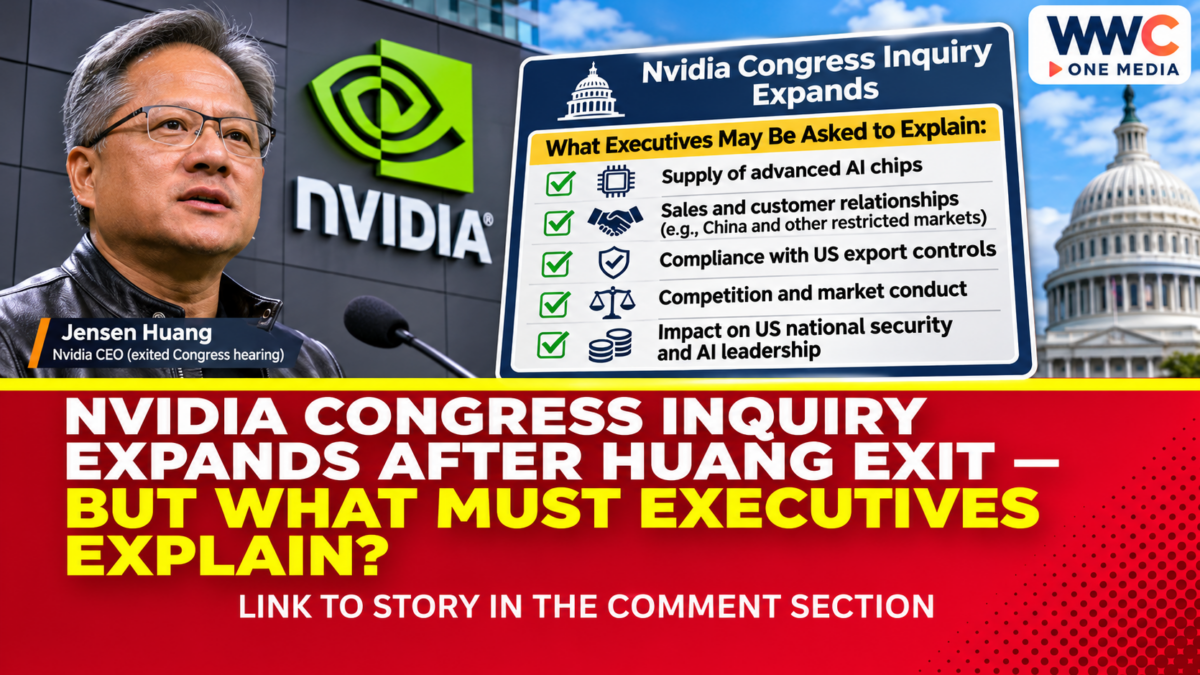
WASHINGTON, Nov. 14, 2026 — Three US House committee chairmen renewed their requests for information from Nvidia and former chief executive Jensen Huang on Nov. 12, seeking interviews about chip security and concerns raised in their earlier correspondence. Their letters broaden the planned discussions to include Nvidia’s general counsel and a senior Commerce Department official, putting corporate security and US export-control oversight on parallel tracks.
The new requests arrive amid a leadership change at Nvidia, but neither the letters nor the company’s public announcements establish that wrongdoing occurred. The issue is how chip-security oversight proceeds amid Nvidia’s leadership change.
Nvidia Congress Inquiry Moves Beyond One Executive
The Nov. 12 letters carry the names of House Foreign Affairs Committee Chairman Brian Mast, House Select Committee on China Chairman John Moolenaar and House Intelligence Committee Chairman Rick Crawford. They follow a Nov. 4 request asking Huang to appear for a closed-door briefing on Nov. 18.
The latest letter instead requests that Huang attend a closed-door, transcribed interview on Dec. 1, 2026. The chairmen ask for written confirmation by 8 p.m. Eastern time on Nov. 13 and state that the Foreign Affairs Committee will issue a subpoena if he does not cooperate.
A subpoena warning is an assertion of a possible congressional enforcement step. It is not proof that a subpoena has already been served. The publicly reviewed letters do not establish whether the recipients accepted the invitations by the requested deadline.
WWC previously examined US Congress’s earlier request for answers about Nvidia. The Nov. 12 records add materially different dates, recipients and topics, making them the centre of this update.
Why Nvidia’s General Counsel Has Been Called
In a separate letter, the same chairmen request a Dec. 2, 2026 closed-door, transcribed interview with Nvidia General Counsel Tim Teter. The stated areas include AI chip smuggling, possible adversary military applications, and public reports of interference with US export-control policies or investigations involving Megaspeed.
Those are matters that lawmakers want to examine. Their appearance in a congressional letter does not demonstrate that Nvidia interfered with an investigation, knowingly enabled smuggling or violated export rules.
The request to a company lawyer matters because legislators appear interested in organisational procedures as well as an individual’s account. In practical terms, security safeguards, internal escalation processes and the handling of regulatory questions can affect how a technology company responds to government inquiries.
This is an analytical reading of the letter’s scope, not a finding about the quality or effectiveness of Nvidia’s actual controls. The correspondence itself does not provide an independent audit of those controls.
Commerce Department Drawn Into Chip-Security Questions
A third letter, signed by Mast, requests that Under Secretary of Commerce for Industry and Security Jeffrey Kessler appear at a Dec. 3, 2026 hearing scheduled for 10 a.m. The topics named include chip smuggling, military use of advanced AI chips and enforcement investigations.
Commerce oversight is distinct from examining any one company’s leadership. Export-control policy applies to categories of products, destinations and transactions under federal rules; a congressional hearing can explore whether the government’s systems are operating as intended.
In the chairmen’s Nov. 12 statement, they also called for consideration of the AI OVERWATCH Act, Chip Security Act, MATCH Act and Remote Access Security Act in the National Defense Authorization Act. The committee statement presents these as legislative priorities; it does not establish that any of them has become law.
That distinction matters to semiconductor manufacturers, cloud operators and customers. Proposed controls can signal the direction of political debate, but legal obligations depend on enacted legislation and applicable regulations rather than a press statement.
Nvidia Leadership Changes the Context, Not the Evidence
Nvidia announced on Nov. 12 that Huang resigned as president, chief executive and director effective immediately. The company appointed Executive Vice President and Chief Financial Officer Colette Kress as interim CEO and Harvey C. Jones as chair of its board.
The board also announced a search for a permanent CEO, with internal and external candidates to be considered. The company statement did not appoint a permanent replacement or say that the congressional requests had determined its management decisions.
The corporate announcement is central to interpreting the second letters: they identify Huang as a former CEO while still requesting his personal appearance. Lawmakers therefore distinguish between questions directed at the founder and those directed at the organisation’s current representatives.
WWC has separately covered Nvidia’s confirmed leadership transition and Colette Kress’s interim leadership role. The latest congressional letters do not require readers to assume either guilt or a predetermined outcome from that transition.
What the Inquiry Could Mean for AI Businesses
Analysis: The separate requests reveal a policy question larger than an individual executive: how should US officials assess access to sensitive chip technology, companies’ compliance systems and the effectiveness of federal enforcement?
A congressional interview can gather testimony and sharpen questions for regulators. It does not itself change the rules for exporting AI processors. Similarly, a committee request to a government official does not automatically establish defects in an agency’s enforcement procedures.
For Nvidia, uncertainty surrounding interviews could complicate the flow of public information even while ordinary operations continue. Its Nov. 12 company announcement said it expected customer commitments and its technology roadmap to proceed without interruption; that expectation is not a guarantee of future performance.
Later proceedings may provide specific evidence about security processes or enforcement. Until then, allegations and established facts must remain distinct.
What Happens Next
The next dates listed in the written requests are Dec. 1 for Huang, Dec. 2 for Teter and Dec. 3 for Kessler. The first two are proposed closed-door interviews; the last is a proposed congressional hearing. The letters reviewed do not confirm that any appearance has been accepted or completed.
Nvidia has also scheduled its fiscal third-quarter 2027 financial-results release for Nov. 17, 2026. That is a corporate reporting event, not a deadline for Congress to conclude its examination.
Watch for committee announcements, published testimony, any subpoenas, regulatory decisions and Nvidia disclosures.
FAQ: Nvidia and the US Congressional Inquiry
Did Congress order Jensen Huang to testify?
The Nov. 12 letter requests a Dec. 1 closed-door interview and warns of a subpoena if he does not cooperate. The reviewed public records do not prove that a subpoena was issued.
Has Nvidia been found guilty of chip smuggling?
No finding of guilt is established by the committee letters. They describe issues lawmakers want to investigate, not a completed adjudication.
Why is Nvidia’s general counsel involved?
Lawmakers requested a separate Dec. 2 interview with Tim Teter to examine company-related questions including chip security and export-control issues.
Is Colette Kress Nvidia’s permanent CEO?
No. Nvidia’s Nov. 12 announcement appointed her interim CEO while the board searches for a permanent successor.
When could the public learn more?
The committee has requested appearances in early December, but further disclosure depends on whether proceedings occur and what official information is subsequently released.