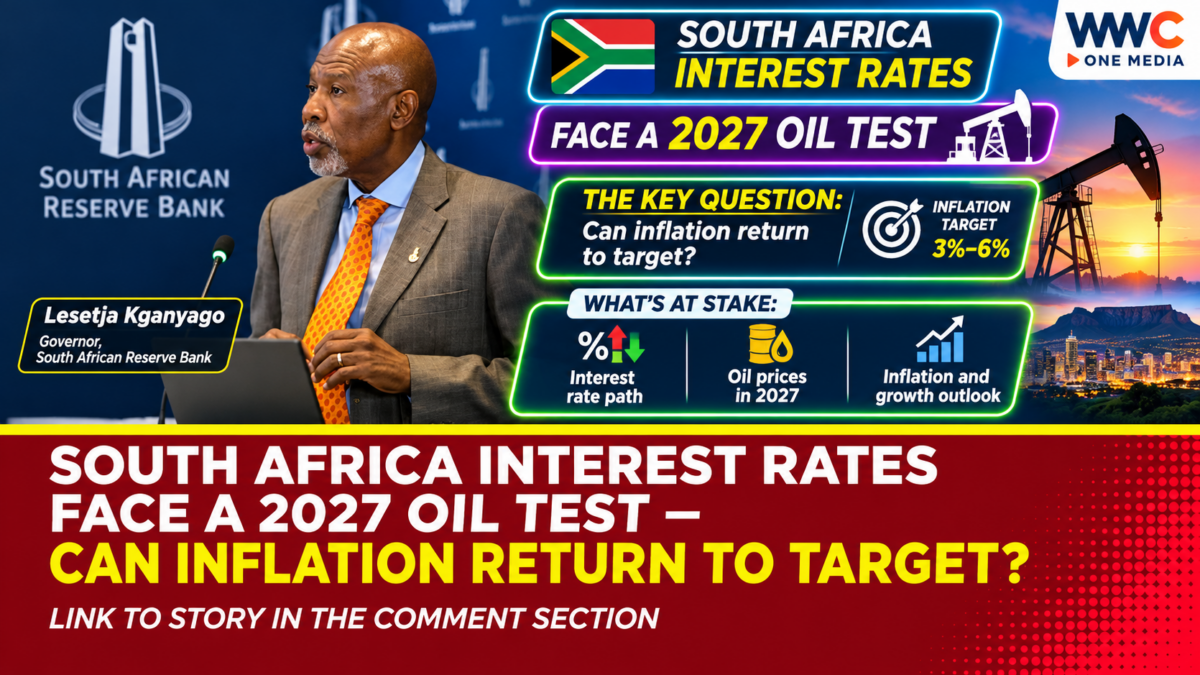
PRETORIA — Nov. 19, 2026. South Africa’s central bank is approaching its final scheduled monetary-policy decision of the year with consumer inflation accelerating to 5.2% in October and its benchmark rate standing at 7.25% after September’s increase. Governor Lesetja Kganyago’s published policy assessments point to oil-related price risks lasting into 2027, even as the bank aims to bring inflation back towards its 3% target.
The decision scheduled for Nov. 19 had not been confirmed in the official records available at the time of this article’s preparation. The immediate question is whether the central bank can stop temporary fuel-cost increases from spreading to wages and other prices without putting unnecessary pressure on a weak economy.
South Africa Interest Rates: Where Policy Stands
The South African Reserve Bank’s September monetary-policy statement recorded a unanimous decision to lift its policy rate by 25 basis points to 7.25%, effective Sept. 25. The bank identified higher fuel costs, stubborn services inflation and risks to inflation expectations as reasons for the move.
That statement also outlined the central bank’s approach to interest rates: decisions are made at individual meetings, while its economic model offers an indicative path rather than a commitment. Its model suggested broadly stable rates over the rest of 2026 and possible reductions later as inflation approached target.
A scheduled Nov. 19 announcement does not mean another increase has already been delivered. Nor can the September projection establish how each policymaker will vote after reviewing new inflation data.
WWC’s earlier examination of African interest-rate decisions compared different central-bank responses across the continent. This article focuses specifically on South Africa’s newly reported consumer prices and its longer oil-related inflation challenge.
October Inflation Raises the Stakes
Statistics South Africa’s Nov. 18 consumer-price release recorded annual headline inflation of 5.2% in October, up from 4.5% in September. The overall consumer-price index rose 0.7% from September to October.
The change is significant because the central bank’s formal inflation objective is 3%, within a tolerance band of one percentage point on either side. An annual 5.2% reading stands above that range, although a single month’s inflation figure cannot identify how long the increase will last.
Inflation measures the pace of price changes, not a direct loss of income or proof that every household experiences an identical increase. Transport costs, food prices and the services people use may change at different rates. Monetary policy must respond to the overall outlook while recognising those differences.
Why Oil Can Keep Prices Elevated Into 2027
The bank’s October Monetary Policy Review explained that the Middle East conflict had disrupted energy supplies, widened refinery margins and increased transport and production costs. Its forecast anticipated headline inflation remaining above 5% until the second quarter of 2027 before returning towards target from the fourth quarter.
This is a forecast, not a statement that oil prices will remain at any particular dollar level throughout 2027. International crude prices, shipping costs, domestic fuel pricing and the rand exchange rate all influence how global energy shocks reach South African consumers.
The September policy statement also distinguished the direct increase in fuel prices from possible secondary effects. Higher transport costs can affect businesses that move goods or deliver services; persistent increases may then influence future prices and wage expectations.
Analysis: A decline in crude prices could ease pressure, but it would not automatically reverse price increases already passed through the economy. The bank’s real concern is whether businesses and households begin planning for inflation persistently above 3%.
Growth Complicates the Central Bank’s Choice
The central bank’s October review projected economic growth of 1.2% for 2026, down from an earlier estimate of 1.4%, with a gradual improvement towards 2% by 2029. These figures are projections, not realised annual growth results.
In an Oct. 29 speech, Kganyago argued that monetary policy cannot by itself repair weak electricity systems, transport bottlenecks or other obstacles to productivity. He noted that South African growth averaged just 0.8% between 2015 and 2025, a structural problem extending beyond any one interest-rate decision.
Higher borrowing costs can weigh on household credit and business investment. But leaving inflation expectations unanchored can also harm long-term financing conditions and household purchasing power. That is the trade-off facing the monetary-policy committee.
WWC has separately covered South Africa’s proposed fiscal oversight changes. Fiscal sustainability and monetary policy are connected through market confidence, but the central bank does not control the government’s budget or directly set public debt levels.
What This Could Mean for Other Emerging Markets
South Africa’s experience illustrates how an imported energy shock can complicate inflation control even when domestic demand is not especially strong. A central bank can influence spending and expectations; it cannot directly produce more crude oil or remove shipping disruptions.
For Philippine readers, the comparison concerns policy mechanisms rather than identical inflation rates. The Philippines has its own basket of consumer goods, currency exposure, fuel taxes and central-bank decisions. WWC’s reporting on Philippine monetary-policy pressures provides the separate domestic context.
What this could mean: If fuel costs moderate while longer-term inflation expectations fall, South Africa may eventually gain room to ease policy. If energy prices or imported inflation rise again, that space could narrow. Neither result is guaranteed by today’s market expectations.
What Happens Next
The SARB’s Nov. 19 policy announcement is the next formal decision point. Its updated forecasts, vote and explanation will determine whether the September policy setting is maintained or changed. The bank’s published calendar also lists Jan. 28, 2027 for the following scheduled announcement.
Investors and households should watch subsequent fuel prices, consumer inflation, the rand and evidence that services inflation is easing. For now, the verified record establishes a 7.25% September policy rate and a sharper October price increase, while the new November decision must be reported only after its official release.
Frequently Asked Questions
What is South Africa’s last verified policy rate before the November decision?
The SARB raised its policy rate to 7.25%, effective Sept. 25, 2026. The Nov. 19 decision was still scheduled when this article was prepared.
What was South Africa’s inflation rate in October 2026?
Statistics South Africa reported annual consumer-price inflation of 5.2%, up from 4.5% in September.
Why do oil prices influence South African interest rates?
Fuel prices affect transport and production costs. If those increases spread to wages and other prices, central bankers may need to maintain tighter policy to protect their inflation target.
Does the central bank expect inflation to return to 3% in 2027?
Its October review projected inflation returning towards target from the fourth quarter of 2027. That is a conditional forecast, not a guaranteed outcome.