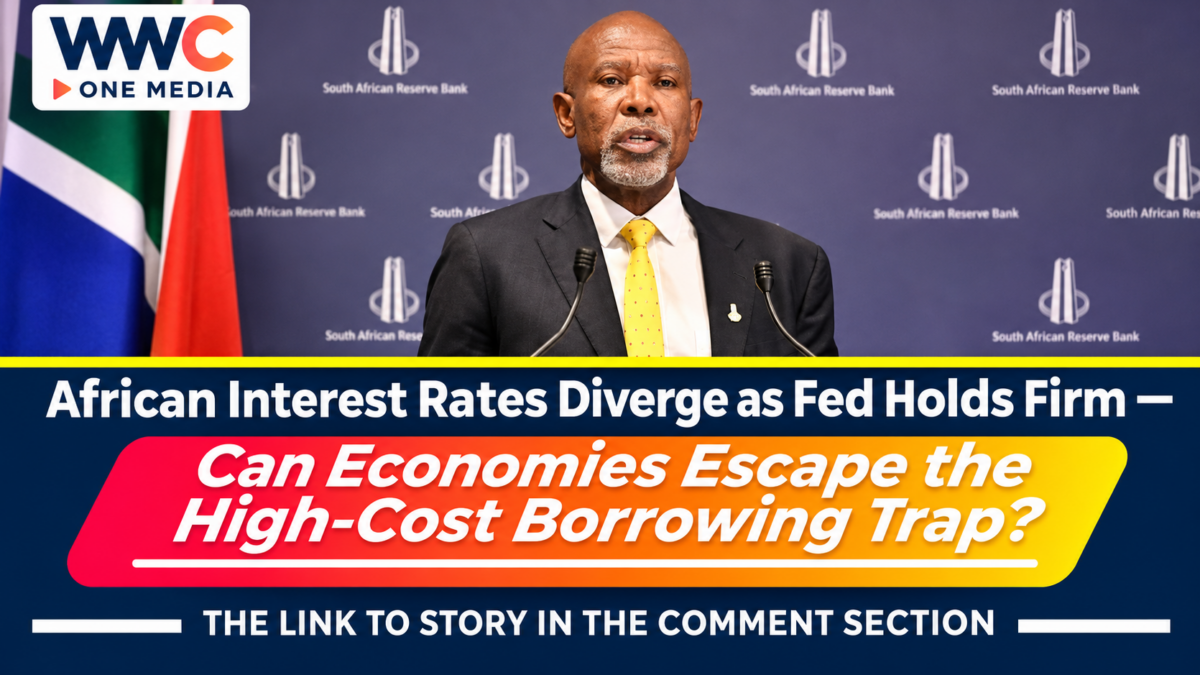
NAIROBI / PRETORIA — African central banks are entering the final weeks of 2026 with sharply different interest-rate settings, after Nigeria reduced its benchmark to 23%, Kenya maintained 8.75%, Ghana held 14% and South Africa increased its policy rate to 7.25%. The African interest rates divide is unfolding while the United States Federal Reserve keeps its own target range at 3.75%–4.00%, leaving policymakers alert to the dollar, imported inflation and financing conditions.
The decisions reveal why Africa cannot be treated as one monetary-policy market. Some economies are still defending against price pressures; others are weighing whether tight financing conditions can ease without destabilising their currencies.
African interest rates are moving in different directions
Nigeria’s monetary policy committee reset its monetary policy rate to 23% at its Sept. 21–22 meeting. The rate had stood at 26.5% after the July meeting, making the September move a substantial reduction, even though the resulting rate remains high in nominal terms.
Kenya’s committee took another route. On Oct. 7, it maintained the central bank rate at 8.75%, citing risks from global energy costs while noting improvement in domestic lending conditions. It indicated that its next meeting would take place in December.
Ghana maintained its monetary policy rate at 14% after a September meeting. Its officials highlighted external inflation threats and the importance of protecting earlier progress against price increases. These decisions cannot be compared as if the same rate would have the same economic effect in every country: inflation, banking systems and currency conditions differ.
South Africa chooses a higher rate to contain inflation
South Africa’s monetary policy committee raised its policy rate by 25 basis points to 7.25%, effective Sept. 25. It reported inflation at 4.4% and identified fuel and service prices as continuing concerns.
Its September statement also described a 3% inflation objective and a weaker near-term growth outlook. The central bank projected annual economic growth of 1.2%, revised from 1.4%, illustrating the difficult balance between controlling prices and supporting activity.
The committee examined a scenario in which global interest rates rose more than expected. In that scenario, rand depreciation added to inflation and required a tighter domestic stance. That was a risk exercise, not a prediction that the currency must fall or rates must increase again.
Analysis: Higher interest rates may protect purchasing power by limiting sustained inflation, but they also raise financing costs for households and businesses. The appropriate balance depends on country-specific evidence rather than a uniform prescription for the continent.
Why the Federal Reserve matters beyond America
The Federal Reserve maintained the federal funds target range at 3.75%–4.00% on Oct. 28 by a 10–2 vote. Two policymakers preferred a quarter-point increase, but their position did not become the committee’s decision.
US interest rates affect the return available on dollar assets. If investors demand higher compensation for holding assets elsewhere, currencies and borrowing terms in developing markets may come under pressure. The size and direction of those movements depend on local fundamentals as well as global risk appetite.
That is the broader mechanism behind WWC’s previous examination of the Federal Reserve rate-hike debate. A US policy decision is not an instruction for African central banks to make an identical move.
For governments and companies borrowing in dollars, a weaker domestic currency can increase the local-currency cost of obligations. But dollar debt exposure differs across borrowers, making sweeping claims about an imminent debt crisis unsupported by the rate announcements alone.
Currency and fuel risks complicate the choices
Kenya’s October decision explicitly identified high energy prices and supply disruptions as reasons for caution. Ghana’s September decision likewise identified fuel-related inflation and international financial conditions as risks that could undermine domestic price stability.
These risks operate through separate channels. Higher oil prices can increase transportation and production costs; a weaker currency can make imported goods more expensive; and higher borrowing rates can discourage investment or household spending.
WWC’s coverage of US dollar movements and emerging-market currency exposure provides a related comparison for Philippine readers. Currency pressure is possible, but no single change in a US benchmark proves that a particular African currency will depreciate.
Analysis: Policymakers may decide that maintaining a restrictive rate is preferable to easing too quickly when imported inflation remains a threat. Others may have room to reduce rates if their own inflation outlook and financial stability allow it.
What the figures mean for growth and borrowing
The rates shown here are policy benchmarks, not identical consumer lending rates. A household mortgage, small-business loan or government bond may carry a different price depending on credit risk, funding costs and local financial-market structures.
Nor does a policy-rate reduction guarantee cheaper loans immediately. Banks may adjust pricing gradually, while borrowers with weaker credit histories may continue paying a significant premium.
This is why headline policy decisions should be read alongside inflation expectations, credit expansion, currency stability and government financing requirements. A nominal rate by itself cannot tell readers whether an economy has escaped expensive borrowing.
The connection to US producer inflation and the Fed’s upcoming decisions is important: continuing US price pressure could influence global expectations, even though African monetary authorities must still assess their own conditions.
What happens next
Ghana’s published schedule places its next policy announcement on Nov. 18, while South Africa is due to announce another decision on Nov. 19. Kenya has identified December for its next meeting, and the Federal Reserve’s next scheduled policy gathering is in December.
The pending decisions may change the comparison. A rate maintained in September cannot automatically be described as a final year-end setting when another meeting remains on the calendar.
The central question is whether domestic inflation improves enough to allow borrowing costs to ease without exposing households and businesses to renewed currency or price shocks. The official records establish differing policy choices, not a guaranteed direction for the rest of 2026.
FAQ
What is Nigeria’s latest verified monetary policy rate?
The Central Bank of Nigeria’s September 2026 decision set the monetary policy rate at 23%, down from 26.5% after its July meeting.
Did South Africa raise interest rates in 2026?
Yes. Its September monetary policy decision increased the policy rate by 25 basis points to 7.25%, effective Sept. 25.
What interest rate did Kenya maintain?
Kenya maintained its central bank rate at 8.75% at the Oct. 7, 2026 meeting.
How could Federal Reserve policy affect Africa?
US rates can influence dollar demand, capital flows and foreign-currency financing costs. Effects differ by economy and are not automatic.
Will African central banks cut rates before 2027?
No continent-wide outcome is confirmed. Several policy decisions remain pending, and each monetary authority evaluates domestic inflation, growth and financial stability.