
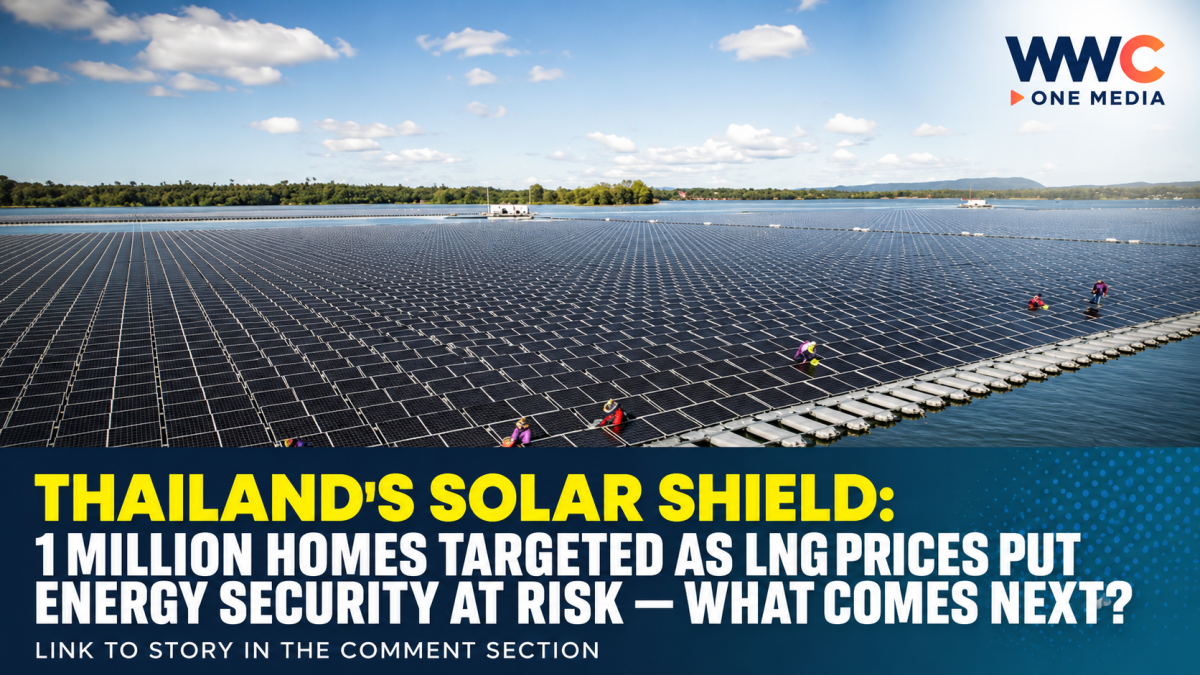
BANGKOK — Thailand is accelerating its push into rooftop solar as the government looks to protect households from volatile energy prices and reduce the country’s heavy dependence on imported liquefied natural gas (LNG).
Energy Minister Akanat Promphan said Thailand plans to help install 5 gigawatts (GW) of rooftop solar capacity within one year, with the program potentially reaching around 1 million households.
The initiative comes as geopolitical tensions in the Middle East have exposed the vulnerability of countries that rely heavily on imported fuel. Thailand currently gets about 64% of its electricity from natural gas, according to the Electricity Generating Authority of Thailand, leaving power costs sensitive to changes in international gas markets.
A 5GW solar push backed by government financing
The rooftop-solar program is expected to draw funding from Thailand’s 400-billion-baht emergency borrowing program, with 200 billion baht earmarked for the country’s energy transition.
The government has also discussed providing households with financial assistance of up to 50,000 baht, alongside loan programs, to help cover the cost of installing rooftop systems.
The objective is not simply to increase renewable-energy capacity. Officials see household solar as a way to allow consumers to generate more of their own electricity and reduce their exposure to fluctuations in fossil-fuel costs.
Why LNG has become a bigger concern
Thailand imported approximately 10.4 million metric tons of LNG last year, with about 5 million tons purchased on the spot market, according to Kpler data cited by Reuters.
That spot-market exposure can make Thailand particularly vulnerable when global LNG prices rise sharply.
Thailand’s energy vulnerability became more visible during the Middle East conflict, which disrupted energy markets and increased concerns about fuel availability and costs across Asia.
A CNA report earlier this year highlighted how Thailand’s longstanding dependence on gas has become increasingly problematic as domestic production declines and the country turns more toward imported LNG. The report noted that the crisis has put additional pressure on electricity costs and exposed structural weaknesses in the country’s energy system.
Thailand wants renewables to reach 60%
The rooftop-solar initiative is part of a much larger energy strategy.
Thailand’s government is targeting 60% renewable energy in its electricity-generation mix over the next 25 years, according to the energy minister.
The long-term plan is expected to include not only solar but also expanded energy storage, grid modernization and carbon-capture technology at some gas-fired power plants.
The Straits Times reported that Thailand’s proposed long-term power strategy could also include nuclear energy, including consideration of small modular reactors, as the country seeks reliable low-carbon electricity alongside intermittent renewable sources.
Rooftop solar is not starting from zero
Thailand has already been building policies around household solar.
In April, Thailand’s National Energy Policy Council approved a rooftop-solar framework using net billing, with an initial target of 500 megawatts of surplus electricity purchases. The framework set a purchase price of 2.20 baht per kilowatt-hour for electricity supplied to the grid, for a period of 10 years.
The government has also introduced measures intended to make rooftop solar more attractive. Thailand’s Energy Ministry said in March that households installing qualifying rooftop systems could receive a personal income-tax deduction of up to 200,000 baht for equipment and installation costs.
Recent Thai government announcements have also focused on registering qualified solar installers and standardizing equipment as the country prepares for wider household deployment.
But experts say the policy still faces hurdles
The size of the government’s ambition does not mean the transition will be easy.
A recent analysis by the Institute for Energy Economics and Financial Analysis (IEEFA) said natural gas accounts for about 66% of Thailand’s electricity generation and warned that declining domestic gas production is increasing dependence on volatile LNG imports.
The organization also pointed to obstacles facing rooftop solar, including installation costs, relatively low electricity buyback rates, capacity restrictions and policy uncertainty.
Those issues could determine whether Thailand’s solar ambitions translate into rapid real-world adoption.
Thailand is pursuing two strategies at once
Interestingly, Bangkok is not abandoning natural gas altogether.
The energy minister said Thailand is seeking longer-term LNG agreements to stabilize supplies regardless of geopolitical disruptions. The country is also looking for additional domestic gas resources.
State-owned PTT’s exploration arm, PTTEP, is preparing to explore potential gas resources in the Andaman Sea and Myanmar, according to the minister.
That means Thailand’s strategy is increasingly becoming a balancing act: expand renewable energy quickly while maintaining enough gas capacity to keep the electricity system stable during the transition.
The bigger question: can Thailand break its LNG dependence?
Thailand’s rooftop-solar push represents more than a climate policy.
It is increasingly being framed as an energy-security strategy.
The Middle East conflict has demonstrated how events thousands of kilometres away can influence fuel prices, electricity costs and national energy planning in Southeast Asia.
For Thailand, the answer is to generate more power domestically — particularly from the sun — while strengthening the grid, expanding storage and securing more predictable gas supplies.
If the government can deliver the planned 5GW of rooftop solar within a year, the program could become one of Southeast Asia’s most significant household-level renewable-energy initiatives.
But the real test will come next: whether Thailand can turn its ambitious solar targets into affordable installations for ordinary households while reducing its dependence on increasingly volatile imported LNG.
WWC ONE MEDIA MJE




Leave a Reply