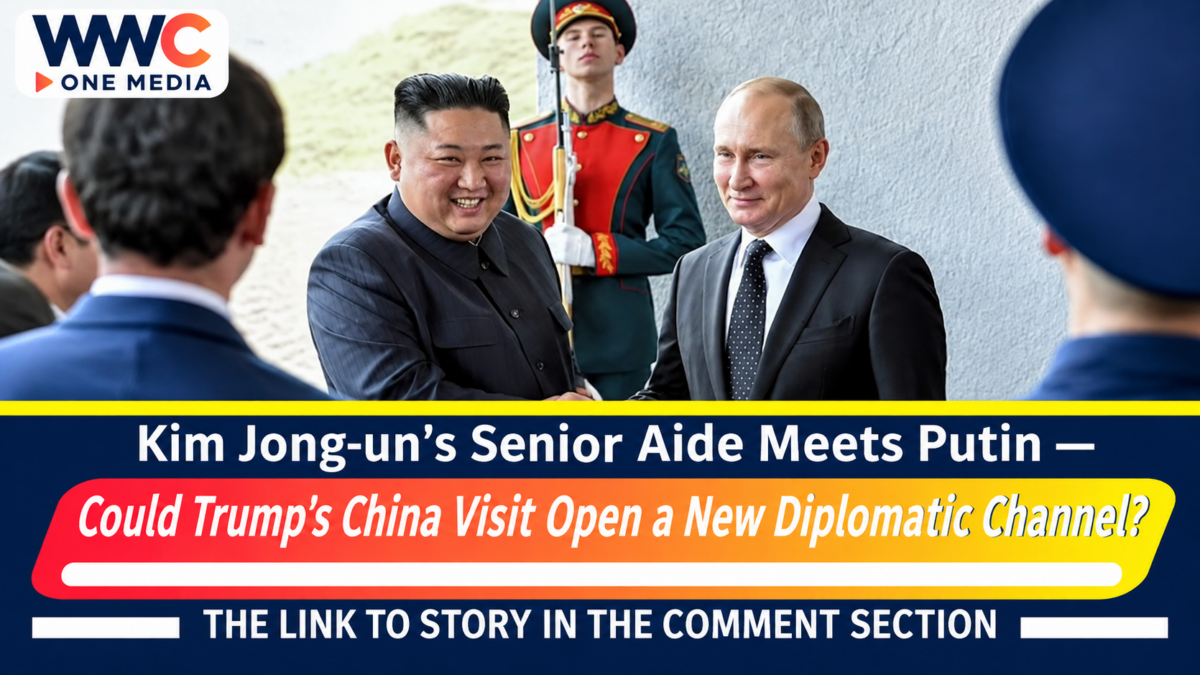
MOSCOW — Russian President Vladimir Putin met senior North Korean official Jo Yong-won on Nov. 16, 2026, while US President Donald Trump publicly raised the possibility of meeting Kim Jong-un during his visit to China. The Kim Jong-un aide meeting was confirmed in Russia’s official presidential record, but neither government’s published material establishes an agreed Trump–Kim summit.
The development matters because Moscow and Pyongyang are strengthening their relationship while Washington considers whether renewed communication with North Korea is possible. A public meeting, an expression of willingness to talk and a negotiated diplomatic agreement are three different stages.
Kim Jong-un aide: What happened in Moscow
Jo, a member of the leadership of North Korea’s Workers’ Party, was received by Putin in Moscow on Monday. The Russian presidential meeting record says Jo conveyed Kim’s greetings and best wishes, while Putin asked him to return his own greetings to the North Korean leader.
Putin described the relationship as a comprehensive strategic partnership and spoke about North Korean military personnel who participated in operations in Russia’s Kursk region. He also credited North Korean engineering and demining units with helping restore local infrastructure. Those are statements made by Russia’s president, not an independent assessment of battlefield activity or military losses.
The presidential record says Jo’s delegation was visiting for a political forum and a programme of meetings with Russian officials. It does not record a new signed treaty, a jointly announced military deployment or an agreement involving Washington.
Party and parliamentary ties are expanding
Jo also met Dmitry Medvedev, chairman of the United Russia party, on Nov. 16. A statement published directly by United Russia says the discussions addressed cooperation between the parties and the implementation of earlier agreements between the countries’ leaders.
Jo’s separate meeting with State Duma speaker Vyacheslav Volodin focused on further parliamentary dialogue. The Russian parliament’s own media service recorded the discussion and described both sides as interested in extending contacts beyond visits by their heads of state.
Analysis: These meetings offer several channels through which the governments can maintain contact. Party ties, legislative exchanges and presidential diplomacy can reinforce each other, but none necessarily means that new international commitments have been made.
WWC previously examined North Korea and Russia’s strategic partnership. The Nov. 16 meetings add identifiable participants and official statements to that broader relationship.
What Trump’s remarks actually establish
The White House published a recording of Trump’s remarks to reporters as he departed on Nov. 16 for his Asian trip. He raised the prospect of meeting Kim during the China visit, but the available official material does not give a confirmed time, venue, agenda or acceptance by Pyongyang.
That distinction is central to the story. A president discussing a possible meeting is evidence of a diplomatic opening being contemplated, not proof that the other side has accepted it.
The China visit also has a wider agenda. WWC’s report on the upcoming Trump–Xi–Putin talks in China considers the separate issues facing major powers. Any contact with Kim would need its own official confirmation rather than being inferred from the presence of other leaders.
Analysis: The possibility of dialogue can itself influence public expectations. But discussing an invitation without an agreed meeting creates uncertainty about who would participate, what would be negotiated and whether any statement would follow.
Military cooperation raises distinct questions
Russia and North Korea signed a comprehensive strategic partnership treaty in 2024. Putin explicitly referred to that treaty at the Nov. 16 meeting, alongside Russian acknowledgements of North Korean military involvement around Kursk.
Separately, the United Nations Security Council maintains a sanctions framework covering North Korean arms transfers, certain financial activities and nuclear- and missile-related technology. The official UN measures remain relevant when assessing claims about further cooperation.
The sanctions framework does not make every political meeting unlawful. It does mean that proposed transactions and military exchanges must be assessed against specific legal restrictions rather than assumed permissible because two governments have a partnership.
The human consequences of the military relationship are considered separately in WWC’s account of the legal aftermath for North Korean soldiers captured in the conflict. Those cases should not be treated as proof of any undisclosed agreement reached during Jo’s visit.
What this could mean for Northeast Asia
Analysis: A North Korean official’s access to Putin demonstrates that Moscow remains willing to receive senior representatives of Kim’s government. That may strengthen Pyongyang’s diplomatic options, but the public meeting record says little about how North Korea would approach any direct negotiation with Washington.
There are also separate interests at stake. Russia has emphasised security cooperation; the United States has raised the possibility of leader-level contact; and North Korea’s own response to a proposed meeting has not been documented in the primary records examined.
For Southeast Asian readers, including those in the Philippines, the key issue is whether major-power conversations produce a documented change in security policy. None of the records reviewed shows a new regional security arrangement or immediate change to existing treaty obligations.
What happens next
The next verifiable developments would be an official US or North Korean announcement confirming a meeting, a published agenda, or a jointly issued statement after talks. Russian records could also disclose follow-up decisions arising from Jo’s visit.
Until those documents appear, the strongest conclusion is limited: Putin received a senior North Korean representative, Russian party and parliamentary leaders held separate meetings, and Trump publicly discussed possible contact with Kim. A new diplomatic breakthrough is not yet established.
FAQ
Who is the North Korean official who met Vladimir Putin?
Jo Yong-won is a senior Workers’ Party official. He met Putin in Moscow on Nov. 16, 2026, and conveyed greetings from Kim Jong-un.
Did Putin and Jo Yong-won sign a new agreement?
No new agreement was identified in the original meeting records reviewed. The Russian side referred to the partnership treaty already in place.
Has Donald Trump confirmed a meeting with Kim Jong-un?
No confirmed meeting schedule was established in the official materials reviewed. Trump raised the possibility during his Nov. 16 departure remarks.
Why are Russia and North Korea cooperating?
The governments publicly describe their relationship as a strategic partnership, including political and security cooperation. Their statements do not independently establish every claimed military transaction.
What would confirm a diplomatic breakthrough?
An official acceptance of a meeting, agreed agenda or joint announcement would provide stronger evidence than a public expression of interest alone.