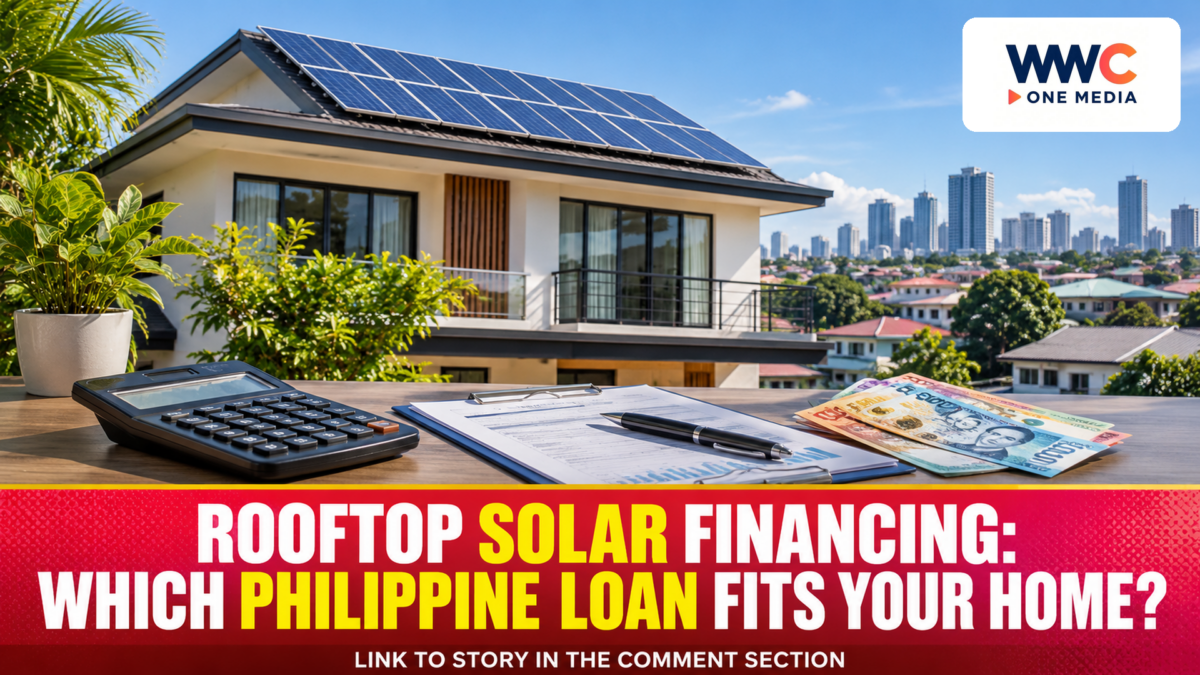
Rooftop solar financing is becoming a more practical consideration for Filipino homeowners as banks and government institutions introduce ways to spread the cost of installing solar panels. But the available options are not identical: some are designed for government workers, while others require an existing housing loan, property collateral or a qualifying credit arrangement.
The choice matters because a solar installation is a long-term household investment. Borrowing can reduce the initial cash requirement, but the monthly repayments, system performance and electricity savings must all make sense together.
Rooftop solar financing now has several routes
The financing market offers more than one way to fund a residential solar installation. Current examples include the Government Service Insurance System’s Ginhawa Solar Energy Loan, Bank of the Philippine Islands’ Solar Mortgage and solar instalment arrangement, and Metrobank’s Home Equity Loan.
These products have different eligibility requirements and repayment structures. They should be compared as financing alternatives, not treated as government subsidies or guaranteed discounts.
For government employees who qualify, the GSIS programme provides a dedicated solar loan. Private homeowners may instead consider bank financing, although some products require property or vehicle collateral.
The growing range of household equipment also makes it important to match the financing decision to the actual system being installed. WWC previously examined residential technology through its report on Marstek’s solar panel offering for Filipino homes.
GSIS offers a dedicated loan for qualified members
The Ginhawa Solar Energy Loan, or GSEL, is one of the clearest financing options for eligible government workers. Under the programme details published by GSIS, qualified members may borrow up to ₱500,000 at an annual interest rate of 5%, with repayment over as long as 60 months.
The programme includes three years of insurance coverage for the solar panels. Applications are submitted through the GSIS Touch mobile application.
Eligibility is not automatic. GSIS stated that applicants must be active members with at least three years of government service and at least six months of paid premium contributions. They must also have no GSIS loans in default, except housing loans.
The programme’s reach had grown substantially by November. In a Nov. 11 update, GSIS reported 66,233 loan applications valued at ₱19.81 billion, with ₱10.12 billion credited to borrowers. Applications are not the same as approved or released loans, so the figures should not be read as the number of completed solar installations.
For eligible members, the main consideration is whether the proposed loan amount and monthly amortisation fit their income after regular household expenses and existing obligations.
BPI offers mortgage-based and instalment options
BPI’s Solar Mortgage provides several ways for homeowners to finance solar panels. Its Top-Up Equity Loan allows an eligible borrower to add funds to an existing housing loan, with a minimum loan amount of ₱400,000 and a maximum term of 20 years.
The bank also lists a Multi-Purpose Loan that uses a fully paid vehicle as collateral. It has a minimum loan amount of ₱200,000 and a maximum term of five years. BPI’s published conditions include a requirement that the car must not be more than five years old upon loan maturity.
The bank also identifies property equity and mortgage-switch arrangements among its Solar Mortgage options. Applicants must submit a quotation for the solar panels from their provider, and approval remains subject to the bank’s review.
A separate BPI announcement describes Flexipay for Solar, which allows customers to purchase solar panel systems at partner merchants through instalments at 0% interest for up to 24 months. This is a different arrangement from a conventional housing or collateral-backed loan, and availability depends on the participating merchants and applicable terms.
The distinction is important: a promotional instalment offer should not be assumed to apply to every installer, equipment package or applicant.
Metrobank uses home equity to fund solar panels
Metrobank’s Home Equity Loan is another route for homeowners who have residential property they can use to support a borrowing application.
The bank says eligible borrowers may access up to 70% of their property’s value, with payment terms of up to 10 years. The loan can be used to finance solar panels, but the final approved amount depends on eligibility, property appraisal and the bank’s applicable terms.
Applicants must submit an application form, identification, income documents and collateral documents. This means the product is not simply an unsecured solar purchase plan.
Using property as collateral can make a larger financing amount possible, but it also creates a serious obligation. Borrowers should understand the consequences of missed payments and review the full loan agreement before proceeding.
Net-metering and own-use solar are not the same
Financing is only one part of the decision. Homeowners must also understand how their solar system will interact with the electricity grid.
Under net-metering, qualified consumers can use electricity generated by their renewable-energy system and export excess electricity to the distribution utility in exchange for bill credits. The Energy Regulatory Commission’s amended rules allow net-metering credits to be banked and rolled over to future billing periods, subject to the rules.
The ERC also requires distribution utilities to publish their application procedures, forms and available hosting capacity information. This is relevant because a proposed installation must meet the applicable technical and interconnection requirements.
There is also a separate route for own-use solar systems that do not export electricity to the grid. The Department of Energy’s 2026 policy changes simplified requirements for covered zero-export and micro-solar installations.
A homeowner should therefore ask the installer whether the proposed system is designed for self-consumption only or for net-metering. The answer affects the approvals and technical arrangements that may be required.
WWC has also covered the changing residential solar market, including TCL’s solar-plus-storage plans for Philippine households. Equipment choices, including whether to include battery storage, can affect the total project cost and the financing amount needed.
What homeowners should calculate before borrowing
A loan’s headline rate or maximum amount does not show the full cost of a solar installation. Homeowners should request an itemised quotation covering panels, inverter, mounting equipment, wiring, installation, permits, maintenance and any battery system.
They should then compare the total amount payable under the loan with the expected electricity savings. Those savings will vary according to system capacity, roof orientation and condition, household consumption, sunlight exposure, equipment performance and the utility’s applicable billing arrangements.
The repayment period also matters. A longer term can reduce the monthly instalment but may increase the total interest paid. A shorter term may cost less in interest but require a larger monthly payment.
This is especially important when electricity rates change. As WWC explained in its report on Meralco’s power-rate movements and temporary bill relief, a lower bill in one month does not guarantee that electricity costs will remain lower over the full life of a solar loan.
What happens next
The next step for interested homeowners is to obtain a system quotation and compare it with the actual financing terms available to them. GSIS members should confirm their eligibility and current GSEL requirements through official GSIS channels. Other borrowers should request written loan computations from their banks, including interest, fees, collateral conditions and total repayment.
Before signing an installation contract, homeowners should also confirm the system’s grid connection requirements with their distribution utility and ensure that the installer explains the equipment warranty, maintenance obligations and expected system output.
Rooftop solar can help households generate part of their own electricity, but financing does not remove the risks of borrowing. The soundest decision is one where the system, loan and household budget work together without relying on guaranteed savings.
Frequently asked questions
Can Filipino homeowners borrow money to install solar panels?
Yes. Examples include GSIS’s Ginhawa Solar Energy Loan for qualified members, BPI’s Solar Mortgage options and Metrobank’s Home Equity Loan. Eligibility and terms differ.
How much can a GSIS member borrow for solar panels?
GSIS programme information published in April 2026 stated that qualified members may borrow up to ₱500,000 at 5% annual interest, payable over up to 60 months. Applicants must meet the programme’s membership and contribution requirements.
Does BPI offer 0% interest solar instalments?
BPI has described Flexipay for Solar as an instalment arrangement at 0% interest for up to 24 months through partner merchants. Availability is subject to the applicable merchant and programme conditions.
Does rooftop solar automatically qualify for net-metering?
No. The installation must meet the applicable technical and regulatory requirements, and the homeowner must follow the distribution utility’s process. Own-use systems designed not to export electricity are covered by a separate policy framework.
Will solar panels guarantee lower electricity bills?
No. Actual savings depend on the system’s output, household electricity use, site conditions, equipment performance and applicable billing rules. Loan repayments and maintenance costs must also be considered.