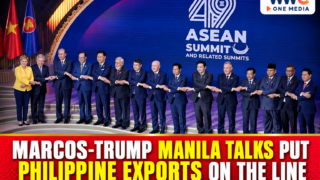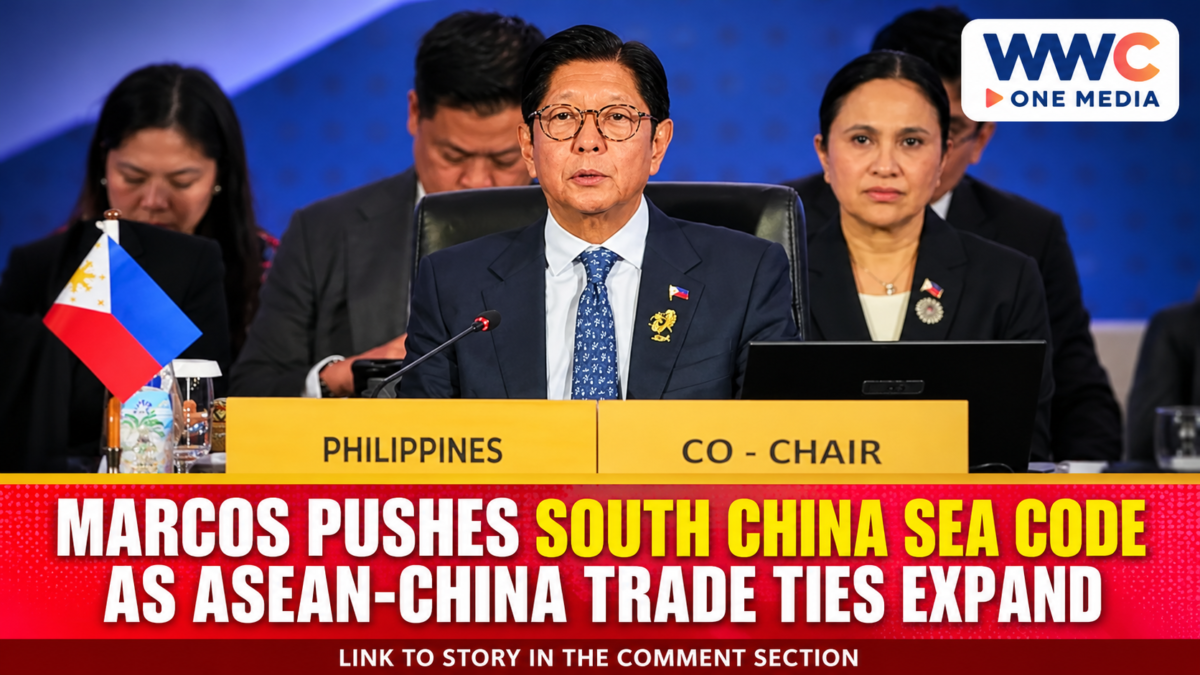
President Ferdinand Marcos Jr. is pursuing two important priorities in the Philippines’ 2026 ASEAN chairship: advancing negotiations for a South China Sea Code of Conduct and strengthening economic cooperation between Southeast Asia and China.
The two issues took centre stage on Nov. 16, 2026, as Marcos co-chaired the 29th ASEAN-China Summit in Pasay City, bringing maritime security and regional economic opportunities into the same diplomatic discussion.
The challenge for the Philippines is to make progress on both fronts: protect its maritime interests through international rules while keeping economic channels open with one of the region’s most important trading partners.
EDITORIAL DUPLICATE ALERT: WWC ONE MEDIA already has an article titled South China Sea Code Moves Into 2027 Talks and another covering the ASEAN-China partnership. This version takes a broader economic-diplomacy angle and is better treated as an update or replacement rather than an entirely new post.
Marcos Seeks South China Sea Code as China Trade Partnership Enters New Phase
President Ferdinand Marcos Jr. is pushing for stronger maritime rules and deeper economic cooperation as the Philippines uses its 2026 Association of Southeast Asian Nations (ASEAN) chairship to advance relations with China.
At the 29th ASEAN-China Summit in Manila on Nov. 16, 2026, Marcos highlighted the importance of international law, peaceful dispute settlement and practical cooperation while regional leaders reviewed the progress of their economic and strategic partnership.
The discussions matter because the Philippines faces a complicated diplomatic balancing act. It must defend its maritime rights while maintaining economic relationships that can create opportunities for Filipino exporters, investors and businesses.
The summit also came as ASEAN and China marked 35 years of dialogue relations and the fifth anniversary of their Comprehensive Strategic Partnership. ASEAN Main Portal+1
South China Sea negotiations remain a major Philippine priority
Marcos placed the proposed South China Sea Code of Conduct among the important regional issues requiring continued attention.
The President’s position is that any eventual agreement must be consistent with international law, particularly the 1982 United Nations Convention on the Law of the Sea (UNCLOS).
The principle is significant for the Philippines because maritime disagreements cannot be separated from questions involving sovereignty, sovereign rights, jurisdiction and the rules governing activities at sea.
In his Nov. 15 address at the 49th ASEAN Summit plenary, Marcos identified maritime cooperation and progress towards an effective and substantive Code of Conduct as part of the country’s Peace and Security Anchors priority.
The speech also made clear that the Philippines considers regional security and economic development connected rather than separate concerns. Philippine Coast Guard+1
The proposed Code of Conduct is intended to provide a framework for managing behaviour and reducing the risk of incidents in the South China Sea.
However, negotiations should not be confused with an accomplished agreement. The November summit did not establish that the maritime dispute had been settled or that a final Code of Conduct had been signed.
For Manila, the next challenge is ensuring that negotiations produce an agreement with meaningful provisions and consistency with international law.
Trade cooperation gives the ASEAN-China partnership another dimension
While maritime security remains sensitive, economic cooperation continues to offer areas where ASEAN and China can work together.
During the Manila summit, the leaders reaffirmed their commitment to strengthening the ASEAN-China Comprehensive Strategic Partnership through the implementation of the ASEAN-China Plan of Action 2026–2030.
The framework provides a basis for cooperation over the next five years and reflects the intention of both sides to sustain engagement across different areas of the ASEAN community.
The ASEAN Secretariat’s official summit account confirms that the leaders reviewed the partnership’s progress and discussed its future direction.
For the Philippines, this creates an opportunity to connect regional diplomatic commitments with practical economic programmes. ASEAN Main Portal+1
An important part of that economic relationship is the ASEAN-China Free Trade Area 3.0 Upgrade Protocol.
The agreement was signed in October 2025 during the 28th ASEAN-China Summit in Kuala Lumpur. Its coverage extends beyond traditional trade, incorporating areas such as digital economy, green economy, supply chain connectivity, competition and consumer protection.
The Presidential Communications Office previously identified micro, small and medium enterprises (MSMEs) as among the businesses that could benefit from the expanded framework.
These provisions are important because regional trade increasingly involves digital services, interconnected production networks and technology-driven business operations, not simply the movement of physical products across borders. ASEAN Main Portal+1
What the trade framework could mean for Filipino businesses
For Philippine companies, closer ASEAN-China economic cooperation could provide access to a wider regional market.
Exporters may find opportunities in sectors covered by improved trade arrangements, while businesses involved in digital services, manufacturing and supply chains could benefit from stronger regional connections.
However, the existence of a trade agreement does not automatically guarantee higher exports, increased investment or additional employment.
Businesses still need to meet applicable rules, compete with regional suppliers and understand the requirements for accessing foreign markets.
The practical value of ACFTA 3.0 will depend on implementation, the use of its provisions and the ability of local companies to participate.
Smaller enterprises may particularly need support in understanding customs requirements, product standards, digital trade rules and other procedures involved in cross-border transactions.
This is where government agencies responsible for trade promotion and business development have an important role.
The Philippines must ensure that regional agreements translate into opportunities that domestic enterprises can realistically use, rather than remaining diplomatic commitments with limited impact on the wider business community.
Why maritime security and economic relations cannot be separated
The ASEAN-China relationship presents an important regional challenge: economic cooperation must continue even as disagreements over maritime issues remain unresolved.
For the Philippines, this requires maintaining diplomatic engagement without compromising its position on international law and maritime rights.
The two objectives are not necessarily contradictory.
Countries can maintain trade and investment relationships while addressing territorial and maritime disagreements through established diplomatic and legal mechanisms.
Marcos’ approach at the summit reflects this broader regional reality. Economic partnerships remain important, but cooperation cannot replace the need for credible rules governing maritime conduct.
The ASEAN framework also gives smaller member states an opportunity to raise shared concerns through collective engagement.
Still, ASEAN’s effectiveness depends on the willingness of its members and dialogue partners to maintain a common direction despite differences in national interests.
For additional context, WWC has previously examined how the ASEAN-China partnership faces a new test under its five-year cooperation plan and how the South China Sea Code negotiations move into 2027.
The next test is turning commitments into measurable results
The November summit reinforced the importance of keeping economic and diplomatic channels open.
But the announcements and commitments must eventually produce concrete results.
On the economic front, attention will turn to the implementation of the ASEAN-China Plan of Action 2026–2030 and the expanded free trade framework.
For Philippine businesses, the important questions will involve actual market access, investment opportunities, trade facilitation and the participation of smaller enterprises.
On maritime security, the priority remains progress towards a substantive Code of Conduct that is consistent with UNCLOS.
These two tracks will require sustained government engagement beyond the Philippines’ current ASEAN chairship.
The country’s diplomatic influence will ultimately be measured not simply by the number of agreements discussed during summits, but by whether those commitments lead to practical benefits and stronger regional stability.
What happens next
The ASEAN-China partnership will continue under the 2026–2030 Plan of Action, while both sides work through established regional mechanisms to advance economic cooperation.
The South China Sea Code of Conduct negotiations also remain an important item on the regional agenda.
Singapore is scheduled to assume the ASEAN chairship in 2027, providing the next stage for regional discussions and cooperation.
For the Philippines, the immediate task is to preserve the progress achieved during its chairship while ensuring that maritime security and economic development remain central to ASEAN’s priorities.
The real measure of success will be whether regional cooperation can deliver tangible economic opportunities without weakening the principles of international law that protect the country’s maritime interests.
Frequently asked questions
1. What did President Marcos push for during the ASEAN-China Summit?
Marcos highlighted peaceful dispute settlement, international law, maritime cooperation and continued progress towards an effective Code of Conduct in the South China Sea.
2. What is the ASEAN-China Free Trade Area 3.0?
It is an upgraded regional trade framework that expands cooperation into digital and green economies, supply chain connectivity, competition and consumer protection.
3. When was the ASEAN-China Free Trade Area 3.0 Upgrade Protocol signed?
The protocol was signed on Oct. 28, 2025, during the 28th ASEAN-China Summit in Kuala Lumpur, Malaysia.
4. Has the South China Sea Code of Conduct been finalized?
No. The negotiations remain ongoing. The November 2026 summit did not announce the signing of a final agreement.
5. Why is ASEAN-China cooperation important to the Philippines?
It provides opportunities for trade, investment, regional connectivity and business development while giving the Philippines a diplomatic platform to address maritime and security concerns.
The article’s distinct angle is the intersection of maritime diplomacy and trade opportunities. The existing WWC coverage should be checked before publishing to avoid competing URLs on substantially similar stories.