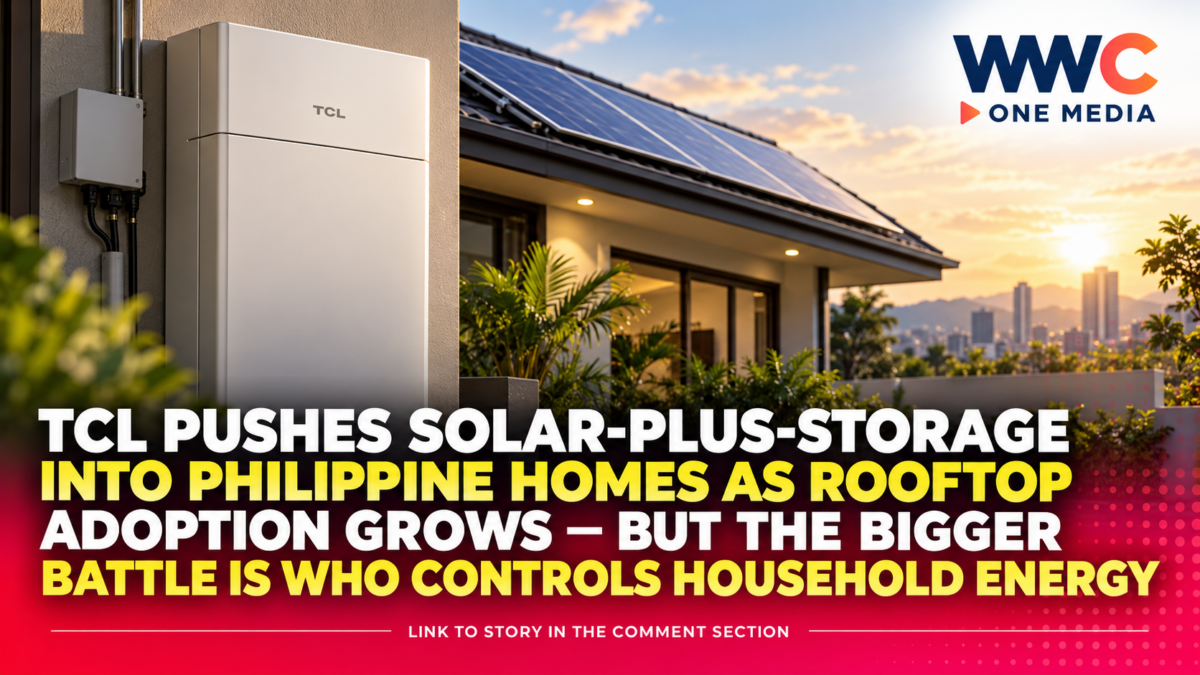
MANILA, PHILIPPINES — TCL is expanding beyond televisions and home appliances into the Philippine energy market, betting that the next phase of rooftop solar will not be about panels alone but about batteries, smart controls and household energy independence.
Through TCL PV TECH, the company is introducing its BlueArk X1 residential energy-storage system in the Philippines beginning this month, as more Filipino households look for ways to use self-generated solar electricity beyond daylight hours.
The system combines a hybrid inverter, battery storage, backup power and an energy-management platform in a single architecture.
TCL says the system can begin with 8 kilowatt-hours of battery capacity and scale to as much as 128kWh, allowing homeowners to expand storage as their electricity requirements increase. Single-phase models are scheduled for Philippine availability beginning in October 2026, while three-phase versions for larger homes are planned for 2027.
The launch comes at a favorable moment.
The Philippine government is accelerating rooftop-solar adoption, shortening net-metering processing times and simplifying rules for consumers who want to generate electricity for their own use.
But the bigger transformation is only beginning.
As batteries become increasingly important alongside rooftop solar, competition is shifting from who sells the cheapest panels to who can control the entire household-energy ecosystem—from generation and storage to appliances, backup power and intelligent energy management.
Solar Panels Alone Do Not Solve the Timing Problem
The basic weakness of rooftop solar is simple.
Solar panels generate the most electricity during daylight hours.
Many households, however, consume substantial amounts of electricity in the evening, when air conditioners, refrigerators, lighting, televisions and other appliances continue operating but solar production has fallen.
Without battery storage, surplus electricity can be exported to the grid through net-metering where applicable.
A battery provides another option.
Excess daytime electricity can be stored and used later, helping consumers increase the amount of their own solar generation they consume directly.
Battery systems can also provide backup electricity during outages.
That is the opportunity TCL is targeting with BlueArk X1.
The company describes the product as an all-in-one residential energy-storage system combining a hybrid inverter, battery modules, uninterruptible-power capabilities and an Energy Management System, or EMS.
BlueArk X1 Can Scale From 8kWh to 128kWh
One of TCL’s main selling points is modularity.
The X1 begins with 8kWh of usable storage capacity and can be expanded significantly as household needs grow.
TCL’s product specifications show configurations ranging up to 128kWh, with single-phase inverter power from 3kW to 8kW and three-phase configurations from 5kW to 16kW.
That means the platform can potentially serve different types of households.
A smaller home may require only enough capacity to cover essential appliances during the evening or a short outage.
A larger residence with multiple air-conditioning units, electric vehicles or other heavy loads may require substantially more storage.
The system also supports the use of newly added and older battery modules together, according to TCL.
That feature is intended to allow homeowners to expand without replacing their existing batteries.
TCL Says Backup Switching Takes Less Than 10 Milliseconds
Energy resilience is another major part of the pitch.
TCL says the X1 can switch to battery backup in under 10 milliseconds if the electricity grid goes down.
That is designed to keep selected appliances operating with little or no noticeable interruption.
The platform also includes a reserved generator connection, which can give households another source of backup power.
TCL describes the system as capable of integrating grid power, rooftop solar, battery storage and generator supply.
Actual backup duration will depend on battery size and household electricity consumption.
An 8kWh system powering only essential appliances will last significantly longer than the same battery supporting several air conditioners and other high-load equipment.
For consumers, this makes system sizing critically important.
TCL Is Building a Bigger Energy Business
The Philippine launch is part of a broader strategic move by TCL.
The company is better known globally for televisions and consumer electronics, but clean energy has become an increasingly important part of its portfolio.
TCL Photovoltaic Technology describes itself as a provider of integrated renewable-energy solutions covering development, manufacturing and energy management for residential and commercial users.
At the IFA technology exhibition in September, TCL presented a broader vision combining solar generation, battery storage and connected-home technology.
The company’s strategy increasingly links its energy products with its existing smart-home ecosystem.
That creates an interesting competitive advantage.
Instead of selling a battery as an isolated device, TCL ultimately wants energy storage to become part of a connected home in which appliances can respond intelligently to electricity availability and pricing.
The Smart Home Could Become a Smart Power Plant
The longer-term concept goes beyond storing solar electricity.
A home-energy-management platform can determine when electricity should be stored, used or potentially exported.
For example, the system may prioritize solar power during the day.
It could charge a battery when excess energy is available.
During the evening, stored electricity could reduce grid purchases.
If a blackout occurs, the battery could automatically supply selected appliances.
Future energy-management platforms could also coordinate with air conditioners, water heaters and electric-vehicle chargers.
This is where TCL’s background in connected consumer electronics may become strategically important.
The company already operates a smart-home ecosystem covering appliances such as air conditioners, washing machines and other devices.
If those products become integrated with household-energy systems, TCL could potentially manage not only how electricity is generated but also when appliances consume it.
Philippine Rooftop Solar Is Already Growing
The market TCL is entering is still relatively small compared with the total number of Philippine households, but rooftop solar adoption is clearly increasing.
Energy Regulatory Commission data showed 23,684 net-metering consumers with a combined installed capacity of about 232 megawatt-peak as of June 30, 2026.
Another 181 distributed-energy-resource participants had approximately 226MWp of capacity.
The numbers demonstrate that tens of thousands of consumers have already moved from being ordinary electricity customers to becoming what regulators call “prosumers”—households or businesses that both consume and generate electricity.
Government agencies want that number to increase substantially.
Government Is Cutting Red Tape for Rooftop Solar
One of the biggest barriers to distributed solar has historically been paperwork and interconnection delays.
The Department of Energy has been working to simplify those requirements.
Under measures implemented in 2026, distribution utilities and electric cooperatives were instructed to process qualified net-metering applications within 10 working days, while local-government approvals were shortened to three working days under emergency measures.
The DOE also launched a nationwide Net-Metering Caravan to address financing, documentation and technical barriers.
The government says its objective is to make rooftop solar more accessible to households, businesses, healthcare facilities and other eligible consumers.
For TCL and other solar suppliers, easier approvals could expand the addressable market.
But installation cost remains a major obstacle.
New Rules Also Make Own-Use Solar Easier
Not every household wants to export electricity to the grid.
Some consumers simply want solar panels to reduce their own electricity purchases.
In August, the DOE simplified rules for Self-Generating Facility Zero-Export Solar Systems and Micro-Solar Systems, allowing eligible consumers to install solar for their own use under a streamlined process.
That policy could be particularly important for battery systems.
A household equipped with both solar and storage can consume more of its own electricity instead of exporting surplus generation.
For some consumers, the economic calculation may therefore become less dependent on net-metering credits.
The more electricity a household can store and consume itself, the less it may need to buy from the grid.
Battery Storage Is Becoming Central to Philippine Energy Policy
TCL is also entering the market at a time when the Philippine government is explicitly promoting energy storage.
In February 2026, the DOE updated its Energy Storage Systems policy to accelerate deployment and support higher levels of renewable-energy integration.
The policy is not limited to household batteries.
Large-scale storage is increasingly being developed alongside utility-scale renewable-energy projects.
For example, the MTerra Solar project began energizing hundreds of megawatts of solar generation and battery capacity in 2026. Once fully developed, the project is designed to combine 3,500MWp of solar power with 4,500MWh of battery storage.
The underlying challenge is the same at both scales.
Solar power is variable.
Batteries can shift electricity from periods of high generation to periods of greater demand.
TCL Is Not Alone in Chasing the Storage Market
Competition is increasing.
Global solar manufacturer Trinasolar announced in May that it was expanding its Philippine business beyond photovoltaic modules into battery-energy-storage systems for utility-scale solar projects.
Other global battery, inverter and solar companies are also competing for Philippine opportunities.
That means TCL will have to compete on more than brand recognition.
Important factors will include pricing, installation quality, warranties, after-sales service, safety certifications and compatibility with existing solar installations.
Battery systems can remain in service for many years.
Consumers will therefore want confidence that suppliers and installers will continue providing technical support long after installation.
Safety Could Become One of the Biggest Selling Points
Lithium battery systems require careful engineering.
Energy-storage products must manage heat, electrical faults and other technical risks.
TCL says the X1 uses lithium iron phosphate battery technology and includes electrical-protection systems.
The company lists an IP66 enclosure rating for indoor or outdoor use and protection systems on both AC and DC sides.
However, product specifications should not substitute for proper installation.
A residential storage system should be sized, installed and commissioned by qualified professionals in accordance with applicable electrical and fire-safety requirements.
Consumers also need to understand battery warranty terms and expected usable life.
As residential storage becomes more common, those details could become as important as initial purchase price.
The Cost Question Could Determine Adoption
TCL’s Philippine announcement did not specify retail pricing in the InsiderPH report.
That leaves one of the most important consumer questions unanswered.
How much will an installed system actually cost?
Battery economics depend heavily on upfront investment.
Consumers must compare installation cost against potential electricity savings, backup-power value and battery life.
A household that already has solar panels may have a different calculation from someone installing solar and batteries simultaneously.
Consumers with frequent outages may also place greater value on backup electricity.
Meanwhile, households with relatively low power consumption may find it harder to justify a very large battery.
This means the Philippine market is unlikely to adopt storage uniformly.
Higher-income households and businesses may move first.
Broader adoption will depend on falling battery prices, accessible financing and evidence of long-term savings.
Net-Metering Changes the Economics
The existence of net-metering also complicates the financial calculation.
Under the Philippine net-metering program, qualified renewable-energy systems of up to 100kW can export excess electricity to the grid and receive credits on their electricity bills.
If export credits are attractive, some households may decide they need less battery capacity.
If consuming stored solar electricity provides greater financial value than exporting it, larger batteries may become more attractive.
The ideal configuration therefore depends on electricity usage patterns, solar production and applicable utility arrangements.
There is no single battery size that makes sense for every home.
More Consumers Could Become Energy Producers
The expansion of rooftop solar is gradually changing the relationship between utilities and electricity customers.
Traditionally, power flowed in one direction.
Power plants generated electricity.
Utilities delivered it.
Consumers paid for it.
Distributed energy changes that structure.
A homeowner with rooftop solar can generate electricity.
With a battery, that homeowner can decide when to use it.
With net-metering, surplus electricity can also flow back into the grid.
As these systems expand, utilities and regulators must manage increasingly complex two-way electricity flows.
That requires updated metering, grid-management technology and technical standards.
Renewable Energy Already Reached 25% of Philippine Generation
The country’s energy transition is accelerating but remains incomplete.
The DOE said renewable energy accounted for approximately 25% of Philippine gross electricity generation by the end of 2025, up from 22% in 2024.
The government is targeting 35% renewable energy by 2030 and 50% by 2040.
Large utility-scale projects will provide much of that growth.
But distributed solar could also play an increasingly important role.
Each individual rooftop system may be small.
Collectively, tens or hundreds of thousands of systems could represent substantial generating capacity.
Adding storage would make that distributed capacity more flexible.
The Philippines Has Attracted Trillions in Renewable Investment
The broader investment environment is already significant.
The Board of Investments said it approved 347 renewable-energy projects worth about ₱3.96 trillion between 2021 and the first half of 2026.
Those figures include large projects rather than only rooftop solar.
Nevertheless, they demonstrate the scale of capital moving into the Philippine clean-energy sector.
Global manufacturers see an expanding market.
Developers see opportunities in solar, wind and storage.
Consumers increasingly see distributed energy as a way to reduce dependence on the grid.
The challenge is ensuring that growth translates into affordable, reliable electricity.
TCL’s Bigger Advantage Could Be Its Appliance Business
TCL’s most interesting opportunity may ultimately lie outside the battery itself.
The company already sells televisions, air conditioners and connected-home products.
If its energy-management platform can coordinate those devices, TCL could create a vertically integrated household-energy ecosystem.
For example, air-conditioning demand could potentially be shifted toward periods when rooftop solar output is highest.
Battery charging could be optimized automatically.
Backup power could prioritize essential devices.
Consumers could monitor generation, storage and electricity consumption through a single interface.
TCL’s international energy strategy already emphasizes bringing together photovoltaic generation, storage and connected-home technology.
That could differentiate the company from businesses focused solely on solar panels or batteries.
But TCL Still Has to Prove the Philippine Business Case
Technology specifications alone will not determine success.
Philippine households are highly price-sensitive.
Electricity savings must justify upfront investment.
Installation must be reliable.
And consumers need confidence in after-sales support.
The company must also compete with established solar installers and global energy-storage manufacturers.
Another challenge is education.
Many consumers understand rooftop solar but may be less familiar with battery sizing, charging cycles and energy-management systems.
Selling residential storage therefore requires explaining not just the product but the economics behind it.
The Market Is Moving From Solar Panels to Energy Systems
The most important shift may be conceptual.
The first phase of residential renewable energy was dominated by solar panels.
The next phase is increasingly about integration.
Solar panels generate electricity.
Batteries store it.
Inverters control electrical conversion.
Energy-management platforms decide when electricity should be used.
Connected appliances can respond to those decisions.
This creates a much larger commercial opportunity than selling photovoltaic modules alone.
It also changes competition.
Technology companies, battery manufacturers, utilities, solar installers and smart-home brands may increasingly compete in the same market.
Can TCL Turn Filipino Homes Into Mini Energy Hubs?
TCL’s BlueArk X1 launch arrives as Philippine energy policy becomes increasingly supportive of rooftop generation and storage.
Government processing times are being shortened.
Own-use solar rules are being simplified.
Net-metering participation is expanding.
And renewable-energy targets are becoming more ambitious.
That provides a potentially attractive environment for integrated residential energy systems.
But mass-market adoption is not guaranteed.
Battery costs remain important.
Households must see convincing financial returns.
Installers must prove reliability.
And the technology must operate safely under Philippine conditions.
TCL is betting that Filipino consumers will eventually want more than solar panels.
It wants households to generate, store, manage and control their own electricity through a single connected platform.
But the bigger question is whether home batteries can become affordable enough to move beyond wealthy early adopters—and turn thousands of ordinary Filipino homes into small, intelligent energy systems.