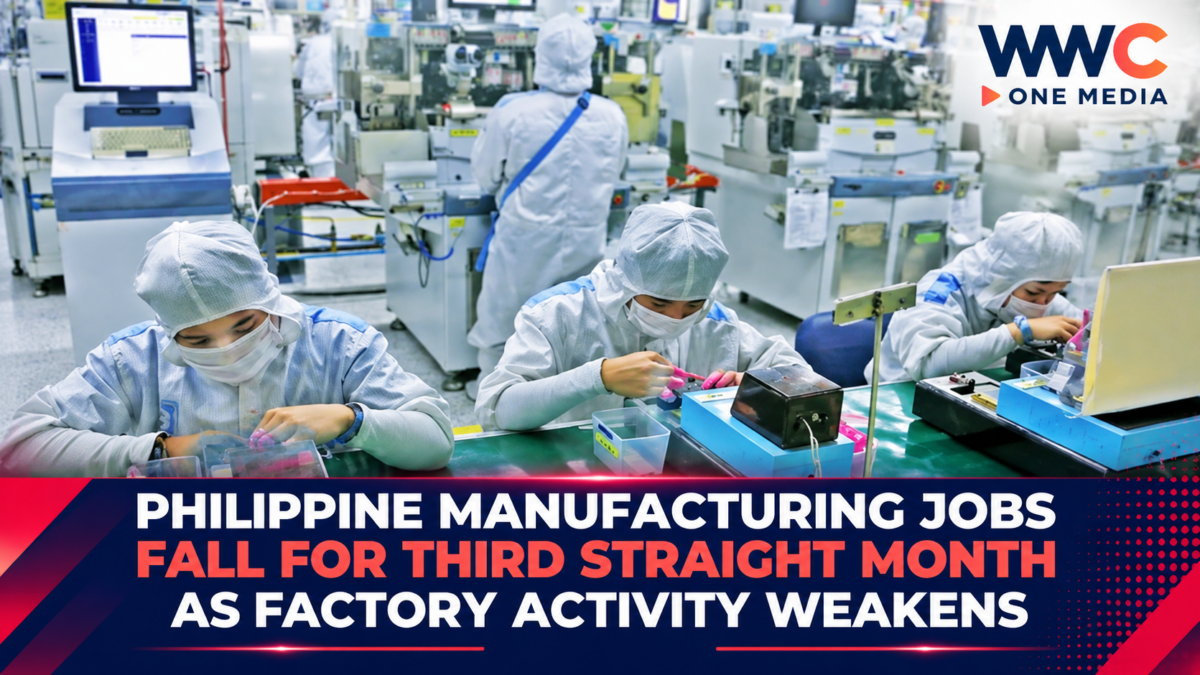
MANILA — Employment in the Philippine manufacturing sector fell for a third consecutive month in September, adding to signs that weaker demand and rising operating pressures are beginning to weigh on factory hiring.
The decline came as Philippine manufacturing activity slipped into contraction, with the sector’s Purchasing Managers’ Index falling to 49.6 in September from 54.9 in August. A reading below 50 signals a deterioration in operating conditions.
Weak Demand Puts Pressure on Factory Jobs
Manufacturers reported weaker new orders during September after four consecutive months of growth. Export orders also declined as companies faced stronger international competition and resistance to higher prices.
With fewer orders coming in, factories reduced production and scaled back purchasing and inventories. Employment also moved further into contraction, although the pace of job losses was described as slight.
Production recorded its first decline in nine months and fell at its fastest pace since November 2025, highlighting the extent of the slowdown during the month.
Oil Prices and Competition Add to the Strain
Manufacturers also faced higher operating expenses, with elevated oil prices and unfavorable exchange-rate movements increasing pressure on businesses.
Higher fuel costs contributed to more difficult logistics conditions, while international competition made it harder for Philippine manufacturers to raise prices without risking further damage to demand.
Companies responded by reducing input purchases and running down inventories, moves that indicate a more cautious approach to production and hiring.
Broader Labor Market Also Shows Weakness
The manufacturing slowdown comes against a broader deterioration in the country’s year-on-year employment picture.
The latest official labor data showed 49.79 million employed Filipinos in August, down from 50.10 million a year earlier. The unemployment rate stood at 5.3%, equivalent to about 2.77 million unemployed people, compared with 3.9% unemployment in August 2025.
Manufacturing remains part of the country’s broader industry sector, which accounted for 17.3% of total employment in August.
Manufacturing Output Still Shows Annual Growth
Despite the deterioration in the September factory survey, official production data show that manufacturing output remained stronger on a year-on-year basis in August.
The manufacturing Value of Production Index increased 10.8% year-on-year in August, accelerating from 9.9% growth in July. The stronger performance was driven in significant part by computer, electronic and optical products, whose production value increased 30.1% during the month.
This suggests that the latest employment decline does not necessarily mean the entire manufacturing industry is collapsing. Instead, the data point to a sector facing increasingly uneven conditions, with some industries continuing to expand while weaker demand is forcing other manufacturers to become more cautious.
What Comes Next for Factory Workers
The immediate outlook will depend heavily on whether new orders recover and whether manufacturers can absorb higher energy and operating costs without further reducing production.
Business confidence among manufacturers weakened sharply in September, falling from a 21-month high in August to its lowest level since January.
If weak demand persists, factories could remain under pressure to control costs through reduced purchasing, lower inventories and restrained hiring. A sustained recovery in domestic and export orders, however, could give manufacturers room to rebuild production and employment in the months ahead.