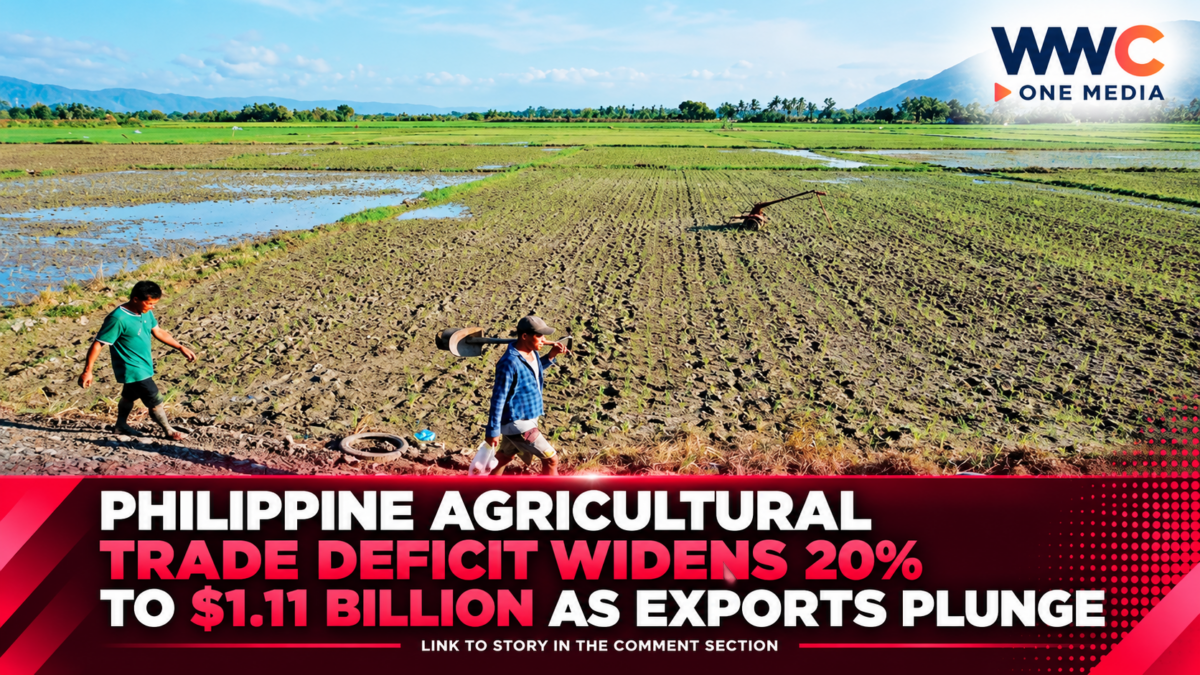
MANILA — The Philippines’ agricultural trade deficit widened by 20% year-on-year to $1.11 billion in August, as agricultural exports plunged while imports barely declined, highlighting the growing imbalance in the country’s farm trade.
Preliminary data showed agricultural exports fell to $554.7 million, down 26.1% from $750.57 million a year earlier. The August export value was the lowest recorded since January 2024.
Exports Collapse While Imports Remain High
Agricultural imports reached $1.67 billion in August, only 0.6% lower than the $1.68 billion recorded in the same month last year.
Because imports remained relatively steady while exports dropped sharply, the agricultural trade gap expanded to $1.11 billion from $928.45 million a year earlier. The deficit, however, narrowed from $1.24 billion in July.
Agricultural products accounted for 24.9% of the country’s total agricultural trade during the month, while imports represented 75.1%, underscoring the Philippines’ continued dependence on foreign farm products.
Fruits and Nuts Lead Philippine Farm Exports
Edible fruits and nuts, including citrus and melon peel, were the country’s biggest agricultural export category in August, generating about $211.99 million, or 38.2% of total agricultural exports.
The sharp decline in overall exports nevertheless pulled total agricultural trade down 8.5% to $2.22 billion, its lowest level since July 2024.
The weak export performance also meant agricultural products accounted for just 6.1% of the Philippines’ total merchandise exports during the month.
Cereals Dominate Agricultural Imports
On the import side, cereals remained the country’s largest agricultural import category, accounting for roughly $416.68 million, or 25% of total agricultural imports.
The continued reliance on imported cereals is particularly significant as the Philippines faces ongoing food-security and agricultural-production challenges.
The country’s agricultural import bill also reflects the importance of regional supply chains. ASEAN supplied about $565.43 million worth of agricultural products to the Philippines in August, with Indonesia, Thailand and Vietnam among the leading suppliers.
ASEAN Remains an Important Market
Philippine agricultural exports to ASEAN amounted to approximately $67.15 million in August.
Malaysia was the largest ASEAN destination for Philippine agricultural products, receiving about $27.82 million, followed by Singapore, Thailand, Vietnam and Indonesia.
Fats, oils and related products were the leading Philippine agricultural exports to the region, followed by tobacco products and miscellaneous food preparations.
The European Union was another significant destination, with Philippine agricultural exports reaching $65.5 million. The Netherlands accounted for the largest share, followed by Spain and Germany.
El Niño Adds Another Risk
The widening agricultural trade deficit comes as the Philippines prepares for potentially difficult weather conditions.
The country’s weather bureau has warned that El Niño is expected to continue through the first half of 2027 and could reach a very strong state toward the end of 2026, increasing the likelihood of below-normal rainfall, dry spells and drought in parts of the country.
A prolonged dry period could put additional pressure on domestic agricultural production, potentially increasing the need for imports of food commodities while making it harder for local producers to expand export volumes.
A Growing Challenge for Philippine Agriculture
The latest figures point to a difficult combination: the country is importing large amounts of agricultural products while earning substantially less from agricultural exports.
The situation is particularly notable because overall Philippine merchandise exports have been performing strongly. Total goods exports reached a record $9.11 billion in August, up 27.8% year-on-year, according to preliminary government data.
That contrast suggests the weakness in August was concentrated in agricultural trade rather than the entire export sector.
For Philippine agriculture, the challenge now is to raise domestic production, improve productivity and strengthen the competitiveness of locally produced goods while reducing excessive dependence on imports.
With El Niño potentially adding further pressure to farm output, the country’s agricultural trade balance could remain a major concern for food security, prices and rural incomes in the months ahead.