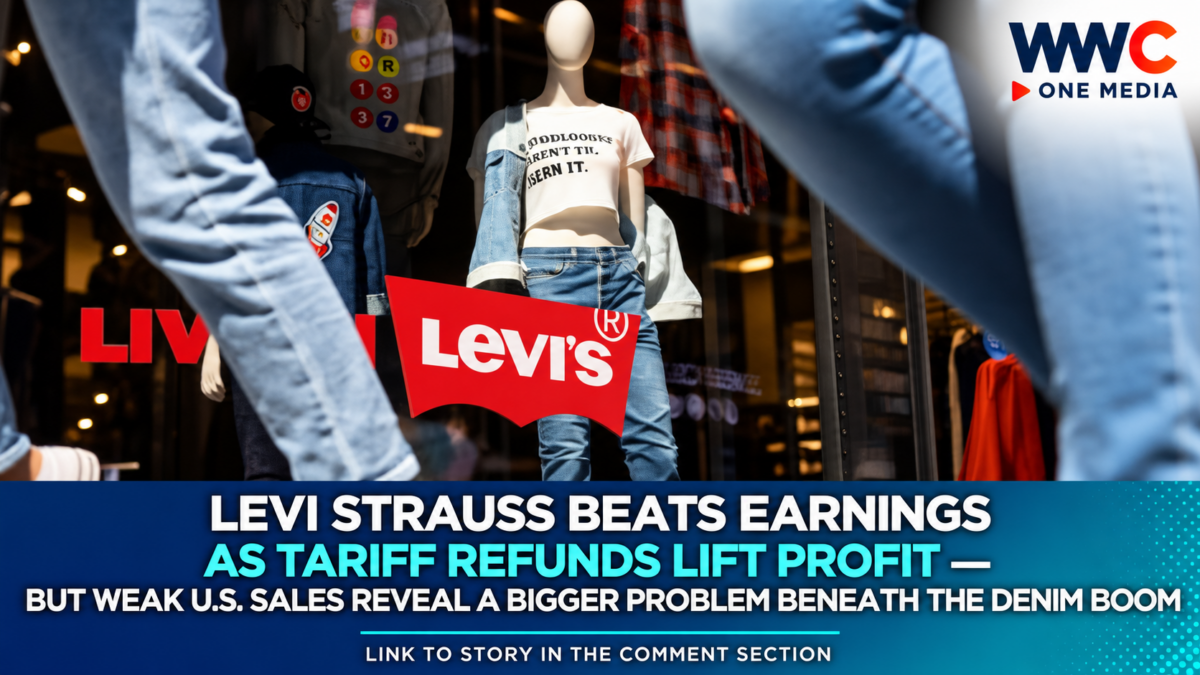
SAN FRANCISCO — Levi Strauss delivered a much stronger-than-expected third-quarter profit and raised its full-year earnings outlook, but the headline numbers came with an important warning: a large portion of the upside came from tariff refunds while sales at the company’s own U.S. stores and websites remained under pressure.
The denim maker reported adjusted earnings of 48 cents per share for its fiscal third quarter, well above the roughly 36 cents expected by Wall Street.
Revenue increased about 4% to $1.61 billion, slightly below analysts’ expectations of approximately $1.62 billion.
The company also raised its full-year adjusted earnings forecast to $1.54 to $1.56 per share, up from its previous range of $1.46 to $1.52.
But the earnings beat was not entirely organic.
Levi Strauss received approximately $80 million in tariff refunds during the quarter, and management said the refunds added about 11 cents per share to adjusted earnings after part of the benefit was reinvested in the business.
That distinction is crucial.
Without that one-time boost, Levi’s underlying adjusted earnings would have been much closer to Wall Street expectations.
The company is therefore entering the holiday season with stronger profitability—but still needs to prove that consumers are buying enough Levi’s products without relying on unusual financial benefits.
Levi’s Earnings Beat Was Huge
On the surface, the quarter looked impressive.
Adjusted EPS of 48 cents beat the 36-cent consensus by roughly one-third.
That kind of upside would normally be enough to trigger a strong stock-market reaction.
But investors were more cautious.
Levi shares fell about 5% during Wednesday’s regular session and slipped further after the earnings release.
The reaction reflects the market’s concern about the quality of the earnings beat.
A company can exceed profit forecasts because sales are booming and margins are structurally improving.
Or it can beat because of temporary factors.
For Levi Strauss, the truth lies somewhere between those two extremes.
The core business did improve in several areas, but tariff refunds provided a substantial additional lift.
The $80 Million Tariff Refund Changed the Quarter
Levi Strauss said it recorded approximately $80 million in tariff refunds, representing substantially all of the refunds it expects to receive.
Those refunds significantly boosted gross margin and operating profit.
The company said the tariff benefit contributed roughly 370 basis points to adjusted gross margin after reinvestment and about 330 basis points to adjusted EBIT margin.
Gross margin reached 66.2%, an increase of 450 basis points from the prior year.
But excluding the tariff-refund benefit, underlying gross-margin expansion was closer to 80 basis points.
That is still positive.
It is simply much less dramatic than the headline number.
Levi’s Is Reinvesting Most of the Windfall
Management is not simply keeping the tariff refund.
Levi Strauss said it plans to redeploy roughly three-quarters of the benefit back into the business.
The money is being directed toward three major areas:
- additional marketing to stimulate demand;
- supply-chain improvements;
- and sharper promotional pricing during the holiday season.
Roughly $25 million was reinvested during the third quarter, with another $35 million expected to be deployed in the fourth quarter.
That strategy explains why the company believes the refund can create value beyond the quarter in which it was received.
Instead of maximizing short-term profit, Levi is using much of the windfall to strengthen future demand.
The Real Problem Is U.S. Direct-to-Consumer Sales
The most important weakness in the report was Levi’s own retail business.
Global direct-to-consumer revenue increased only about 2%, while comparable sales were flat.
In the United States, direct-to-consumer sales fell around 1%.
Europe also experienced weakness in company-operated channels even though the region’s overall revenue grew.
This matters because direct-to-consumer sales are strategically important.
Selling jeans through Levi’s own stores and websites typically gives the company greater control over pricing, customer relationships and brand presentation.
It can also produce better economics than selling entirely through third-party retailers.
Weakness in this channel therefore deserves more attention than the small overall revenue miss.
U.S. Revenue Was Still Soft
The Americas business generated approximately 2% revenue growth overall, helped by strong performance in Latin America.
LATAM revenue increased around 10%, according to management.
But the U.S., Levi’s largest individual market, remained much more difficult.
Reuters reported that U.S. sales declined about 1%.
That explains why management is spending heavily on marketing and holiday promotions.
The company believes trends improved later in the quarter and expects the U.S. to return to growth in the fourth quarter.
But investors will want evidence, not simply guidance.
Denim Fashion Is Changing Faster Than Expected
Part of Levi’s challenge is fashion rather than macroeconomics.
The company had leaned heavily into baggier denim silhouettes as consumer tastes shifted away from skinny jeans.
But fashion trends have continued evolving.
CEO Michelle Gass said the company has had to respond to growing interest in low-rise denim, requiring Levi’s to adjust its assortment quickly.
That illustrates one of the biggest risks in apparel.
A company can correctly identify a trend and still be wrong about how long that trend will last.
Inventory decisions made months in advance can become less attractive by the time products actually reach stores.
Levi’s Is Trying to Become More Than a Jeans Company
The company is also broadening beyond denim.
Levi Strauss has been expanding tops, dresses and other apparel categories.
According to the Wall Street Journal, non-denim categories accounted for roughly half of the quarter’s growth.
That is strategically important.
If Levi can sell customers shirts, sweaters and other products alongside jeans, it can increase spending per customer and reduce dependence on denim cycles.
The challenge is that Levi’s brand identity remains overwhelmingly associated with jeans.
Expanding without weakening that identity requires careful product development.
Women’s Apparel Is Becoming More Important
Women’s products remain another major growth area.
Levi has been investing in more silhouettes, fits and lifestyle categories designed to increase its share of women’s wardrobes.
This is part of a longer-term strategy to reduce dependence on traditional men’s denim.
The opportunity is significant because women’s fashion purchases are generally more frequent and more trend-sensitive.
But that also creates additional execution risk.
Women’s fashion changes faster than classic men’s denim, making inventory planning more complicated.
Wholesale Was Stronger Than Levi’s Own Stores
One of the better parts of the quarter was wholesale.
Global wholesale revenue increased about 6%, helping offset weaker direct-to-consumer trends.
Europe’s performance was particularly notable.
European revenue increased approximately 5%, driven by double-digit wholesale growth in markets including the U.K., Germany and Italy.
The company also said spring-summer 2027 wholesale pre-bookings are running up by high single digits.
That gives management some confidence that demand from retail partners remains healthy.
Asia Was the Strongest Region
Asia delivered another strong quarter.
Revenue increased approximately 10%, marking the region’s third consecutive quarter of double-digit growth.
Levi cited strength in Japan, India, Australia and China.
China itself grew about 13%.
The region’s operating margin also improved.
For Levi Strauss, Asia is increasingly important because it provides growth outside the mature U.S. market.
If the company can sustain double-digit gains there, international growth could partly offset slower domestic performance.
Inventory Is Becoming Healthier
Levi ended the quarter with inventory down approximately 3% year-on-year.
That is a positive sign.
Excess inventory can be dangerous for apparel companies because unwanted products often have to be discounted.
Discounting reduces margins and can damage premium brand positioning.
Lower inventory therefore gives Levi more flexibility.
The company expects year-end inventory levels to be aligned with expected sales growth.
Distribution Costs Are Still Too High
Not every operational problem has been solved.
Management acknowledged that distribution expenses were higher than expected.
The company is restructuring its logistics network, but the transition has taken longer than planned.
A fire-related incident also affected operations.
Levi closed its Hebron distribution center at the end of the quarter and expects the full financial benefits of that closure to begin appearing in 2027.
Europe provides a more encouraging example.
Levi says its European distribution-network transformation is largely complete and is already producing cost leverage.
If the U.S. network eventually produces similar improvements, operating margins could benefit.
Profit Guidance Goes Up—But Sales Guidance Becomes More Conservative
This is perhaps the clearest summary of the quarter.
Levi raised its profit outlook.
But it became slightly more cautious about revenue.
The company now expects reported full-year revenue growth of approximately 7%, compared with its previous range of 7% to 7.5%.
The reduction is partly related to currency movements.
Organic revenue growth is expected at approximately 6%, around the high end of the previous outlook.
So the sales story is not collapsing.
But it is also not accelerating enough to erase concerns about the U.S. consumer.
Full-Year EPS Guidance Gets a Major Upgrade
Adjusted diluted earnings are now expected between $1.54 and $1.56 per share for fiscal 2026.
That compares with the prior guidance range of $1.46 to $1.52.
The revised guidance includes approximately four cents of net benefit from tariff refunds for the full year.
That means the majority of the full-year improvement is still expected to come from the underlying business rather than simply passing through the entire refund.
But investors will likely focus more heavily on 2027.
The tariff benefit will be much harder to repeat.
Fourth-Quarter Earnings Could Look Weaker
Management expects fourth-quarter adjusted EPS of roughly 36 to 38 cents.
Reported revenue growth is expected around 3%, while organic growth is projected closer to 4%.
Fourth-quarter margins will also reflect additional reinvestment of the tariff refund.
The company expects approximately $30 million of refund-related redeployment to hit SG&A during the quarter.
That means the holiday period could look less spectacular than Q3 even if underlying consumer trends improve.
Holiday Demand Is Now Critical
Levi Strauss is effectively betting that additional marketing and promotions will help strengthen demand during the most important shopping period of the year.
The holiday season will provide an early test of whether those investments are working.
If U.S. direct-to-consumer sales return to growth, investors may view Q3 weakness as temporary.
If they remain soft despite heavier marketing and promotions, questions about brand momentum will become harder to dismiss.
Reuters said management remains optimistic about strong holiday demand for premium denim and sweaters.
The Consumer Is Still Selective
Levi’s results also reveal something broader about the U.S. consumer.
People have not stopped spending.
But they are becoming more selective about discretionary purchases.
Premium jeans compete with cheaper private labels, resale fashion and fast-fashion retailers.
When households face higher food, housing or borrowing costs, clothing purchases can be delayed.
That makes strong branding important.
Consumers may still pay more for Levi’s if they believe the product is distinctive enough.
But brand loyalty does not eliminate price sensitivity.
Promotions Are a Double-Edged Sword
Using part of the tariff refund to fund holiday promotions could improve sales.
But discounts create their own risks.
If promotions become too frequent, customers learn to wait for sales.
That weakens full-price demand.
Premium brands therefore have to balance traffic generation against pricing discipline.
Levi’s management believes it can use targeted promotional activity without damaging long-term pricing power.
Investors will be watching margins closely to see whether that assumption holds.
Share Repurchases Show Management Confidence
Levi Strauss also announced plans for an additional $100 million accelerated share repurchase program.
The company returned approximately $62 million to shareholders through dividends during the quarter, an increase of 11% from the previous year.
Buybacks can increase earnings per share by reducing the number of shares outstanding.
They can also signal that management believes the stock is undervalued.
But repurchases do not solve operating problems.
Ultimately, sustainable stock appreciation depends on revenue, margins and cash generation.
Why the Stock Fell Despite the Earnings Beat
At first glance, the reaction may seem strange.
Levi beat earnings estimates by a wide margin.
It raised full-year profit guidance.
Margins improved.
International sales remained strong.
Yet the stock weakened.
The explanation is that markets look forward.
Investors recognized that part of the profit surprise came from tariff refunds.
They also saw that U.S. direct-to-consumer sales were weak and overall revenue slightly missed expectations.
The question investors care about is therefore not how much Levi earned in Q3.
It is how much the company can earn once the tariff windfall is gone.
2027 Will Be the Harder Comparison
That is why next year may be more important than this quarter.
Levi Strauss will eventually have to compare its results against a period inflated by a major tariff refund.
To continue growing earnings, it will need genuine operating improvement.
That could come from:
stronger U.S. sales;
continued Asian growth;
greater women’s-apparel penetration;
successful non-denim expansion;
lower distribution costs;
and healthier full-price selling.
If those drivers strengthen, the company can grow through the comparison.
If not, the one-time Q3 boost could make future growth appear weaker.
Levi’s Brand Still Has Global Power
The company retains an important advantage.
Levi’s is one of the world’s most recognizable apparel brands.
Its jeans have survived multiple fashion cycles over generations.
That brand equity gives it resilience many smaller fashion companies do not have.
But legacy alone is not enough.
Younger consumers still need reasons to choose Levi’s over increasingly crowded alternatives.
That requires staying relevant in fit, styling and marketing while preserving quality and authenticity.
The Bigger Question Is What Earnings Look Like Without the Refund
Levi Strauss delivered a quarter with plenty to like.
Revenue increased.
Asia remained strong.
Wholesale demand improved.
Inventory declined.
Gross margins expanded.
And management raised its full-year profit outlook.
But the $80 million tariff refund changed the economics of the quarter dramatically.
Adjusted earnings beat Wall Street expectations by 12 cents per share—and approximately 11 cents of that upside came from the tariff benefit after reinvestment.
That does not mean the quarter was weak.
Underlying earnings still improved.
It simply means investors have to separate recurring progress from a temporary windfall.
The real test now comes during the holiday season: can Levi Strauss turn stronger marketing, healthier inventory and global brand momentum into renewed U.S. consumer demand?
Because once the tariff refund disappears, the company will have to prove that the denim business itself is strong enough to keep profits growing.