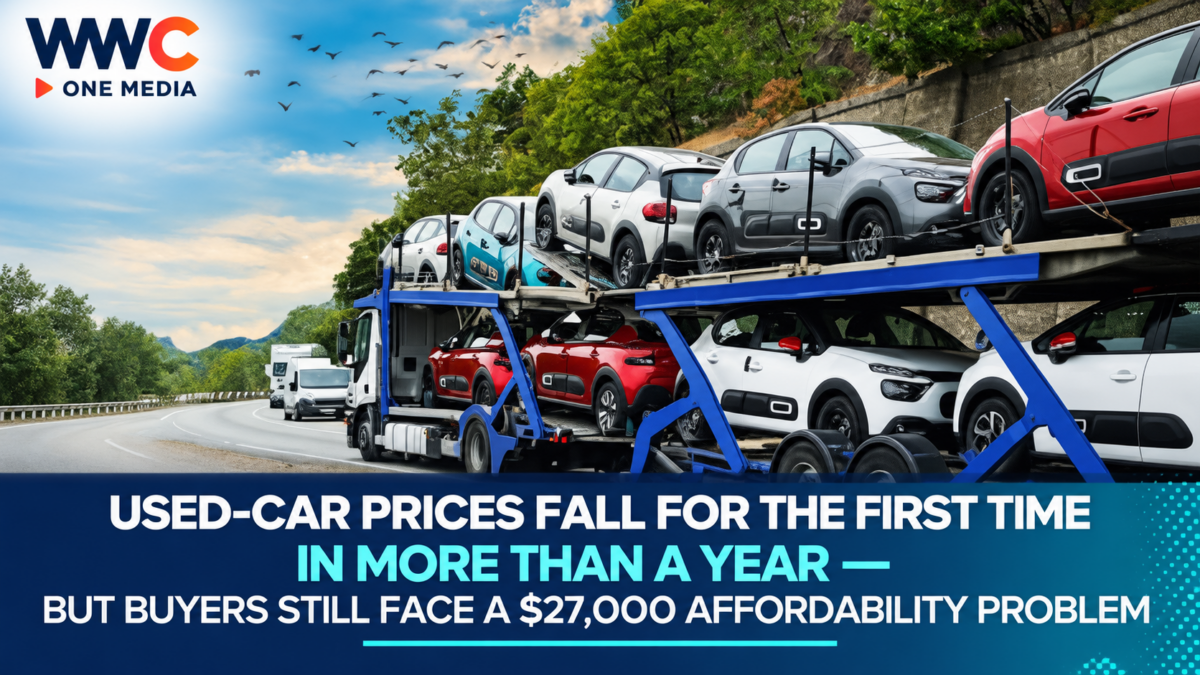
ATLANTA, GEORGIA — America’s used-car market is finally showing signs of cooling, with wholesale vehicle values falling year over year for the first time since early 2025—but consumers looking for relief may be disappointed by what they still face at the dealership.
The Manheim Used Vehicle Value Index fell to 205.9 in September, down 0.6% from a year earlier and 1.1% from August after adjustments for vehicle mix, mileage and seasonality, according to Cox Automotive.
On a non-adjusted basis, wholesale used-vehicle prices declined 1.2% year over year and 1.3% month over month.
That marked a notable reversal after a strong first half of 2026, when used-vehicle values held up better than expected.
But the decline does not mean used cars suddenly became cheap.
In August, the average retail listing price for a used vehicle was still $27,239, up 7% from a year earlier.
And financing remains punishing.
Cox Automotive’s September market data show an average prime used-auto loan rate of about 14.43%, compared with 10.17% for new vehicles.
That creates an uncomfortable contradiction: used-car values are softening at auction, but many consumers are still paying historically high retail prices and extremely expensive interest rates.
Wholesale Prices Fell Faster Than Normal
September is normally a weaker month for used-vehicle prices.
But this year’s decline was steeper than usual.
Cox said the long-term average seasonal movement for September is actually a 0.3% increase in the seasonally adjusted index.
Instead, prices fell 1.1% from August.
Jeremy Robb, chief economist at Cox Automotive, said depreciation was stronger than normal as several economic pressures hit the market simultaneously.
Those pressures included:
- rising interest rates;
- record-high diesel costs;
- weaker consumer sentiment;
- and broader economic uncertainty.
That combination has reduced how aggressively dealers are willing to bid for inventory at wholesale auctions.
Cox Cuts Its 2026 Used-Car Price Forecast
The September decline was strong enough for Cox Automotive to lower its full-year outlook.
The company now expects the Manheim Used Vehicle Value Index to end 2026 just 0.2% higher than a year earlier.
That is a major reduction from the 2% year-over-year increase Cox had forecast in July.
The downgrade suggests the market has lost more momentum than economists expected.
It does not necessarily mean values will continue falling sharply.
But it does indicate that the rebound seen earlier this year has weakened considerably.
Why Wholesale Prices Matter
The Manheim index measures prices paid by dealers and other buyers at wholesale auctions.
It is not the same thing as what consumers pay at dealerships.
But wholesale values matter because they influence dealer acquisition costs.
If dealers can buy cars more cheaply, those savings can eventually flow into retail prices.
The key word is eventually.
Retail pricing often moves more slowly because dealers may still hold inventory purchased at higher prices.
They also need to protect profit margins.
That means consumers may not immediately feel the full benefit of September’s wholesale decline.
Retail Prices Are Still Near Multi-Year Highs
The gap between wholesale and retail prices is one of the most important parts of the story.
In August, the average used-vehicle listing price reached $27,239, the highest level since 2022.
That represented a 7% increase from the same month a year earlier.
So even though wholesale prices have now started falling, the typical advertised used car remains expensive.
This disconnect can persist for weeks or months.
Retail prices usually respond with a lag.
If wholesale weakness continues into the fourth quarter, buyers may finally see more meaningful sticker-price declines.
Financing Costs Could Wipe Out the Price Relief
Even lower sticker prices may not solve the affordability problem.
Used-car buyers are typically more dependent on financing than cash buyers.
That makes interest rates extremely important.
Cox Automotive’s September market snapshot puts the average prime used-auto loan rate at 14.43%.
At that rate, financing a $27,000 used vehicle can produce a much higher monthly payment than many consumers expect.
The problem is particularly severe for borrowers with weaker credit, who can face rates significantly above the prime average.
That means a buyer may negotiate hundreds or even thousands of dollars off the vehicle price and still end up with an expensive monthly payment.
Used Cars Are Supposed to Be the Affordable Alternative
Historically, consumers who could not afford a new vehicle turned to the used market.
That relationship has weakened.
The average transaction price for a new vehicle reached $50,089 in August, while the average used listing price was $27,239.
Used cars are still cheaper in absolute terms.
But their financing costs can be substantially higher.
That can narrow the affordability advantage.
MarketWatch reported this week that used-auto loan rates are around 11% on average across broader consumer categories, while Cox’s prime-market measure is even higher at 14.43% for September.
The exact rate depends on credit quality, lender and loan structure.
But the broader conclusion is clear: borrowing remains expensive.
The Market Is Finally Moving Away From Pandemic Distortions
Used-car prices exploded during the pandemic.
Factory shutdowns, semiconductor shortages and supply-chain disruptions reduced new-car production.
With fewer new vehicles available, buyers moved aggressively into the used market.
Prices surged.
Even after supply chains improved, the market remained distorted because fewer new vehicles had been produced during the shortage years.
That created a smaller pool of two-, three- and four-year-old cars entering the used market later.
Cox says many market indicators are now gradually converging toward more normal pre-pandemic behavior, although the path has been highly uneven.
Three-Year-Old Cars Fell Faster Than Normal
Cox’s data show that its index for three-year-old vehicles declined 1.7% in September.
That was slightly worse than the usual depreciation rate of about 1.5% for this period.
Younger used cars are particularly important because they compete directly with new vehicles.
A three-year-old SUV or pickup can look attractive if the discount from a new model is large enough.
But if new-car manufacturers offer incentives while used financing remains expensive, that equation can change.
Dealers therefore have to price late-model used vehicles carefully.
SUVs, Pickups and Midsize Cars Are Under More Pressure
Not all used vehicles are performing equally.
Cox said midsize cars, pickups and SUVs continued trending lower year over year.
Compact cars and electric vehicles showed more resilience.
That reflects changes in fuel economics.
Large SUVs and pickups can become less attractive when gasoline and diesel prices rise.
Consumers may instead gravitate toward smaller, more efficient vehicles.
That shift is already visible elsewhere in the U.S. auto market.
Reuters reported that hybrid models have gained demand as fuel prices remain elevated, helping Asian automakers such as Toyota and Honda take share.
Electric Used Cars Are Moving in the Opposite Direction
One of the most surprising parts of Cox’s September report was used EV pricing.
The EV component of the Manheim index was up 4.3% year over year and 0.6% from August.
Non-EV prices, by contrast, fell 1.6% year over year and 1.7% month over month.
That makes used EVs one of the strongest pockets of the market.
High gasoline prices are part of the explanation.
Consumers looking to reduce fuel costs may find used electric vehicles increasingly attractive.
EV Supply Is Also Tightening
Cox noted that used-EV days’ supply has declined as demand improved.
Its August data showed used EV inventory at about 42 days of supply.
Tighter supply helps support prices.
This is a sharp contrast with periods when used EVs suffered steep depreciation because of aggressive new-EV discounts and uncertainty over battery values.
The market appears to be changing again.
If fuel prices remain high, used EV demand could stay stronger than the rest of the used market.
Diesel Vehicles Are Getting Hit Hard
Diesel vehicles are facing the opposite problem.
Cox said diesel makes up only a little over 3% of vehicles in the wholesale market, but record diesel prices are putting clear downward pressure on valuations.
Days’ supply for diesel vehicles has also been rising.
That creates a basic affordability problem.
A truck may look cheap to buy but expensive to operate.
When fuel costs increase enough, consumers begin demanding a larger discount upfront.
Dealers then lower bids at auction.
Higher Oil Prices Are Reshaping Vehicle Demand
The change in used-car pricing is closely connected to the wider energy market.
Oil prices have remained elevated amid geopolitical instability, while U.S. fuel costs have risen significantly.
That is affecting the entire auto industry.
Reuters reported last week that Toyota’s hybrid sales jumped sharply as consumers sought more fuel-efficient alternatives.
The same economics apply to used cars.
Fuel-efficient compacts, hybrids and EVs can gain value when operating costs become more important.
Large internal-combustion vehicles can lose value.
Interest Rates Are Hurting Dealers Too
Higher rates do not only affect consumers.
Dealers often borrow money to finance inventory.
That is known as floorplan financing.
When interest rates rise, holding unsold cars becomes more expensive.
Dealers therefore become more cautious about paying high prices at auction.
That can accelerate wholesale depreciation.
It also creates pressure to move inventory faster.
If a vehicle sits too long, carrying costs eat into profit margins.
Treasury Yields Are Adding to the Pressure
The financing environment has become even tougher because long-term U.S. bond yields have risen sharply.
On October 7, long-term Treasury yields climbed to levels not seen in roughly 24 years before easing somewhat later in the session.
That matters because auto-loan rates are influenced by broader borrowing costs.
Higher market rates make it harder for lenders to offer cheap financing.
So even if used-vehicle prices fall, affordability may remain strained if financing continues getting more expensive.
Consumer Confidence Is Weakening
Cox also highlighted weaker consumer sentiment as a major headwind.
Buying a vehicle is one of the largest purchases most households make.
Consumers become more cautious when they worry about employment, inflation or interest rates.
They may keep an existing car longer.
They may choose a cheaper model.
Or they may postpone buying entirely.
That can reduce bidding pressure at wholesale auctions.
Dealers Are Converting Fewer Auction Opportunities Into Sales
Another indicator of softer conditions is the auction sales-conversion rate.
Cox said September sales conversion was 55.2%, down 1.1 percentage points from August and 1.9 percentage points below the recent three-year September average.
That means fewer offered vehicles are successfully selling at auction.
Lower conversion rates generally indicate that buyers and sellers disagree more about price.
Sellers want more.
Dealers are willing to pay less.
Eventually, one side has to adjust.
September suggests sellers are beginning to accept lower values.
Wholesale Supply Is Slightly Higher Than Last Year
Wholesale inventory also increased compared with 2025.
Cox said September wholesale supply stood at 28 days, up 2.4 days from a year earlier.
That is still within normal seasonal ranges.
So the market is not flooded with cars.
But even a modest increase in supply can weaken pricing when demand also slows.
This helps explain why depreciation accelerated in Q3.
Retail Inventory Was Still Tight in August
At the retail level, however, supply remained relatively constrained.
Used-vehicle inventory in August was about 2.13 million units, representing roughly 44 days of supply.
That was one reason listing prices remained elevated.
Retail dealers did not have enough inventory pressure to force aggressive discounting.
If wholesale prices continue falling and inventories rise, the retail market could finally loosen more materially.
Rental Cars Are Another Important Market Signal
Rental-company vehicles also showed unusual strength.
Cox said wholesale rental-vehicle prices were 4.2% higher year over year in September, despite declining 2.2% from August.
One reason is mileage.
Average mileage on rental vehicles entering auction was down 13.4% from a year earlier.
Lower mileage generally supports higher resale values.
Rental fleets are an important source of used-car supply, so changes in fleet replacement patterns can affect the broader market.
No Hurricanes Also Changed September’s Market
Cox identified another unusual factor: September passed without the Atlantic hurricanes that often create a temporary boost in used-vehicle demand.
Storms frequently destroy or damage vehicles, leading households and insurers to replace them quickly.
That can tighten inventory and support wholesale pricing.
With no comparable hurricane-driven replacement demand this September, that seasonal support was absent.
It is a reminder that used-car markets can be affected by factors far outside traditional auto economics.
Buyers Should Not Assume Prices Will Collapse
A 0.6% annual decline in the Manheim index is not a crash.
Wholesale values remain far above pre-pandemic levels.
Retail prices also remain elevated.
And supply is not excessively high.
That makes a dramatic near-term collapse unlikely unless the economy weakens much more severely.
Cox itself expects the full-year index to end roughly flat, not plunge.
The most realistic scenario is a gradual normalization rather than a return to 2019 prices.
High Rates Could Keep Monthly Payments Elevated
For many consumers, the monthly payment matters more than the purchase price.
Consider a hypothetical buyer financing roughly $25,000.
At a much lower interest rate, the payment could be manageable.
At a double-digit used-car rate, the payment rises sharply.
Longer loan terms can reduce the monthly amount, but they also increase total interest expense and the risk that borrowers owe more than the car is worth.
That is why affordability remains strained even while wholesale prices decline.
Negative Equity Remains a Hidden Risk
Consumers who bought vehicles near the peak of pandemic-era pricing can face another problem: negative equity.
If a car loses value faster than the loan balance falls, the owner may owe more than the vehicle is worth.
That makes trading into another vehicle more difficult.
Dealers sometimes roll the unpaid balance into a new loan.
But that increases the amount financed and can trap borrowers in even higher payments.
Falling used-car values can therefore be good for new buyers while creating problems for existing owners.
New Cars Are Not Necessarily a Better Deal
Used-car affordability looks difficult.
But new vehicles are expensive too.
Cox Automotive said the average new-vehicle transaction price climbed to $50,089 in August.
That means a new vehicle still costs almost twice the average used listing price.
However, automakers can offer subsidized financing on new models that used-car dealers cannot easily match.
So the monthly-payment difference between a new and late-model used vehicle can sometimes be smaller than the sticker-price gap suggests.
Consumers increasingly have to compare total financing costs rather than purchase prices alone.
The Market Could Become More Buyer-Friendly in Q4
Several factors could help buyers in the coming months.
Wholesale prices are falling.
Dealer acquisition costs are easing.
Inventory could improve.
And seasonal demand usually softens toward year-end.
If those trends continue, dealers may become more willing to negotiate.
But interest rates remain the largest obstacle.
A buyer getting a cheaper car at a much higher financing rate may not experience meaningful savings.
The Bigger Story Is Affordability, Not Auction Prices
The September Manheim report offers the clearest evidence yet that used-car inflation is finally losing momentum.
Wholesale prices are down year over year.
Depreciation accelerated in the third quarter.
Cox slashed its year-end forecast.
And dealers are becoming more cautious.
That is good news after years of extreme vehicle inflation.
But consumers should not celebrate yet.
The average used vehicle still carries a listing price above $27,000.
Prime used-car loan rates are running above 14%.
And retail prices have not yet fully reflected the drop at wholesale auctions.
The bigger question is therefore not whether used-car prices are finally falling—they are—but whether financing costs will fall fast enough for American households to actually feel the benefit.