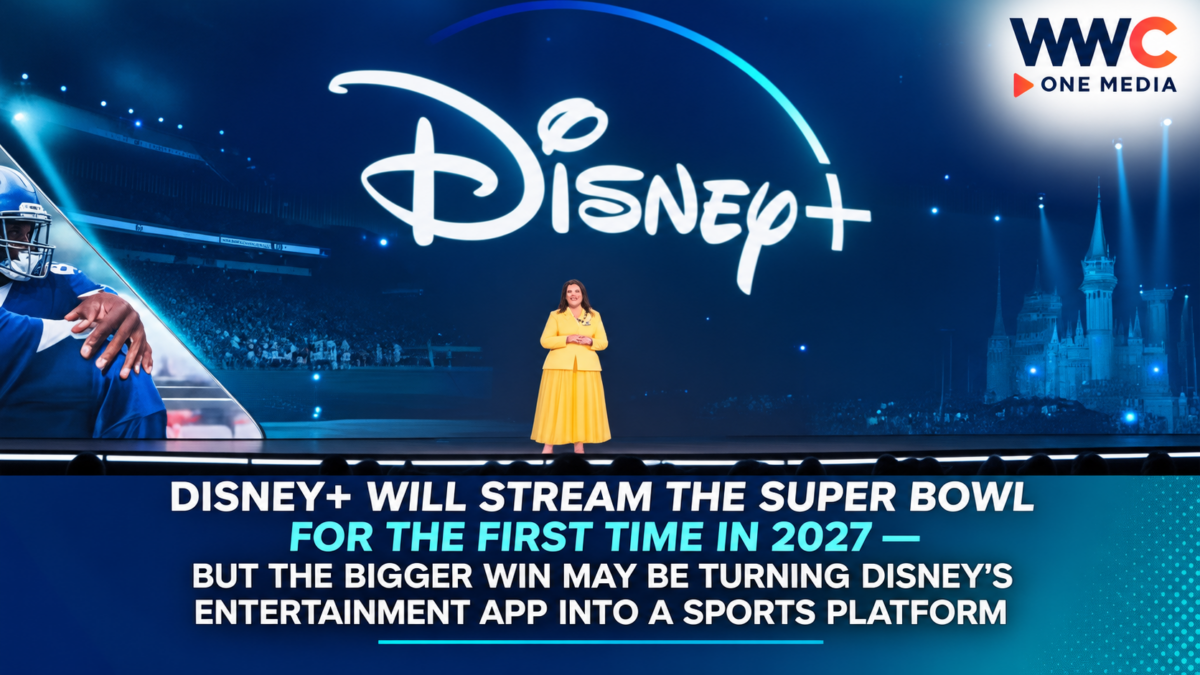
BURBANK, CALIFORNIA — Disney is bringing America’s biggest television event to Disney+ for the first time, turning Super Bowl LXI into a test of whether its flagship streaming service can become a serious home for live sports as traditional television continues to lose viewers.
Disney and ESPN announced that Super Bowl LXI will stream live on Disney+ on February 14, 2027, while continuing to air on ESPN and ABC in the United States.
All U.S. Disney+ subscribers will be able to watch ESPN’s English-language production of the game, while the Spanish-language ESPN Deportes telecast will also be available on the platform.
Internationally, Disney+ will carry the Super Bowl in more than 55 markets, including Latin America, Brazil, the Caribbean, South Africa and Australia/New Zealand, while ESPN’s linear channels will distribute the game in more than 130 countries and territories.
That makes the announcement much more than another streaming simulcast.
Disney is using the NFL’s biggest event to push Disney+ beyond movies, Marvel, Pixar and Star Wars—and toward becoming a broader platform where sports, entertainment and family content live in one app.
Super Bowl LXI Will Be ESPN’s First-Ever Super Bowl
The 2027 game will also mark a major milestone for ESPN.
Although ESPN has carried NFL games for decades, Super Bowl LXI will be the network’s first-ever Super Bowl production.
The game will be played at SoFi Stadium in Inglewood, California, marking the venue’s second Super Bowl in five years.
Disney says Joe Buck and Troy Aikman will call the game, with Lisa Salters and Laura Rutledge also part of the lead broadcast team.
For ESPN, the event is the culmination of what it has branded its “Year of the Super Bowl,” a company-wide campaign that has been running since early 2026.
The company has been building toward the game across ESPN, ABC, Disney properties and other platforms, turning the Super Bowl into a yearlong marketing opportunity rather than a single-night broadcast.
Disney+ Is Getting Monday Night Football Before the Super Bowl
Disney is not waiting until February to introduce more NFL content to Disney+.
Two Monday Night Football games airing on ESPN and ABC will also be made available to Disney+ subscribers this fall.
The first will be the Dallas Cowboys at Philadelphia Eagles on October 26, with a second game to be announced later.
Both English- and Spanish-language broadcasts will be available.
This gives Disney a valuable opportunity to test viewer behavior, streaming reliability and cross-platform promotion before the Super Bowl.
The move also familiarizes Disney+ subscribers with the idea that live sports can sit alongside traditional entertainment in the same app.
ESPN Is Becoming More Important to Disney+
The Super Bowl announcement fits into a much broader expansion of ESPN content on Disney+.
In April, ESPN launched on Disney+ across 53 countries and territories in Europe and Asia-Pacific, adding live sports, studio programming and original content to the service.
With that rollout, ESPN-related content on Disney+ reached approximately 100 international markets.
In selected Asia-Pacific markets—including Japan, Korea, Singapore, Taiwan and Hong Kong—Disney+ subscribers can now access curated ESPN programming directly inside the service.
The Super Bowl gives Disney its most powerful opportunity yet to demonstrate the value of that strategy.
Why Live Sports Matter So Much to Streaming
Movies and television shows can be watched whenever consumers want.
Live sports are different.
Fans usually want to watch them as they happen.
That makes sports especially valuable for media companies because live events can create appointment viewing and reduce subscriber churn.
A customer who might cancel Disney+ after finishing a favorite series may think differently if major sporting events are also available.
That is one reason streaming companies have spent heavily on live sports rights.
Amazon has Thursday Night Football.
Netflix has expanded into live sports and major events.
Apple has invested in Major League Soccer and other programming.
Disney already owns one of the world’s most powerful sports brands through ESPN.
Putting more ESPN content inside Disney+ allows the company to use that advantage more aggressively.
The Super Bowl Remains One of Television’s Most Valuable Assets
Despite the shift toward streaming, the Super Bowl remains one of the strongest properties in traditional television.
Advertisers pay enormous prices because the game attracts a massive simultaneous audience.
That makes it different from ordinary television programming, where audiences are increasingly fragmented across apps and devices.
Disney is therefore not abandoning broadcast television.
Super Bowl LXI will still air on ABC and ESPN.
Instead, it is adding Disney+ as another distribution path.
This hybrid approach allows Disney to serve households that still watch linear television while also reaching cord-cutters and younger viewers who primarily use streaming services.
Disney Is Trying to Avoid an Either-Or Strategy
This is important because the media industry has spent years debating whether streaming would kill traditional television.
Disney’s strategy increasingly suggests the answer may be more complicated.
The company is keeping major events on linear networks while simultaneously making them available digitally.
That reduces the risk of forcing consumers to choose one platform.
It also allows Disney to monetize the same content through multiple channels.
For a media company managing declining cable economics and expensive streaming investments, that flexibility can be valuable.
Traditional Television Is Still Under Pressure
The Super Bowl decision comes as Disney is reassessing its broader television business.
Reuters reported this month that Disney is considering another restructuring of its television operations as traditional networks face continuing revenue pressure from cord-cutting.
The company is reportedly looking at ways to consolidate divisions and align programming more closely with streaming audiences.
That broader restructuring reinforces why Disney+ distribution matters.
Disney cannot assume that cable and broadcast audiences will remain as large as they once were.
Live sports offer a way to move premium content onto streaming without abandoning the reach of traditional TV overnight.
Disney Is Also Licensing More Content to Rivals
Another sign of strategic change came this month when Disney agreed to license a selection of films and television series to Netflix.
The deal includes titles such as the “Ice Age” films and shows including “Percy Jackson and the Olympians” and “Will Trent.”
That would once have seemed counterintuitive.
Streaming companies originally competed by locking content inside their own platforms.
Now media companies are becoming more willing to license programming to rivals when doing so generates attractive economics.
Disney’s Super Bowl strategy follows the same broader principle.
The company is becoming more flexible about where content appears—as long as distribution strengthens the business.
The NFL Has Also Embraced Streaming
Disney is not making this shift alone.
The NFL has spent years expanding its digital distribution.
Its long-term media deals include traditional broadcasters as well as Amazon Prime Video, which became the exclusive national home of Thursday Night Football.
The league’s strategy is to preserve mass reach while following viewers onto new platforms.
That approach has allowed it to remain one of the most valuable properties in American entertainment even as the television industry changes around it.
The Super Bowl on Disney+ is another step in that evolution.
Spanish-Language Distribution Is Expanding Too
Super Bowl LXI will also have unusually broad Spanish-language availability.
ESPN Deportes will produce one Spanish-language telecast.
TelevisaUnivision will separately produce and air another Spanish-language presentation on Univision in the United States under an agreement announced earlier this year.
That means Spanish-speaking viewers will have multiple ways to watch.
For Disney and the NFL, that matters because Hispanic audiences represent an increasingly important part of U.S. sports consumption.
Expanding Spanish-language access could help the league grow further with those viewers.
Disney+ Could Gain a Powerful Subscriber-Retention Tool
The Super Bowl by itself will not transform Disney+ economics.
It is a one-day event.
But its strategic value lies in what it teaches subscribers to expect.
If users begin to think of Disney+ as a place where major live sports also appear, the service becomes harder to categorize as simply an entertainment library.
That can improve retention.
It can also increase the perceived value of bundled offerings involving Disney+, Hulu and ESPN.
Over time, this could help Disney reduce churn and support higher subscription prices.
The Bundling Strategy Is Becoming Clearer
Disney’s long-term streaming strategy increasingly revolves around combining entertainment and sports.
Instead of asking consumers to subscribe to multiple unrelated services, Disney can create bundles that make the whole portfolio feel more valuable.
Disney+ provides family and franchise entertainment.
Hulu adds general entertainment.
ESPN provides sports.
The Super Bowl is one of the strongest possible marketing tools for showing how those pieces can work together.
If consumers use Disney+ to watch the NFL and then stay for entertainment content—or vice versa—the company gains more value from the same subscriber relationship.
Disney’s First Super Bowl Comes at an Important Time for ESPN
ESPN itself is undergoing a major transformation.
The sports network has historically depended heavily on pay-TV affiliate fees.
Cord-cutting has weakened that model.
ESPN has responded by expanding direct-to-consumer access and integrating more aggressively with Disney’s streaming infrastructure.
The 2026-27 NFL season is already ESPN’s largest NFL portfolio ever, including Monday Night Football, postseason games and NFL Network programming.
Super Bowl LXI gives ESPN an opportunity to prove that it can maintain premium broadcast quality while reaching audiences across multiple platforms simultaneously.
Streaming the Super Bowl Also Raises Technical Stakes
A Super Bowl stream presents technical challenges on a scale few events can match.
Millions of viewers could try to access the feed at the same time.
Streaming delays, buffering or outages would attract immediate criticism.
That gives Disney strong incentive to test systems well in advance.
Making Monday Night Football games available on Disney+ before February allows the company to evaluate streaming performance under meaningful live-sports traffic.
But no regular-season game matches the audience intensity of the Super Bowl.
The 2027 broadcast will therefore become a major test of Disney’s streaming infrastructure as much as its programming strategy.
Disney Has a Global Opportunity That Broadcast Alone Cannot Match
One of the strongest advantages of Disney+ is international reach.
Traditional U.S. broadcast networks are geographically limited.
Streaming platforms can distribute content across dozens of markets within the same technological ecosystem.
For Super Bowl LXI, Disney+ will carry the game in more than 55 international markets while ESPN linear networks reach more than 130 countries and territories.
That gives Disney a chance to use the Super Bowl as an international subscriber-engagement event.
It also supports the NFL’s ambition to grow outside the United States.
International NFL Growth Is Becoming More Important
The NFL has steadily expanded its overseas schedule.
Games have been played in London, Germany, Brazil and other markets, with ESPN’s 2026-27 schedule also including international games from London, Madrid and Paris.
Streaming can accelerate that strategy because international viewers are less tied to U.S. broadcast networks.
Disney+ provides an existing consumer platform that can introduce casual audiences to the league without requiring a separate sports subscription in every market.
The Super Bowl is the obvious flagship event for that effort.
Disney Is Blurring the Line Between Entertainment and Sports
The company has already been marketing its first Super Bowl using Disney characters and franchises.
Its “We’re Going” campaign included characters from Pixar, Marvel, Star Wars, Frozen, The Simpsons, The Muppets and other Disney properties.
That shows how Disney thinks about the Super Bowl differently from a pure sports network.
It can connect the event to its entire entertainment ecosystem.
Few competitors have that combination of sports rights and global franchise characters.
The strategy allows Disney to turn the Super Bowl into a company-wide cultural event rather than simply another football game.
The Media Industry Is Moving More Major Events Online
Disney’s announcement is part of a much bigger industry trend.
Major live events that were once considered inseparable from traditional broadcast television are increasingly moving toward streaming.
Reuters reported this week that the Emmy Awards will leave traditional U.S. broadcast television for Amazon Prime Video starting in 2027 under a six-year deal.
The Oscars are also scheduled to move to YouTube later in the decade.
These moves demonstrate that streaming platforms are increasingly competing for events once considered core broadcast-TV assets.
The Super Bowl remains different because Disney is keeping it on ABC and ESPN.
But adding Disney+ shows that even television’s biggest event is no longer confined to linear distribution.
Broadcast TV Is Not Dead Yet
It would be a mistake to interpret the move as Disney abandoning ABC.
ABC remains important because broadcast television can still reach huge audiences without requiring a paid streaming subscription.
The Super Bowl’s advertising value depends partly on maximizing reach.
That makes simulcasting strategically logical.
Disney gets the audience scale of ABC, the sports identity of ESPN and the digital reach of Disney+ at the same time.
This three-platform model could become increasingly common for premium sports rights.
The Bigger Battle Is Over Consumer Attention
Ultimately, Disney is not simply competing with CBS, NBC or Fox.
It is competing with Netflix, YouTube, TikTok, Amazon, Apple and every other service trying to capture consumer time.
Live sports remain one of the few forms of content capable of creating enormous simultaneous audiences.
That makes the NFL especially valuable.
A viewer can postpone watching a television drama.
A football fan usually does not want to watch the Super Bowl three days later.
That urgency gives live sports a power most entertainment content no longer has.
Super Bowl LXI Could Become a Blueprint for Disney’s Streaming Future
Disney’s decision to put the game on Disney+ is therefore more important than it first appears.
It gives subscribers another way to watch one of the world’s largest sporting events.
It helps ESPN expand beyond its traditional television distribution.
It strengthens Disney+ internationally.
And it allows Disney to connect sports with its entertainment franchises and bundles.
The Super Bowl is not leaving television in 2027.
It is expanding beyond television.
And that distinction could define the next phase of sports media.
Disney is betting that the future is not ESPN versus Disney+, or streaming versus broadcast.
The bigger bet is that audiences will increasingly expect all of those experiences to exist together—and Super Bowl LXI may be the event that finally proves whether that model works at global scale.