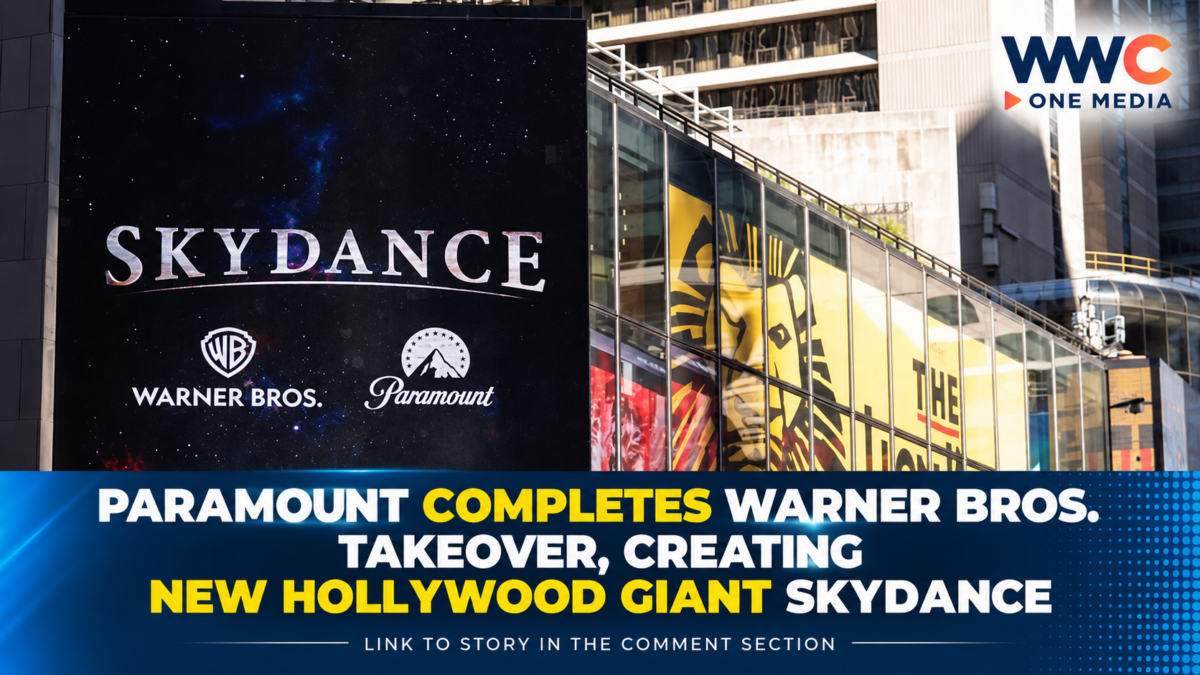
Paramount has completed its $81 billion acquisition of Warner Bros. Discovery, bringing two of Hollywood’s biggest entertainment businesses under one roof and creating a new media giant called Skydance.
The transaction officially closed on Oct. 6, marking one of the largest mergers in entertainment history. Including debt, the overall value of the deal is close to $111 billion.
The newly combined company places an extraordinary collection of Hollywood studios, television networks, streaming platforms, sports properties and entertainment franchises under the leadership of Skydance CEO David Ellison and co-CEO Ynon Kreiz.
Among the properties now under the same corporate umbrella are Paramount Pictures, Warner Bros., HBO Max, Paramount+, CBS, CNN, Nickelodeon, DC, Warner Bros. Games and a vast collection of film and television libraries.
A New Hollywood Powerhouse
The merger combines two companies with more than a century of entertainment history.
Paramount brings major franchises including Mission: Impossible, Top Gun, Star Trek and The Godfather, while Warner Bros. contributes properties such as Harry Potter, Batman, Superman, The Lord of the Rings and Game of Thrones.
The combination also brings together two major streaming businesses: Paramount+ and HBO Max.
CBS and CNN will now sit within the same corporate group, alongside an extensive collection of cable channels, sports operations and other entertainment businesses.
Skydance said the combined company expects to have more than 200 million streaming subscribers across its platforms and reach audiences in more than 200 countries and territories.
The company has also committed to producing at least 30 theatrical films annually, alongside more than 180 television shows and series.
David Ellison Takes Control
The new company is being led by David Ellison, the son of Oracle co-founder Larry Ellison and founder of Skydance Media.
Skydance originally built its reputation as a production company behind major films and television projects before becoming increasingly involved in the ownership and management of Paramount.
Skydance acquired Paramount last year for about $8 billion before pursuing Warner Bros. Discovery.
What followed was a months-long battle over Warner’s future, with Netflix initially emerging as the preferred buyer before Paramount ultimately increased its offer and secured the deal. Paramount and Warner reached a merger agreement in February.
Ellison described the completion as a historic moment for Skydance and the entertainment industry.
The new company begins trading on the New York Stock Exchange under the ticker SKYD, while Warner Bros. Discovery shares have ceased trading on Nasdaq.
Netflix Was Once in the Picture
Warner Bros. Discovery’s sale became one of the most closely watched corporate battles in Hollywood.
Warner initially reached an agreement with Netflix covering its studios and streaming operations in December. Paramount subsequently launched a competing effort to acquire the entire company.
For much of early 2026, Paramount and Netflix competed over Warner’s future.
Netflix eventually withdrew from the bidding after Paramount raised its offer to $31 per share. Warner and Paramount subsequently entered into a mutual merger agreement in late February.
The eventual acquisition gives Skydance a far broader portfolio than the company had before the transaction.
Merger Faced Hollywood Opposition
The deal was not without controversy.
Thousands of actors, writers, directors and other entertainment professionals publicly opposed the merger, arguing that further consolidation could reduce employment opportunities, competition and creative diversity.
Critics also warned that bringing so many major franchises and distribution platforms together could give the new company enormous influence over what audiences watch and how entertainment is distributed.
The merger also faced legal challenges.
In July, Democratic attorneys general from 12 US states sued to block the transaction, arguing that the combination could reduce competition and consumer choice. The Writers Guild of America also filed a lawsuit opposing the deal.
Settlements reached in September helped clear the remaining legal obstacles.
Among the commitments were increased US film production over the next five years, funding intended to support workers displaced by the merger and additional editorial oversight involving CNN and CBS.
Gulf Investors Backed the Deal
The transaction also attracted scrutiny because of its financing.
Paramount secured billions of dollars in financial backing from investors in Saudi Arabia, Qatar and the United Arab Emirates.
US regulators approved arrangements allowing the Gulf investors to hold significant indirect economic interests in the combined company, while the investors would not receive voting rights.
Critics, including Democratic FCC Commissioner Anna Gomez, raised concerns about the potential for foreign financial influence over a major US media business.
Paramount has argued that the additional capital strengthens the company and supports its ability to compete in an increasingly challenging global entertainment market.
Can Skydance Compete With Netflix and Disney?
The biggest question now is whether the enormous new company can turn its scale into sustainable growth.
Skydance enters the market with a huge collection of intellectual property, two major streaming platforms, broadcast television, cable networks, film studios, sports rights and news operations.
But it also inherits significant debt and faces an entertainment industry undergoing rapid structural change.
Traditional cable television continues to decline as viewers move toward streaming, while Netflix, Disney, Amazon and Apple have invested heavily in content and technology.
Skydance estimates the combined company will generate nearly $70 billion in annual revenue and is targeting at least $6 billion in recurring cost savings within three years. It also expects to spend more than $30 billion on content based on its latest 12-month period.
The company expects to use technology, procurement, marketing and real-estate consolidation to generate much of those savings.
What Happens to HBO Max and Paramount+?
One of the biggest changes for consumers could eventually involve the two streaming services.
Skydance says HBO Max and Paramount+ will ultimately be unified into a single direct-to-consumer streaming service, although the integration will take time.
That could create one of the largest entertainment libraries available through a single platform, combining Warner’s television and film catalogue with Paramount’s extensive collection.
For viewers, that could mean easier access to major franchises under one subscription.
But it could also raise questions about pricing, advertising, content availability and whether the combined service will eventually cost more than either platform does today.
A New Era for Hollywood
The Paramount-Warner merger represents another major step in Hollywood’s transformation from a collection of competing traditional studios into a smaller group of enormous entertainment conglomerates.
The new Skydance controls an unusually broad collection of brands — from Harry Potter and DC superheroes to Top Gun, Star Trek, SpongeBob SquarePants and Mission: Impossible. It also controls major news organisations, sports properties and streaming platforms.
Whether that scale becomes an advantage or a burden will depend on how effectively Ellison and his management team integrate the two companies.
For now, one thing is certain: two of Hollywood’s most recognisable names are no longer separate corporate powers.
They are now part of Skydance, one of the world’s biggest entertainment companies.