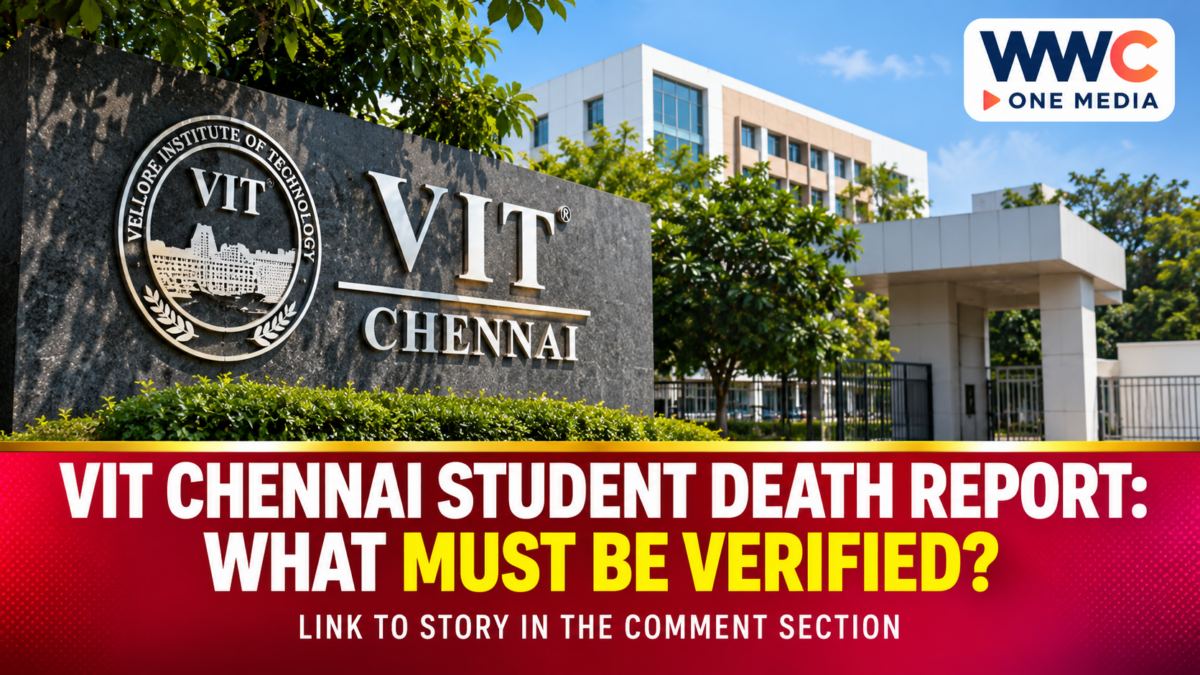
CHENNAI, India — Nov. 21, 2026. A Nov. 19 report concerning the death of a student associated with Vellore Institute of Technology’s Chennai campus has raised questions about the facts available to families and the public. The VIT Chennai student death report cannot yet be certified as a case-specific news account by WWC because a directly inspectable police incident note, authorised medical finding or university statement has not been obtained.
The immediate public interest lies in establishing an accurate record and understanding what welfare and grievance systems a university says it maintains. Neither an allegation about academic discipline nor a theory about a student’s state of mind should be treated as a verified explanation for a death.
VIT Chennai Student Death: What Is Not Yet Established
The initial report describes a 19-year-old engineering student found dead on Nov. 19. Those identifying details and the reported circumstances are derived from secondary coverage, not from an original record independently inspected for this review. They remain leads, not authenticated facts in this draft.
A case-specific police record could establish when and where officers were informed, the procedural status of the investigation and whether a medical examination was ordered. An authorised medical statement could clarify what has been determined, without relying on speculation or details circulated online.
The reported examination-related allegation has not been established through a directly inspected disciplinary notice, police document or university statement. Its repetition could wrongly imply a causal relationship that no verified record has demonstrated.
Analysis: The reporting standard is especially important when the deceased is a young person. Public curiosity does not justify publishing an unconfirmed motive, disciplinary accusation or private family detail.
What VIT Chennai’s Published Policies Actually Show
VIT Chennai’s institutional disclosures describe an Institutional Students’ Grievance Redressal mechanism. The institution says it receives complaints relating to academic issues, interactions between students and teachers, campus services and student conduct. Its published procedure describes recording, registering and examining grievances.
Those policies identify intended institutional processes. They do not demonstrate that any student involved in this reported incident sought help, faced a formal inquiry, received counselling or had a grievance considered. Such conclusions require a case-specific authenticated record.
The university’s own administrative descriptions also identify a counselling division, while its student-welfare materials discuss support for campus life. A listed service is not proof of its availability to a particular individual at a particular moment.
WWC previously reported on the limits of publicly established evidence in a Perak boarding-school death investigation. That Malaysian case is separate, but the same editorial rule applies: published procedures and actual case findings must not be confused.
Why Academic Discipline Cannot Be Assumed to Explain a Death
Universities may have rules for examinations and grievance handling. But a suggestion that academic consequences caused a person’s death is a serious factual claim requiring more than an unverified report of a prior incident.
Even if a disciplinary process were eventually confirmed, that would not alone establish a person’s intentions or a medical cause of death. Investigators would need to evaluate relevant evidence, while the institution could separately examine whether it followed its procedures.
Analysis: Responsible accountability asks whether fair processes, communications and access to support function as intended. It does not assign blame through an imagined explanation of a student’s private thoughts.
WWC’s coverage of the separate Negeri Sembilan school-hostel proceedings illustrates a different procedural stage: formal charges can be reported as charges, not convictions. There is no verified basis to transfer any allegation from that case to Chennai.
What India’s Higher-Education Rules Require
India’s University Grants Commission publishes the Redressal of Grievances of Students Regulations, 2023 in its official collection of student-centred rules. That framework sits alongside an institution’s internal complaint and appeal channels.
A university’s publicly documented grievance arrangements provide a basis for asking practical questions: Can students identify the correct channel? Is the process accessible? Are decisions communicated clearly? Are appeals or independent review mechanisms available? Those are institutional accountability questions, not allegations of a specific breach.
VIT Chennai’s 2024–2025 mandatory disclosures identify grievance arrangements and an ombudsman role. The disclosures describe mechanisms designed to consider student complaints fairly. They do not establish what occurred in the reported Nov. 19 incident.
In a separate Philippine case, WWC examined the continuing uncertainty surrounding an Ateneo law student’s death. That article concerns different people and circumstances; its relevance here is only the need to avoid conclusions before an official investigation is complete.
Privacy, Welfare and Reporting After a Campus Death
A family’s privacy and the dignity of the deceased should shape what a newsroom publishes. Unless an authorised original record and a clear public-interest need justify disclosure, personal contact information, private messages, medical history and identifying photographs should be withheld.
Campus administrators may need to communicate with residents, explain available support and cooperate with relevant authorities. But a news report should distinguish what a university’s general policy promises from what it has actually confirmed doing in this case.
There is also an important difference between an early death report and a completed determination. Police procedures, forensic examinations and institutional reviews may operate on different timetables. A first account should not be labelled definitive merely because it was widely repeated.
Analysis: The strongest follow-up will be documentary rather than speculative: a verified chronology, the investigation’s status and a transparent account of any institutional measures that can appropriately be made public.
What Happens Next
Before reporting the incident as confirmed, WWC needs an original Nov. 19 or later police statement, any appropriately released medical finding, and an attributable response from VIT Chennai. The newsroom should also verify whether officials have disclosed an investigation outcome or corrections to the initial account.
Until those records are obtained, the available primary material supports an article about VIT’s published student-support systems and India’s grievance framework, but not an assertion about why this student died. The case remains on editorial hold.
Frequently Asked Questions
1. Has the cause of the reported VIT Chennai student’s death been verified?
No original police conclusion or authorised medical finding was directly inspected for this review. The cause must not be inferred from secondary reporting.
2. Was the student involved in an examination disciplinary case?
The allegation appears in secondary coverage. No original university notice or police document was directly obtained to verify it, so it is not treated as fact.
3. Does VIT Chennai publish student grievance procedures?
Yes. Its institutional disclosures describe grievance channels, handling procedures and an ombudsman arrangement. Those general procedures do not establish what occurred in an individual case.
4. What national rules address student grievances in India?
The University Grants Commission lists its Redressal of Grievances of Students Regulations, 2023, among its student-centred regulations.
5. What must WWC confirm before publishing a case report?
The original police record, any released medical conclusion, the institution’s attributable statement and the current investigative status.