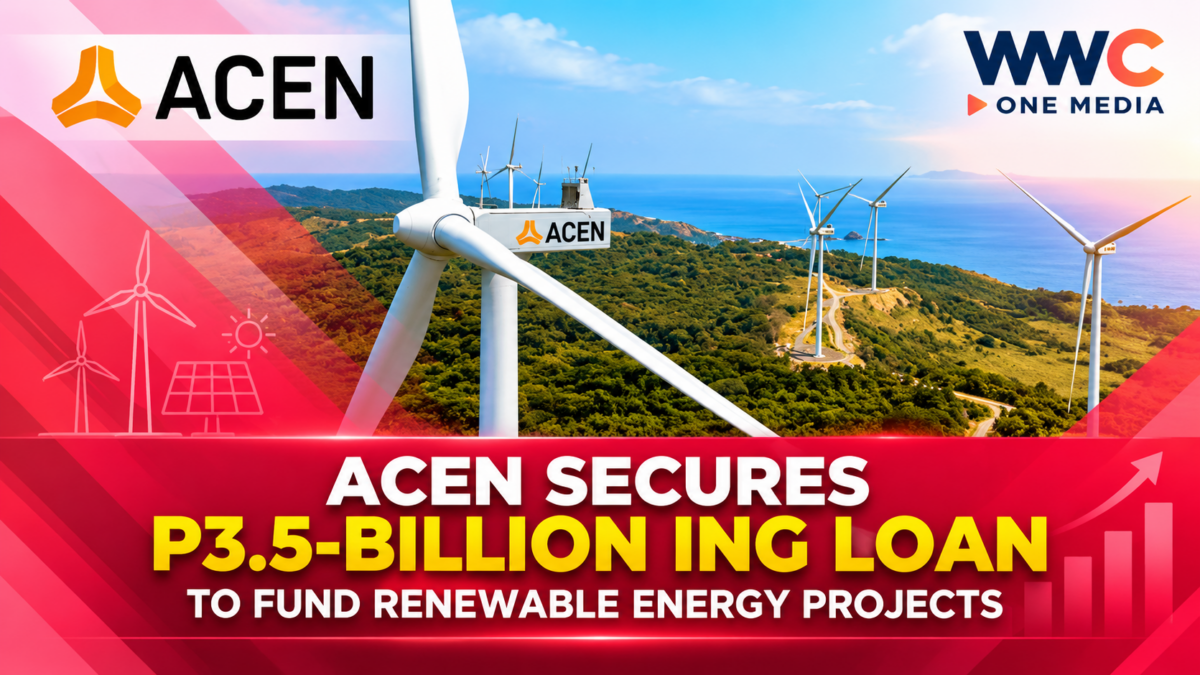
MANILA, Philippines — ACEN Corp., the renewable energy platform of the Ayala group, has secured a €50-million term loan facility from ING Bank, equivalent to about P3.5 billion, to finance and refinance renewable energy investments as the company continues expanding its clean-power portfolio in the Philippines and overseas.
The facility was signed by ACEN Investments, Inc., a subsidiary of ACEN, with ING Bank N.V., Manila Branch as lender and ING Bank N.V., Singapore Branch acting as agent.
According to a disclosure filed with the Philippine Stock Exchange, the proceeds will be used for investments in and advances to existing and future renewable energy projects through ACEN’s subsidiaries and joint ventures. The facility may also be used for general corporate purposes.
The latest borrowing gives ACEN additional financing capacity as it pursues a large pipeline of solar, wind, geothermal and battery-storage projects across several markets.
Loan to support existing and future projects
Unlike project-specific financing, ACEN did not identify particular renewable energy facilities that will receive the proceeds.
Instead, the company said the €50-million facility can be used to finance or refinance investments in existing and future renewable energy projects developed through its subsidiaries and joint ventures.
The flexibility allows ACEN to allocate capital according to project requirements as developments move through construction and operating stages.
The company also did not disclose the interest rate, maturity or other commercial terms of the facility in its PSE filing.
For renewable energy developers, access to long-term financing is particularly important because solar, wind and other clean-energy projects require substantial upfront capital before generating operating revenues.
ACEN’s renewable portfolio reaches 7,517 MW
The new financing comes as ACEN continues to expand its renewable energy portfolio.
As of the first half of 2026, the company had 7,517 megawatts (MW) of attributable renewable energy capacity, with about 57% already operational, according to its latest financial results.
Attributable renewable generation reached 4,024 gigawatt-hours (GWh) in the first six months of the year, up 21% from a year earlier.
ACEN’s core attributable EBITDA also increased by 40% to P14.7 billion, while consolidated net income surged 411% year on year to P3.9 billion.
The company said the improvement was driven by higher renewable generation across its markets, newly operational assets, stronger contracted energy sales and growth in its retail electricity supply business.
Expansion spans several renewable technologies
ACEN’s growth strategy is not limited to solar power.
The company has investments in solar, wind, geothermal and battery energy storage, giving it a diversified renewable energy portfolio.
In the Philippines, ACEN’s projects include solar facilities in Laguna, Pampanga, Zambales and northern Luzon, wind projects in Ilocos Norte and Guimaras, geothermal capacity in Batangas and battery storage in Laguna.
The company is also developing renewable energy projects in markets including Australia, Vietnam, India, Indonesia and other parts of the Asia-Pacific region.
This geographic and technological diversification is intended to support ACEN’s long-term growth while increasing the amount of clean electricity it can generate.
Zambales becomes major clean-energy hub
One of ACEN’s largest current Philippine development areas is Zambales, where the company is building a renewable energy hub with nearly 1 gigawatt of solar and battery capacity.
The portfolio includes the 585-MW SanMar Solar project and the 363-MW Palauig Solar project.
Together, the two solar developments represent 948 MW of capacity, with about 450 MW already operational and the remaining capacity under construction and expected to be completed by 2027, according to ACEN.
ACEN has also been investing in transmission infrastructure to connect its projects to the Luzon grid.
The company said it had completed about 14 kilometers of transmission infrastructure for its Zambales developments, with another 22 kilometers under construction as of July.
Financing remains crucial for renewable expansion
The ING facility is part of a broader financing strategy that has seen ACEN work with both Philippine and international financial institutions.
The company has previously secured loans and sustainability-linked financing from institutions including the Asian Development Bank, Bank of the Philippine Islands, LandBank and Metrobank.
ACEN’s own financing disclosures show that its renewable expansion has increasingly been supported by green and sustainability-linked debt structures, in addition to conventional corporate borrowing.
Such financing can help renewable developers spread the substantial capital requirements of new projects over longer periods while matching debt funding with the expected cash flows from operating assets.
ACEN continues to build beyond the Philippines
The latest ING facility also comes as ACEN expands its renewable energy footprint internationally.
The company has been pursuing projects across the Asia-Pacific region, where it sees opportunities in markets with growing electricity demand and government support for clean-energy investment.
Its portfolio includes large-scale solar and wind developments as well as energy-storage projects, allowing ACEN to participate in different segments of the energy transition.
The company has previously set a target of expanding its attributable renewable energy capacity beyond 8 GW, with additional projects expected to move into construction and operation.
More financing could support project pipeline
The €50-million ING facility does not represent a commitment to a single new power plant. Instead, its broader mandate gives ACEN Investments greater flexibility in financing projects as they progress.
That could include refinancing existing investments, funding advances to subsidiaries and joint ventures, or supporting new renewable projects that enter development and construction.
For ACEN, the timing is significant. The company is simultaneously experiencing strong growth in renewable generation while committing substantial capital to new capacity.
The company’s first-half results showed that its existing renewable portfolio is already contributing significantly to earnings, while its project pipeline continues to expand.
Another step in the Philippines’ clean-energy expansion
The P3.5-billion equivalent ING facility adds another source of capital for ACEN as it works to increase renewable energy capacity and strengthen its presence across multiple markets.
While the company has not identified specific projects that will be funded by the loan, the financing provides additional flexibility for its subsidiaries and joint ventures to advance both existing and future developments.
For the Philippine power sector, ACEN’s continued investment also comes as electricity demand rises and the country seeks to increase renewable energy’s contribution to its power mix.
With thousands of megawatts of renewable capacity already operating or under development, the company is positioning financing, construction and grid infrastructure as interconnected parts of its expansion strategy.
The latest ING loan is therefore another piece of ACEN’s broader effort to turn its growing renewable energy pipeline into operating clean-power assets across the Philippines and the wider region.