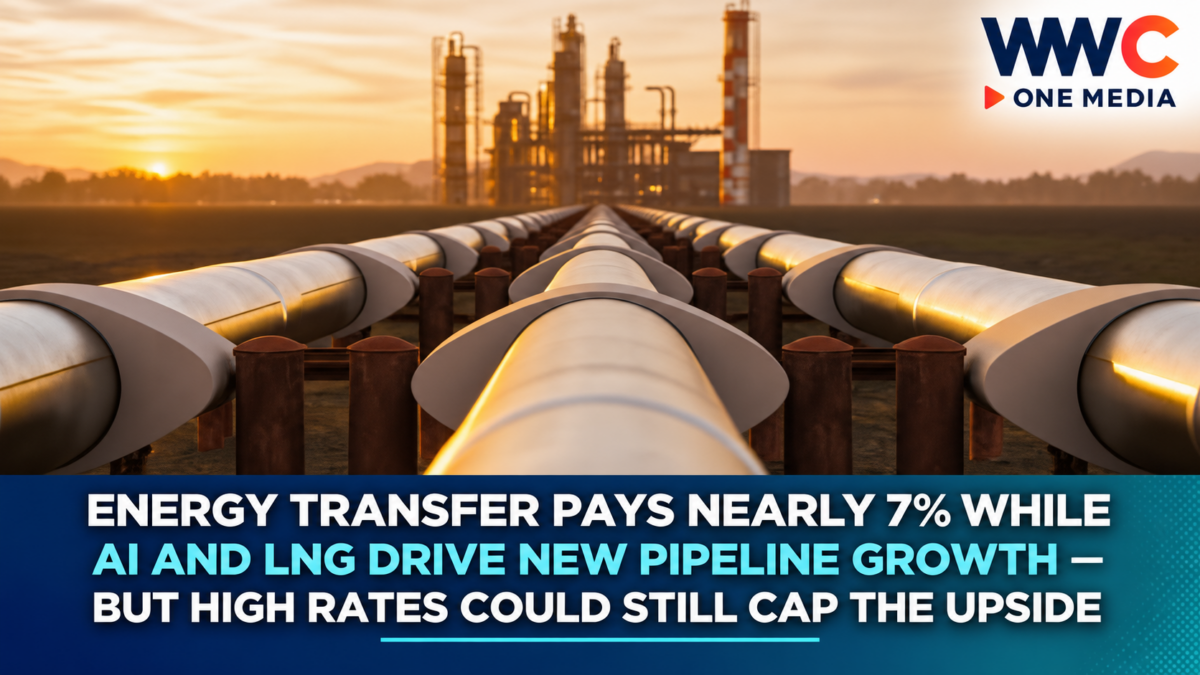
DALLAS, TEXAS — Energy Transfer is emerging as one of Wall Street’s more unusual energy trades: a pipeline giant offering investors a distribution yield near 7% while simultaneously expanding into some of the fastest-growing corners of the U.S. energy economy.
The Dallas-based midstream operator controls roughly 140,000 miles of pipelines and related infrastructure across 44 states, connecting major oil, natural-gas and natural-gas-liquids producing regions with processing plants, export terminals and end markets.
CNBC contributor Tim Seymour described Energy Transfer as a rare “dual-threat” stock—one capable of generating income through its large cash distribution while also offering growth as U.S. electricity demand, LNG exports and data-center construction increase the need for natural-gas infrastructure.
That thesis received another boost this week when Energy Transfer agreed to acquire Vaquero Midstream for approximately $2.625 billion, adding gas-gathering and processing assets in the Delaware Basin.
The acquisition strengthens Energy Transfer’s exposure to one of the most productive areas of the Permian Basin at a time when AI data centers are helping push U.S. electricity consumption to record levels.
But investors should not confuse a high yield with a low-risk investment.
Energy Transfer’s story depends on strong cash flow, disciplined capital spending, continued natural-gas demand and an interest-rate environment that does not make safer fixed-income alternatives too attractive.
Why Energy Transfer Is Different From an Oil Producer
Energy Transfer is not primarily a company that drills wells.
Its business is moving, gathering, processing, storing and exporting hydrocarbons.
That distinction matters because midstream companies are generally less directly exposed to day-to-day swings in commodity prices than exploration and production companies.
Energy Transfer often earns fees for transporting natural gas, crude oil and natural-gas liquids through its infrastructure.
In simple terms, it can function more like a toll-road operator than a producer betting directly on the price of oil.
Its investor materials emphasize that a large share of earnings is fee-based and diversified, with no single segment contributing more than 30% of the business.
That can make cash flow more predictable.
It does not eliminate commodity risk completely, but it reduces the company’s dependence on any single oil or gas price.
The Yield Is the First Attraction
One of Energy Transfer’s biggest attractions is income.
The partnership has been offering a cash-distribution yield of roughly 7%, according to company investor materials and CNBC’s analysis.
That is significantly higher than the dividend yield of the S&P 500.
For investors seeking income, that can be appealing because they are paid while waiting for expansion projects and acquisitions to contribute additional growth.
Energy Transfer also says it is targeting 3% to 5% long-term annual distribution growth.
The company announced its 19th consecutive quarterly distribution increase in July.
That creates a potential compounding story.
If cash flow rises and the distribution grows, investors can benefit from both income and capital appreciation.
But a 7% Yield Is Not the Same as a 7% Treasury
This is one of the most important distinctions in the story.
Energy Transfer’s distribution is not guaranteed in the same way as interest on a U.S. Treasury security.
Partnership distributions depend on operating cash flow, leverage, capital requirements and management decisions.
The stock price can also fall.
That means the true return for an investor depends on both the cash distribution and the market value of the units.
CNBC’s Seymour specifically identified high interest rates as a major risk.
If investors can earn 4% or 5% from relatively low-risk government debt, the extra return offered by a 7% pipeline yield may not look as attractive once equity and business risk are considered.
Energy Transfer’s Earnings Have Been Growing
The recent operating numbers are strong.
For the second quarter of 2026, Energy Transfer reported $5.07 billion in adjusted EBITDA, up 31% from $3.87 billion a year earlier.
Distributable cash flow attributable to partners rose 32% to $2.59 billion, from $1.96 billion in the same quarter of 2025.
Net income attributable to partners reached $2.09 billion, compared with $1.16 billion a year earlier.
The strength prompted management to raise full-year adjusted EBITDA guidance to $18.8 billion to $19.1 billion, up from a previous forecast of $18.2 billion to $18.6 billion.
These numbers are important because they show the distribution is being supported by rising operating cash flow rather than merely financial engineering.
Vaquero Adds More Permian Exposure
The acquisition of Vaquero Midstream is the latest growth move.
Energy Transfer agreed to pay approximately $1.95 billion in cash plus about 33.3 million newly issued common units, valuing the transaction at roughly $2.625 billion.
Vaquero operates about 300 miles of pipeline infrastructure in the southern Delaware Basin.
Its Caymus Processing Complex includes three natural-gas processing plants with combined capacity of approximately 675 million cubic feet per day.
The assets are backed by customers with roughly 100,000 dedicated acres and average contract lives of about 10 years.
Energy Transfer says the deal should be immediately accretive to distributable cash flow per common unit.
The transaction is expected to close during the fourth quarter of 2026, subject to customary conditions.
The Deal Fits Energy Transfer’s Existing Network
Vaquero is especially attractive because the assets connect naturally with Energy Transfer’s broader system.
Gas gathered and processed in the Delaware Basin can feed downstream pipelines, natural-gas-liquids infrastructure, fractionation facilities, export terminals and other assets already owned by the company.
That creates what the industry calls integration.
A molecule entering one part of the Energy Transfer network can potentially generate fees multiple times as it moves through gathering, processing, transportation and export infrastructure.
This is one of the reasons large midstream companies can create more value from acquisitions than a standalone buyer.
The acquired assets can feed existing systems rather than operate independently.
AI Is Becoming an Energy Story
One of the most important growth drivers may come from outside the traditional energy industry.
Artificial intelligence is consuming enormous quantities of electricity.
Data centers require power not only for processors but also for cooling, networking and backup infrastructure.
The U.S. Energy Information Administration expects electricity consumption to reach new records in both 2026 and 2027, driven in part by AI and cryptocurrency data centers.
U.S. power use is projected to rise from 4,195 billion kilowatt-hours in 2025 to 4,288 billion in 2026 and 4,356 billion in 2027.
That growth is significant because America had spent years with relatively stagnant electricity demand.
AI is changing the equation.
Natural Gas Still Plays a Major Role in Power Generation
Renewables are expanding rapidly.
But natural gas remains one of the largest sources of U.S. electricity.
It can provide dispatchable power when solar or wind generation is insufficient.
The EIA expects natural gas to remain a major part of the generation mix even as renewable energy expands from 24% of electricity generation in 2025 to around 27% in 2027.
That creates a direct opportunity for companies such as Energy Transfer.
More gas-fired generation requires more pipeline capacity.
More pipeline capacity can mean more contracted volumes and fee revenue.
Data Centers Need Infrastructure, Not Just Chips
Much of the AI-investment debate focuses on Nvidia GPUs, semiconductors and cloud-computing companies.
But the physical infrastructure behind AI is much broader.
Data centers need:
electricity;
gas pipelines;
transmission lines;
cooling water;
backup power;
and industrial materials.
That is why AI is increasingly affecting sectors that appear far removed from software.
Energy Transfer is one example.
The company does not design AI models.
It provides part of the energy infrastructure that may help keep them running.
Power Demand Is Already Reshaping Energy Markets
The AI boom is not theoretical anymore.
Reuters reported that U.S. power consumption is already on track to hit record highs as data-center usage accelerates.
Other countries are seeing similar effects.
Japan’s JERA recently partnered on a planned $15 billion, 400-megawatt AI data-center project near Tokyo, with long-term power supply central to the development.
The global pattern is becoming clear.
AI infrastructure is increasingly constrained by power.
That makes energy transportation and generation assets more strategically valuable.
LNG Exports Add Another Growth Engine
Energy Transfer also benefits from the growing role of U.S. liquefied natural gas.
Europe remains a major LNG buyer as governments continue seeking diversified energy supplies.
Reuters reported this week that European LNG demand is expected to remain strong during winter 2026-27 because storage levels are relatively low and U.S. cargo economics remain attractive.
More LNG exports mean more natural gas needs to be gathered, processed and transported toward export terminals.
That can increase utilization across U.S. midstream infrastructure.
Energy Transfer is positioned along several parts of that chain.
Natural-Gas-Liquids Exports Are Another Key Business
Energy Transfer also has substantial exposure to natural-gas liquids, including ethane and propane.
These products are important feedstocks for petrochemical manufacturing and are increasingly exported from the United States.
The company has been expanding its Nederland terminal in Texas.
In June, Energy Transfer said an export expansion there was fully subscribed.
That project is part of the company’s broader strategy to increase export capacity and capture rising international demand.
Export infrastructure can be particularly valuable because it links U.S. production to global markets.
Capital Spending Is Still Enormous
Energy Transfer is not a passive income vehicle.
It spends heavily to expand.
The company plans approximately $5 billion to $5.5 billion of growth capital expenditure in 2026.
That money is being directed toward pipelines, processing plants, fractionation capacity, export terminals and other infrastructure.
Large capital programs can create future growth.
But they also create risk.
Projects can run over budget.
Permits can be delayed.
Commodity flows may not develop as expected.
And higher interest rates make financing more expensive.
That means management’s capital discipline is critical.
High Rates Are the Biggest Valuation Threat
Energy Transfer currently trades at roughly 11 times enterprise value to EBITDA, according to the CNBC contributor analysis.
Seymour argues that valuation is attractive relative to the company’s growth opportunities.
But the market may be applying a discount for good reasons.
Pipeline businesses are capital-intensive.
Their valuations are sensitive to interest rates.
When yields rise, investors often demand higher returns from infrastructure stocks.
That can push valuations lower even if operating results remain strong.
Debt Still Matters
Midstream companies generally use significant amounts of debt because their assets are expensive and long-lived.
That structure can work well when cash flows are stable.
But leverage becomes more important when interest rates remain elevated.
A company refinancing debt at higher rates may see interest expense increase.
Energy Transfer’s scale and cash generation provide meaningful flexibility.
Even so, investors should monitor leverage alongside distribution growth.
A high cash payout becomes less attractive if it is funded by excessive borrowing.
Acquisitions Can Create Growth—or Complexity
Energy Transfer has historically been acquisitive.
Vaquero is the latest example.
Acquisitions can create synergies by bringing more volume onto existing infrastructure.
But they can also increase integration risk and debt.
The Vaquero deal appears strategically straightforward because the assets are adjacent to Energy Transfer’s existing Delaware Basin footprint.
Still, investors should distinguish between management’s expectations and realized results.
The company says the deal will be immediately accretive to distributable cash flow.
That claim will need to be confirmed by future operating performance.
Oil Prices Are Not the Whole Story
One common mistake is assuming Energy Transfer should automatically rise when crude oil rises.
The relationship is more complicated.
Higher energy prices can encourage production and infrastructure demand.
But extremely high prices can also hurt economic growth or reduce consumption.
Likewise, falling commodity prices can hurt drilling activity while pipeline contracts provide some protection.
Energy Transfer’s diversified fee-based model reduces direct price exposure.
That is precisely why income investors often treat midstream companies differently from oil producers.
Regulatory Risk Is Permanent
Pipeline companies operate in one of the most politically sensitive areas of the economy.
Projects often require federal, state and local approvals.
Environmental groups can challenge permits.
Governments can change emissions or infrastructure rules.
A project that looks attractive economically can become delayed legally.
Energy Transfer has dealt with high-profile regulatory disputes in the past.
That makes permitting and political risk a permanent part of the investment case.
The Energy Transition Cuts Both Ways
The long-term transition away from fossil fuels is another obvious risk.
Electric vehicles, renewable energy and battery storage could eventually reduce demand for some hydrocarbons.
But the timeline is uncertain.
The Reuters analysis of the U.S. power system showed that renewable energy played a crucial role during the 2026 summer demand surge, particularly solar and battery storage.
That means Energy Transfer cannot assume every additional unit of electricity demand will be met with natural gas.
Renewables will take part of the growth.
The relevant question is whether total electricity and export demand expands enough for gas infrastructure to remain highly utilized despite cleaner alternatives.
AI Could Support Gas Even as Renewables Grow
These two trends do not have to be mutually exclusive.
AI data centers can increase electricity demand so quickly that utilities need both renewable energy and natural gas.
Solar may serve daytime demand.
Batteries can shift some power into evening hours.
Gas plants can provide reliability and backup.
That kind of mixed energy system could support Energy Transfer’s infrastructure even while the share of renewable electricity rises.
The EIA currently expects exactly that kind of transition: higher renewable generation with natural gas still retaining a large role.
The Distribution Growth Story Is Important
Income investors should look beyond today’s yield.
Energy Transfer targets long-term distribution growth of 3% to 5% annually.
If it achieves that target while maintaining strong coverage, the total income generated by an investment could compound over time.
A 7% yield that grows is much more powerful than a static 7% yield.
But growth is a target, not a guarantee.
It depends on cash flow, capital requirements and management priorities.
Partnership Taxes Are Different From Ordinary Stocks
Energy Transfer is structured as a master limited partnership.
That means investors should understand that tax reporting can differ from owning a conventional corporation.
U.S. investors typically receive a Schedule K-1 rather than a standard Form 1099 dividend statement for partnership distributions.
The tax treatment can be attractive in some circumstances but also more complicated.
International investors may face additional withholding or tax considerations.
That is another reason Energy Transfer should not be treated as simply a high-yield utility stock.
The Texas Stock Exchange Move Is Symbolic
Energy Transfer also shifted its primary listing to the newly launched Texas Stock Exchange in October, while retaining its ET ticker.
The move does not materially change the partnership’s operating economics.
But it reinforces the company’s Texas identity and gives the fledgling exchange a major energy name.
For investors, the important issues remain cash flow, growth projects, leverage and distributions—not the exchange itself.
The Bull Case Is Easy to Understand
The optimistic thesis rests on several straightforward ideas.
U.S. power demand is rising.
AI data centers need enormous amounts of electricity.
Natural gas remains a major generation source.
LNG and NGL exports are growing.
Energy Transfer already owns a huge network connecting production with demand centers.
The Vaquero acquisition adds more Permian volumes.
And investors receive a distribution near 7% while waiting.
That is why CNBC’s contributor sees the stock as both an income vehicle and a growth opportunity.
The Bear Case Is Just as Important
The risks are equally clear.
Interest rates could stay high.
Treasury yields could make the distribution less attractive.
Large capital projects could disappoint.
Debt costs could rise.
Renewables could capture more power-demand growth than expected.
Regulatory challenges could delay pipelines.
And a severe economic slowdown could reduce energy consumption and drilling activity.
No high-yield infrastructure stock is risk-free.
The Bigger Question Is Whether AI Can Turn Pipelines Into Growth Stocks
Energy Transfer has traditionally been viewed as an income investment.
The AI boom could change that perception.
If data-center demand drives a sustained increase in U.S. electricity consumption, natural-gas infrastructure could experience a longer growth cycle than investors currently expect.
That could support both higher cash flow and higher distributions.
But valuation matters.
If interest rates remain elevated, investors may continue assigning lower multiples to capital-intensive businesses no matter how strong their cash flows become.
Energy Transfer currently offers investors two potential ways to win: a cash distribution near 7% and a growing network positioned to benefit from natural-gas, LNG and AI-related power demand.
The Vaquero acquisition adds another growth engine in the Permian Basin, while second-quarter adjusted EBITDA and distributable cash flow both rose more than 30%.
But the bigger question is whether those operating gains can outrun higher financing costs and competition from safer yields—or whether the very interest rates that make Energy Transfer look cheap will also prevent the stock from getting the valuation bulls believe it deserves.