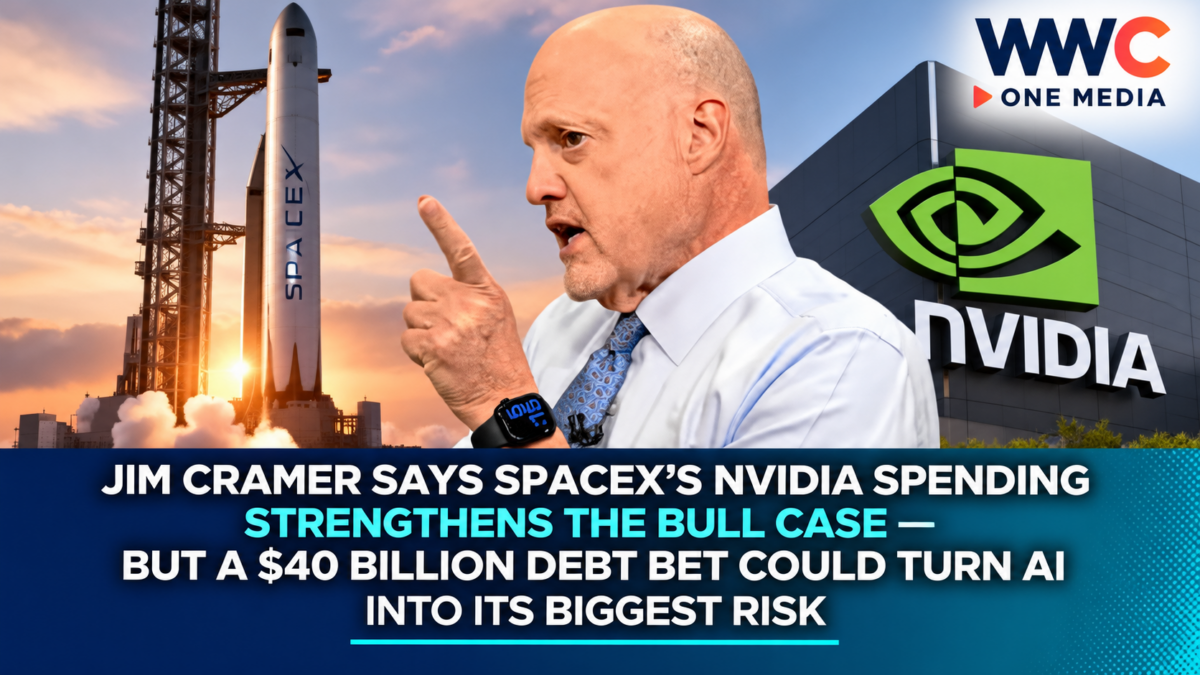
NEW YORK — Jim Cramer is becoming increasingly bullish on SpaceX for a reason that has little to do with sending rockets to Mars: Elon Musk is trying to turn the company into one of the world’s biggest owners and sellers of artificial-intelligence computing power.
The CNBC host argues that SpaceX’s willingness to buy enormous quantities of Nvidia processors reinforces the investment case for both companies because expensive AI chips can potentially be converted into recurring revenue by renting computing capacity to customers.
Cramer’s reasoning is straightforward: SpaceX is not buying Nvidia GPUs simply to own them. It intends to put that computing infrastructure to work.
He has argued that the more Nvidia hardware SpaceX deploys successfully, the more computing capacity it can monetize—extending the company well beyond rockets and Starlink into a potentially enormous AI-infrastructure business.
But that strategy has become dramatically more aggressive.
SpaceX is now seeking roughly $40 billion in new financing, including about $30 billion of investment-grade bonds and $10 billion in bank loans, to purchase Nvidia chips and expand AI infrastructure.
That comes after the company already issued about $25 billion of bonds in June, shortly after its record-setting initial public offering.
The latest borrowing plan has pushed the cost of insuring SpaceX debt against default sharply higher, showing that credit investors are far less relaxed about the strategy than some equity bulls.
The result is one of Wall Street’s most fascinating investment debates: SpaceX may be building a uniquely integrated empire spanning rockets, satellites, broadband and AI computing—but it is also committing extraordinary amounts of capital before investors know how profitable the AI business will ultimately become.
Cramer’s Bull Case Is No Longer Mainly About Rockets
SpaceX spent most of its history being judged as an aerospace company.
That description is increasingly incomplete.
The company today sits across several major technology markets:
Space launch through Falcon and Starship.
Satellite broadband through Starlink.
Direct-to-device mobile connectivity.
Government and national-security contracts.
And now large-scale AI computing infrastructure.
Cramer’s bullish thesis increasingly centers on how those businesses reinforce one another.
SpaceX can launch its own satellites.
Starlink creates recurring subscription revenue.
Its communications network gives it a global infrastructure footprint.
Its growing computing business can potentially sell AI capacity to some of the world’s largest technology companies.
That is why bulls increasingly value SpaceX less like a traditional aerospace contractor and more like a vertically integrated technology platform.
Starlink Is the Financial Foundation
The strongest existing piece of that platform is Starlink.
SpaceX disclosed that Starlink had approximately 10.3 million subscribers as of March 31, 2026, more than double the roughly 5 million reported a year earlier.
The company’s connectivity division generated $1.188 billion in operating income during the first quarter of 2026, up from $1.033 billion a year earlier.
Subscriber growth was approximately 105%, although average revenue per subscriber declined about 23% as SpaceX expanded internationally and introduced lower-priced plans.
That combination explains why Starlink is so important.
It provides recurring revenue that SpaceX can use to help finance much more speculative projects.
Rockets built Starlink.
Starlink is now helping finance the next generation of SpaceX.
Starlink Has Become More Than Rural Internet
The original Starlink proposition was simple: provide high-speed broadband in areas poorly served by terrestrial networks.
That market still matters.
But the service has expanded far beyond rural households.
Starlink increasingly serves:
airlines;
ships;
businesses;
governments;
military users;
and mobile-device connectivity.
SpaceX has also been moving aggressively into direct-to-device services that allow ordinary smartphones to connect through satellites when terrestrial networks are unavailable.
The FCC recently advanced policies aimed at expanding this market, while SpaceX has acquired significant wireless spectrum assets to strengthen its position.
This potentially puts SpaceX into competition with parts of the traditional telecom industry.
The FCC Just Strengthened the Satellite-to-Phone Story
The Federal Communications Commission is moving to make substantially more spectrum available for satellite direct-to-device services.
Its latest proposal includes auctioning 25 megahertz of spectrum and making hundreds of additional megahertz available for satellite coverage.
SpaceX has already invested heavily in spectrum.
The company acquired approximately 65 megahertz from EchoStar for $19.6 billion to expand mobile services.
That tells investors something important about Musk’s ambitions.
Starlink is not being positioned merely as an internet provider.
It could become a global communications network capable of competing across broadband, mobile connectivity, aviation and enterprise communications.
That optionality is a major part of Wall Street’s bullish valuation models.
Morgan Stanley Says SpaceX Could Still Be Cheap
Cramer is not alone in seeing upside.
Morgan Stanley analyst Adam Jonas recently reiterated a $300 price target, arguing that SpaceX shares looked unusually attractive ahead of important catalysts including further Starship testing, AI product announcements and new computing contracts.
Jonas argues that investors are assigning too little value to SpaceX’s newer AI businesses.
His analysis suggests the current market valuation is still dominated by Starlink and launch operations.
If the compute business scales successfully, SpaceX could be worth substantially more.
That is the bull case.
But Wall Street is nowhere near agreement.
Analysts Are Divided From $75 to $800
Few major public companies have a valuation debate as wide as SpaceX.
Some bearish analysts have placed values below $100 per share.
Morgan Stanley sits at $300.
Other bullish research has floated targets as high as $800, reflecting dramatically more optimistic assumptions about AI, Starlink and Starship.
That range tells investors something important.
SpaceX is extremely difficult to value.
Analysts are not disagreeing over whether next year’s earnings will be 5% higher or lower.
They are disagreeing over what businesses SpaceX will even dominate five or ten years from now.
Cramer Sees Nvidia Chips as Revenue-Producing Assets
Cramer’s argument about Nvidia provides another way to understand the bull case.
Nvidia GPUs are extraordinarily expensive.
But if a company can keep them heavily utilized by AI customers, they can generate enormous revenue.
SpaceX is essentially betting that it can borrow money, buy advanced processors and sell the resulting computing capacity at attractive rates.
The model resembles a landlord financing a building and renting out the space—but with high-end AI processors instead of offices.
Cramer has pointed to Nvidia CEO Jensen Huang’s argument that companies can generate attractive economics from deploying scarce compute.
SpaceX is now taking that idea to an enormous scale.
SpaceX Wants to Raise $40 Billion for AI
The latest financing plan shows just how aggressively Musk is pursuing the opportunity.
SpaceX is reportedly seeking:
$30 billion in investment-grade bonds
plus
$10 billion in bank financing.
The money would primarily fund purchases of Nvidia processors and associated data-center infrastructure.
The financing package would be one of the largest corporate debt raises tied directly to the AI infrastructure boom.
Apollo Global Management is expected to play a leading role in the transaction, while major bond investors including Pimco have reportedly been involved in discussions.
SpaceX Wants Enormous Computing Capacity
Musk’s ambitions go far beyond a conventional corporate data center.
Reuters Breakingviews reported that SpaceX wants to increase computing capacity from roughly 1.4 gigawatts to as much as 15 gigawatts by the end of 2027.
For comparison, that would put SpaceX in the same broad infrastructure class as the world’s largest cloud operators.
That scale explains why the financing needs are so large.
AI is extraordinarily capital-intensive.
GPUs are expensive.
Electricity infrastructure is expensive.
Cooling systems are expensive.
Data-center construction is expensive.
SpaceX is effectively trying to accelerate years of infrastructure investment into an extremely compressed timeline.
The Returns Could Be Extraordinary—If Utilization Stays High
The attraction is equally obvious.
Scarce AI computing power can command premium prices.
Breakingviews reported that SpaceX believes the payback period on some new AI capacity could potentially be less than a year, although outside analysts see a somewhat longer period.
If those economics prove sustainable, borrowing money to buy GPUs could be extremely profitable.
SpaceX would essentially earn returns far above its financing costs.
This is the central logic behind Cramer’s enthusiasm.
The more processors SpaceX can deploy profitably, the more money it can potentially generate.
But the word profitably is doing a lot of work.
SpaceX’s AI Business Is Still Burning Cash
The AI operation remains far from a mature cash machine.
Independent analysis of SpaceX’s second-quarter results shows AI-related capital expenditure remained extraordinarily high relative to revenue.
The company has been spending tens of billions of dollars on infrastructure while the compute business remains in an early stage.
That means the current strategy depends on future customers filling the capacity.
If utilization remains strong, margins can improve dramatically.
If demand weakens, SpaceX could be left with expensive hardware financed partly through debt.
This is the same problem confronting the broader AI industry.
Debt Investors Are Already Getting Nervous
The market is beginning to price that risk.
The cost to insure $1 million of SpaceX debt against default recently rose to about $19,400 annually, with five-year credit-default-swap spreads reaching approximately 194 basis points, up from roughly 110 basis points in June.
That does not mean investors expect SpaceX to default.
It means lenders are demanding more compensation for the additional risk.
SpaceX bonds have also weakened as investors digest the scale of the planned borrowing.
The contrast is striking.
Equity bulls see enormous growth.
Credit investors increasingly see leverage.
Both can be right at the same time.
AI Debt Is Becoming a Wall Street-Wide Problem
SpaceX is not alone.
Broadcom, Oracle and other technology companies are also using debt markets to finance the AI infrastructure boom.
Reuters reported that Broadcom is pursuing tens of billions of dollars in financing while SpaceX seeks its own $40 billion package.
This represents an important shift.
The first stage of the AI boom was financed heavily by the massive cash flows of companies such as Microsoft, Meta, Amazon and Alphabet.
Increasingly, debt markets are being asked to fund the next stage.
That introduces leverage into a technology cycle that was previously much more equity-funded.
If AI returns stay high, leverage magnifies gains.
If returns disappoint, leverage magnifies losses.
SpaceX Already Proved It Can Turn Massive Capex Into a Business
The strongest argument in SpaceX’s favor is Starlink.
Building thousands of satellites, factories, ground stations and launch systems required enormous upfront capital.
For years, critics questioned whether satellite broadband economics would ever work.
Now Starlink has millions of customers and produces substantial operating income.
That history gives Musk credibility with investors.
He has already turned one extremely capital-intensive infrastructure project into a profitable global business.
Cramer’s bullish interpretation is effectively that SpaceX can repeat the playbook with AI.
Build enormous capacity.
Accept heavy upfront costs.
Scale quickly.
Then monetize the network once demand catches up.
But Data Centers Are Not Satellites
There is an important difference.
SpaceX had a major structural advantage in satellite broadband because it controlled its own rockets.
Launching Starlink satellites internally gave the company a cost advantage competitors struggled to match.
AI computing is more competitive.
Microsoft, Amazon, Google, Oracle, CoreWeave and other companies are all building data centers.
Customers can switch between providers much more easily than they can switch satellite constellations.
Breakingviews warned that AI-compute customers often have more flexible contracts, making pricing pressure and competition potentially much more intense than SpaceX experienced when scaling Starlink.
That could make AI economics less defensible over time.
Starship Is the Other Giant Piece of the Valuation
The bull case cannot be separated from Starship.
SpaceX’s next-generation launch system is intended to be fully reusable and dramatically reduce the cost of reaching orbit.
If successful, Starship could support:
larger Starlink satellites;
higher launch cadence;
Moon missions;
Mars ambitions;
national-security launches;
and potentially entirely new orbital industries.
SpaceX’s September 28 Starship Flight 14 reached orbit and deployed Starlink V3 satellites, although one upper-stage Raptor engine shut down prematurely.
The test still achieved major objectives, but the engine issue demonstrated that the system remains under development.
Morgan Stanley Sees the Next Starship Test as a Major Catalyst
Morgan Stanley has identified the next Starship flight as one of the most important near-term events for the stock.
A successful demonstration of additional reusability—including eventually catching the upper stage—could significantly strengthen the economics of future launches.
Reusable rockets matter because launch cost is one of the biggest constraints on space businesses.
Falcon 9 already transformed the industry by reusing first-stage boosters.
If Starship can do the same with a much larger vehicle, SpaceX could reduce launch costs further while placing vastly more mass in orbit.
That would strengthen Starlink and many future businesses simultaneously.
SpaceX Already Dominates the Launch Market
The company’s current launch infrastructure provides a formidable competitive advantage.
SpaceX’s own launch records show hundreds of completed missions and extensive reuse of Falcon boosters.
That scale gives the company operating experience competitors cannot easily replicate.
Rockets, satellites and communications are tightly integrated.
This vertical integration is one of the strongest reasons investors assign SpaceX such an enormous strategic premium.
But the AI expansion takes that model into unfamiliar territory.
Government Contracts Add Another Revenue Stream
SpaceX is also deeply embedded in U.S. government and defense programs.
Its launch services support military satellites, NASA missions and national-security payloads.
Reuters-based reporting has highlighted multibillion-dollar Space Force awards, including contracts connected to missile-defense and communications infrastructure.
Government work helps diversify revenue away from consumers and commercial customers.
It also gives SpaceX strategic importance far beyond ordinary technology companies.
That can strengthen the long-term investment case.
It can also create political and regulatory risks.
The IPO Changed the Investment Story
SpaceX became a publicly traded company in June 2026 through the largest U.S. IPO on record.
The offering priced at $135 per share, raised tens of billions of dollars and quickly pushed the company into mega-cap territory.
Shares initially surged.
They later dropped below the IPO price during the summer before recovering strongly.
The volatility reflects a market still trying to determine what SpaceX should be worth.
Is it an aerospace company?
A broadband company?
A telecom company?
An AI infrastructure company?
A defense contractor?
Or all of them simultaneously?
The answer produces dramatically different valuations.
Starlink Subscribers Continue to Grow
The connectivity business remains the easiest part to value because it already generates significant revenue and operating income.
Official SpaceX disclosures showed approximately 10.3 million Starlink subscribers at the end of the first quarter.
More recent estimates put the customer base even higher.
As Starlink expands into aviation, maritime, enterprise and direct-to-cell services, average customer value could become increasingly diverse.
Consumer broadband subscriptions are only one part of the future revenue model.
Direct-to-Cell Could Be a Massive New Market
Satellite-to-phone connectivity could eventually be one of SpaceX’s largest businesses.
The FCC is opening additional spectrum and modernizing regulations specifically to support direct-to-device services.
That could allow satellite providers to fill mobile dead zones without requiring consumers to purchase specialized satellite phones.
For telecom companies, this is both an opportunity and a threat.
Satellite coverage could supplement existing networks.
Or over time, it could compete with them.
SpaceX’s decision to spend nearly $20 billion acquiring spectrum suggests it sees significant value in owning more of the wireless stack itself.
The Bear Case Starts With Valuation
Despite all these opportunities, valuation remains difficult to ignore.
SpaceX has traded around a market capitalization exceeding $2 trillion, even after substantial volatility.
Traditional measures make the stock look expensive.
SpaceX trades at unusually high multiples of current revenue and earnings compared with most large public companies.
Bulls argue that these measures underestimate future businesses.
Bears respond that investors are already paying today for revenues that may not arrive for years.
This is the fundamental disagreement.
Morningstar and Other Skeptics See Much Lower Value
Not every analyst accepts the moonshot assumptions.
Research summarized in recent Wall Street coverage has produced fair-value estimates dramatically below current prices.
Some skeptical analysts argue that current valuation already assumes extraordinary execution across Starlink, AI computing and Starship.
If just one major growth pillar disappoints, the stock could fall substantially.
That does not invalidate the bullish case.
It demonstrates how much future success is already embedded in the price.
Analyst Conflicts Also Deserve Attention
Another caution is that several bullish Wall Street banks participated in SpaceX’s IPO and have other potential banking relationships with the company.
That does not automatically make their research wrong.
But investors should understand possible conflicts of interest.
A bank that helps a company raise capital can also benefit from future financing, acquisitions and debt issuance.
With SpaceX now looking to borrow another $40 billion, those relationships matter.
Independent analysis should therefore be considered alongside investment-bank research.
High Treasury Yields Make the Valuation Test Harder
The macroeconomic environment is also becoming less forgiving.
Long-term U.S. Treasury yields have climbed toward multi-decade highs.
When investors can earn attractive returns from government bonds, they generally demand more compensation for owning risky growth stocks.
That can pressure valuations even if underlying company performance remains strong.
SpaceX is especially exposed because much of its valuation depends on earnings expected years into the future.
Higher discount rates reduce what those future profits are worth today.
The AI Spending Boom Is Facing Its First Credit Test
SpaceX’s new debt plan therefore arrives at a critical moment.
Wall Street has enthusiastically funded the AI boom through equity markets.
Now bond investors are being asked to provide much more capital.
The response has been cautious.
Credit-default spreads are widening.
Technology bonds are coming under pressure.
Investors are asking whether hundreds of billions in new data-center investment can actually generate sufficient returns.
SpaceX could prove the skeptics wrong.
But it now has much more financial leverage riding on the outcome.
Cramer’s Bull Case Is Powerful—but Conditional
Cramer’s enthusiasm makes sense if several things happen together.
SpaceX must keep Starlink growing.
Starship must become reliably reusable.
AI-compute customers must keep paying premium prices.
Nvidia hardware must remain highly utilized.
And financing costs must stay manageable.
If those pieces align, SpaceX could generate enormous revenue across multiple industries.
But failure in any one area could weaken the economics substantially.
The Biggest Opportunity May Be the Integration
The most compelling argument for SpaceX is not any individual business.
It is the combination.
Rockets launch satellites.
Satellites provide communications.
Communications produce recurring cash flow.
AI infrastructure generates additional enterprise revenue.
Government contracts add another customer base.
Direct-to-device services open telecommunications markets.
Starship potentially lowers the cost of everything in orbit.
Few companies control so many interconnected infrastructure layers.
That is what makes SpaceX unique.
The Bigger Question Is Whether Musk Can Repeat the Starlink Playbook
Jim Cramer’s bullish SpaceX thesis ultimately comes down to one historical precedent.
SpaceX once spent enormous sums building a satellite network that skeptics thought might never generate attractive returns.
Starlink now has millions of users and generates substantial operating income.
Musk is betting that AI computing can follow the same curve.
Build aggressively while capacity is scarce.
Raise massive amounts of capital.
Acquire as many Nvidia chips as possible.
Then sell computing power into a market where demand is still exploding.
If it works, the $40 billion debt package could look like exceptionally cheap financing for an enormously profitable business.
If it fails, SpaceX could be left with billions of dollars of debt tied to rapidly depreciating computer hardware.
Cramer sees the upside: rockets, Starlink, AI computing and satellite communications reinforcing one another inside the same company.
But the bigger question is whether SpaceX is building the most powerful vertically integrated technology platform of the next decade—or using the cash flows from one extraordinary success to finance an even bigger and riskier bet.