NEW YORK — One of Wall Street’s best-known technology bulls says investors are still dramatically underestimating the artificial-intelligence spending boom—even after trillions of dollars of market value have already been added to the world’s biggest technology companies.
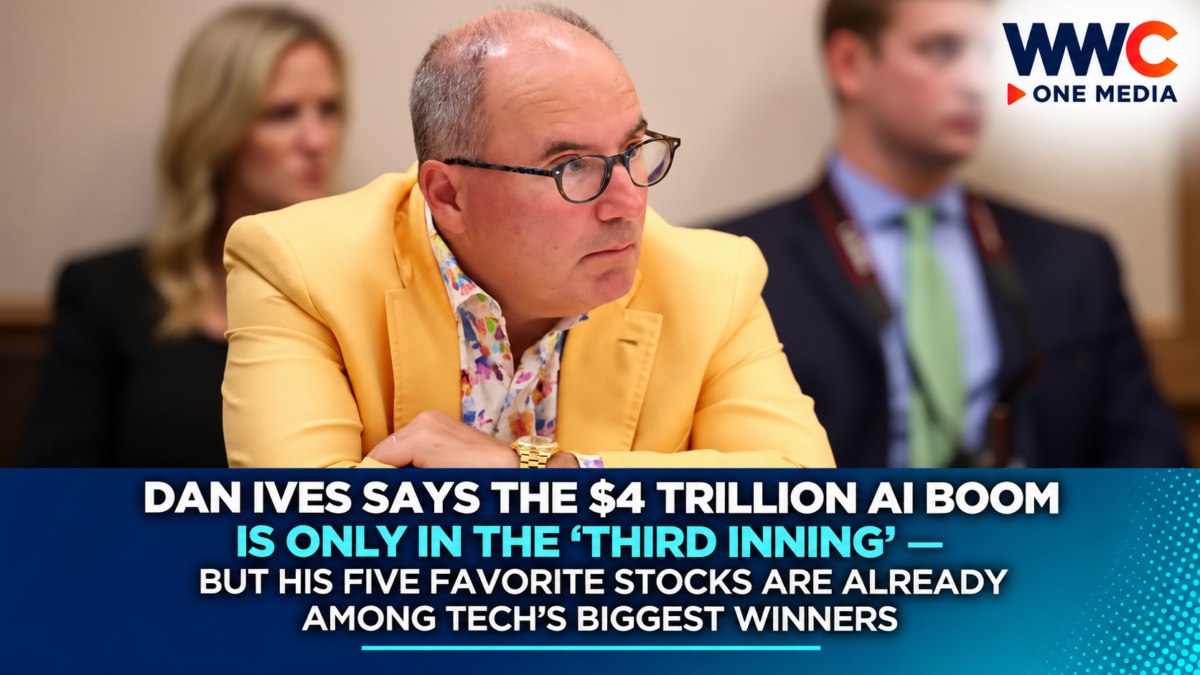
Veteran analyst Dan Ives, now a senior managing director at Yorkville Ives after leaving Wedbush Securities, says the AI infrastructure buildout is only in the “third inning of a nine-inning game.”
His central argument is that the market is still underestimating what he sees as a roughly $4 trillion technology-investment wave over the coming years as businesses, governments and cloud providers spend on chips, data centers, software, cybersecurity and AI applications.
Ives’ top five technology plays heading into 2027 are:
Nvidia, Microsoft, Palantir Technologies, Apple and CrowdStrike.
Tesla remains his favorite “disruptive technology” play but is not included in the formal top five.
The picks cover nearly every layer of the AI economy—from semiconductors and cloud infrastructure to enterprise software, consumer devices and cybersecurity.
But they also expose investors to a common risk.
If the enormous AI capital-expenditure cycle slows, many of these companies could be hit at the same time because they are different pieces of the same economic chain.
Ives Says AI Spending Is Still Supply-Constrained
Ives’ most important claim is that the current AI boom is being limited more by supply than by demand.
The industry still needs more:
- computing power;
- advanced memory;
- data-center space;
- electricity;
- networking equipment;
- cybersecurity;
- and enterprise software capable of putting AI models into real business processes.
Ives argues that this imbalance will continue through at least 2027, keeping spending elevated as corporations move beyond experimentation and begin deploying AI more broadly.
That is a crucial distinction.
If the AI boom were already demand-constrained, companies might struggle to find buyers for new infrastructure.
Ives believes the opposite is happening.
Customers still want more capacity than the technology ecosystem can easily provide.
Nvidia Is His No. 1 AI Play
At the top of Ives’ list is Nvidia.
That is unsurprising.
The company remains the dominant supplier of graphics processors used to train and run large AI models.
Yorkville Ives initiated Nvidia with an Outperform rating and a $300 price target, while Ives argues that demand is expanding beyond traditional hyperscale cloud providers into sovereign AI projects, enterprises and specialized AI-cloud companies.
Nvidia’s financial performance supports the bullish case.
The company reported approximately $96 billion in quarterly revenue in its most recent reported quarter, while demand for AI accelerators remained exceptionally strong.
Nvidia shares also recently reached a record high, pushing the company’s market capitalization toward $6 trillion.
That makes the investment debate more complicated.
The company may still have enormous growth potential.
But investors are no longer buying an overlooked semiconductor company.
They are buying one of the most valuable businesses ever created.
Nvidia’s Biggest Advantage Is More Than Its Chips
Nvidia’s lead is not based solely on hardware.
Its CUDA software ecosystem has become a major competitive advantage because developers and companies have spent years building AI applications around Nvidia technology.
Switching to competing hardware can require substantial engineering effort.
That creates what investors call a moat.
Analysts cited by Barron’s expect Nvidia to maintain a very large share of AI-computing revenue, helped by its combination of hardware, software and developer tools.
The company is also investing in AI-cloud companies and startups that could eventually become large customers.
Nvidia-backed infrastructure providers now carry enormous order backlogs as demand for compute continues to rise.
This creates a powerful ecosystem.
But it also raises concentration concerns if Nvidia becomes financially exposed to the same customers buying its chips.
Microsoft Is Ives’ Second Choice
Ives ranks Microsoft second.
Yorkville Ives initiated the company with an Outperform rating and a $615 price target.
His thesis is that Microsoft has one of the broadest ways to monetize AI because it controls multiple layers of the technology stack:
Azure cloud infrastructure;
Microsoft 365;
enterprise databases;
developer tools;
security;
Copilot;
and increasingly AI agents.
Microsoft’s latest reported numbers provide strong evidence of demand.
Its commercial remaining performance obligation—the value of contracted business that has not yet been recognized as revenue—reached $678 billion, up 84% year over year.
Importantly, Microsoft said all sequential growth in that backlog came from customers outside the major frontier AI-model companies.
That suggests AI demand is spreading beyond a handful of companies such as OpenAI.
Azure Has Become a Massive AI Engine
Microsoft Cloud revenue reached $59.3 billion in its latest reported quarter, up 27%.
Azure and other cloud-services revenue grew 43%.
Microsoft also said Microsoft 365 Copilot had surpassed 30 million paid seats.
These figures support Ives’ argument that the AI story is starting to move from infrastructure spending toward software monetization.
That matters because cloud companies cannot spend indefinitely without generating returns.
The strongest long-term AI investment case requires businesses to actually pay for AI products.
Microsoft appears to be demonstrating that transition earlier than many competitors.
But Microsoft Is Spending Enormously to Support That Growth
The downside is capital intensity.
Microsoft paid $35.8 billion for property and equipment in its latest reported quarter, while significant additional money went toward data-center leases and infrastructure.
That level of spending is necessary because customers continue demanding more AI computing capacity.
But it also raises the financial bar.
Microsoft must eventually generate enough revenue from AI services to justify enormous infrastructure spending.
This is one of the core questions surrounding the entire AI boom.
The revenue is growing quickly.
The spending is growing quickly too.
Palantir Is Ives’ Third Pick
Ives places Palantir Technologies third.
Yorkville Ives initiated Palantir with an Outperform rating and a $250 price target.
His argument is that Palantir is becoming an important operating layer for businesses and governments trying to deploy AI into real-world decision-making.
Palantir’s technology connects data, software and AI models through products including Foundry, Gotham and its Artificial Intelligence Platform.
The company has benefited heavily from corporate demand for systems that can move AI beyond demonstration projects and into daily operations.
Recent reporting cited by TipRanks showed Palantir revenue growth of roughly 93% year over year to $1.94 billion in its latest reported period.
That kind of growth explains why investors are willing to assign Palantir an unusually high valuation.
Palantir May Also Be the Most Valuation-Sensitive Pick
Palantir’s strength is also its biggest risk.
The stock has already risen dramatically over the past several years.
When a company is valued on expectations of extraordinary future growth, even strong earnings can disappoint investors if growth slows modestly.
This is particularly important because AI software competition is increasing.
Microsoft, Salesforce, ServiceNow, Oracle and many startups are building competing enterprise-AI products.
Palantir therefore has to prove that its technology remains sufficiently differentiated to support premium pricing and exceptional growth.
Ives clearly believes it can.
But his $250 target remains an analyst forecast, not a guaranteed outcome.
Apple Is the Most Controversial Pick
The fourth name, Apple, is arguably the most interesting.
Apple was not an early leader in generative AI.
The company has faced repeated questions over whether it moved too slowly while Microsoft, Google, Nvidia and OpenAI accelerated.
Yet Ives remains bullish.
Yorkville Ives initiated Apple with an Outperform rating and a $400 price target.
His argument is less about Apple building the largest AI models and more about distribution.
Apple has an installed base of more than 2.5 billion active devices, giving it one of the biggest consumer-technology platforms in the world.
If Apple can make AI useful across iPhone, Mac, wearables and services, Ives believes it could trigger hardware upgrades while creating new monetization opportunities.
Apple’s Strength Is Distribution
Many AI companies have impressive technology but relatively limited consumer reach.
Apple has the opposite advantage.
Hundreds of millions of consumers already carry its devices every day.
That means Apple does not necessarily need to win the race to build the most advanced foundational AI model.
It needs to integrate AI into products in a way that consumers actually find valuable.
That could include personal assistants, device automation, health services, productivity tools and new forms of application interaction.
Ives argues that investors have focused too heavily on whether Apple arrived early or late to generative AI.
He believes the more important question is how effectively Apple monetizes AI across its enormous installed base.
But Apple Faces a Serious AI Risk
Other analysts are less enthusiastic.
Morgan Stanley has warned that AI agents could eventually disrupt Apple’s profitable services ecosystem by reducing the role of traditional apps and app-store discovery.
If consumers increasingly ask an AI assistant to complete tasks directly, they may interact less with individual applications.
That could weaken part of Apple’s economic control over the iPhone ecosystem.
Apple therefore faces both opportunity and disruption from AI.
Ives believes the opportunity wins.
The market has not fully settled that debate.
Apple Is Also Going Through Leadership Change
Another complication is internal transition.
Apple’s new CEO, John Ternus, is reportedly considering an engineering-focused overhaul aimed at accelerating product development and responding more quickly to AI-related competition.
The company has also been experimenting with new hardware categories and organizational changes.
That makes Apple’s AI story different from Nvidia’s or Microsoft’s.
Nvidia is already monetizing AI infrastructure at enormous scale.
Microsoft is already selling AI through cloud and enterprise products.
Apple’s biggest AI monetization opportunity is still more forward-looking.
CrowdStrike Is Ives’ Fifth Pick
The fifth name is CrowdStrike.
Its inclusion reflects Ives’ belief that AI will not only create productivity gains.
It will create more cybersecurity threats.
As businesses deploy autonomous AI agents capable of acting across corporate systems, security becomes more important.
Cybercriminals can also use AI to automate attacks, create convincing phishing campaigns and search for vulnerabilities.
That is why Ives expects cybersecurity budgets to rise as AI adoption accelerates.
CrowdStrike has already been one of 2026’s strongest cybersecurity stocks.
MarketWatch reported that shares have risen approximately 138% this year.
Cybersecurity Could Be AI’s Second-Order Winner
The broader cybersecurity sector has surged.
Reuters reported this week that CrowdStrike, Fortinet and Palo Alto Networks have posted extremely strong gains as fears that AI would destroy traditional software businesses have faded.
Instead, many software companies are now using AI to strengthen their own products.
CrowdStrike is particularly well positioned because its Falcon security platform spans endpoint protection, cloud security, identity and next-generation security information management.
The company’s previously reported fiscal third-quarter revenue grew 22% year over year, while management cited record pipeline activity associated with AI-driven security demand.
The bullish argument is straightforward:
more AI means more digital activity;
more digital activity creates more attack surfaces;
and more attack surfaces create greater cybersecurity spending.
But CrowdStrike Is No Longer Cheap
The problem is familiar.
Investors already understand much of this story.
CrowdStrike’s enormous 2026 rally means expectations are now very high.
A stock can have an excellent business and still perform poorly if its valuation becomes too aggressive.
This is one of the biggest risks across Ives’ entire top-five list.
These are not undiscovered small-cap companies.
They are businesses Wall Street already associates strongly with AI.
Tesla Is Ives’ Favorite Disruptive Technology Play
Although not in the formal top five, Ives continues to highlight Tesla separately as his favorite disruptive technology stock.
Tesla’s AI story revolves around autonomous driving, robotics and its broader computing ambitions rather than traditional enterprise software or data centers.
That makes it different from Nvidia, Microsoft and Palantir.
It also makes the investment thesis considerably more speculative.
Tesla shares were down roughly 14% for 2026 at the time of Ives’ new coverage, according to reporting summarizing his selections.
That stands in sharp contrast to several of his top-five names, which have already generated substantial gains.
Ives Has Changed Firms—but Not His Bullishness
There is an important personnel detail in the CNBC story.
Ives is no longer at Wedbush Securities.
He is now a partner and senior managing director at Yorkville Ives, which recently launched broad technology-sector coverage.
The firm initiated coverage on dozens of technology stocks this week.
Ives’ top-five selections are therefore part of his new firm’s formal research strategy rather than a continuation of Wedbush recommendations.
This distinction is important for attribution.
The $4 Trillion Number Is a Forecast
Another critical distinction concerns the headline spending estimate.
The approximately $4 trillion AI spending wave is a forward-looking thesis.
It is not $4 trillion that has already been spent.
Goldman Sachs and other analysts have estimated that worldwide investment in AI infrastructure could approach that scale by 2030 as companies build data centers, purchase chips and expand computing capacity.
Actual spending could be higher.
It could also be lower.
Investors should treat the figure as a forecast, not a confirmed future cash flow.
AI Spending Is Already Enormous
Even with that caveat, there is substantial evidence behind the bullish view.
AI-related spending is already reshaping corporate profits and capital markets.
The Financial Times reported that S&P 500 earnings are expected to post another quarter of more than 25% growth, with AI-related companies responsible for a large share of the increase.
Micron and Nvidia alone are expected to account for more than one-third of projected aggregate earnings growth in the quarter.
This shows that the AI boom is producing real financial results.
It is no longer solely a valuation narrative.
But AI Is Becoming More Dependent on Debt
The next phase of the expansion may look different.
Technology companies and data-center developers are increasingly borrowing large amounts to fund infrastructure.
The Financial Times reported that AI-focused hyperscalers could issue as much as $1 trillion of additional debt by 2030.
That introduces financial risk into a boom that initially relied heavily on the extraordinary cash flows of Big Tech companies.
Debt increases leverage.
It also makes projects more sensitive to interest rates and future revenue.
If AI infrastructure produces strong returns, that leverage can magnify gains.
If returns disappoint, it can magnify losses.
Power May Become the Biggest AI Bottleneck
Ives’ “third inning” thesis also depends on the physical limits of AI infrastructure.
More GPUs require more electricity.
Data centers need grid connections, cooling systems and power-generation capacity.
This is one reason energy and utility companies are increasingly becoming part of the AI investment story.
The bottleneck has moved beyond chips alone.
Memory, networking equipment, data-center construction and electricity are all becoming critical.
That supports Ives’ argument that secondary and tertiary AI beneficiaries may have significant opportunities ahead.
Enterprise Software Is Recovering
Another positive development for Ives’ thesis is the rebound in software stocks.
Early in 2026, investors worried that powerful AI systems could make traditional software companies obsolete.
Reuters reported this week that those fears have eased significantly.
The S&P software and services index recently reached its highest level since late 2025.
Expected 2026 earnings growth for the sector has also increased substantially as companies including Salesforce and ServiceNow demonstrate that AI can enhance existing software businesses rather than simply destroy them.
That supports Palantir, Microsoft and CrowdStrike—the software-heavy portion of Ives’ portfolio.
The Biggest Risk Is That These Picks Are Not Truly Diversified
On the surface, Ives’ top five look diversified.
Nvidia makes chips.
Microsoft sells cloud and software.
Palantir sells enterprise data platforms.
Apple makes consumer devices.
CrowdStrike provides cybersecurity.
But economically, all five benefit from continued AI adoption.
That means an investor owning all five could still be heavily exposed to the same fundamental factor.
Kiplinger recently described AI not as one industry but as a supply chain, warning that investors can mistake ownership across multiple AI layers for genuine diversification.
If hyperscalers cut AI spending, the impact could move through chips, data centers, software and cybersecurity simultaneously.
A Capex Slowdown Is the Central Bear Case
This is the single biggest challenge to Ives’ thesis.
What happens if cloud giants decide they have built enough capacity?
Reuters reported in September that investors were already becoming nervous about a potential AI-spending slowdown, even as current investment remained extraordinarily strong.
Industry-wide AI infrastructure spending was expected to approach $795 billion in 2026 and potentially exceed $1 trillion in 2027, according to estimates cited by Reuters.
The numbers are enormous.
That is bullish if returns continue.
It is dangerous if customers eventually discover they have overbuilt.
AI Stocks Are Carrying More of the Market
The concentration risk extends beyond Ives’ picks.
AI-related technology companies have become increasingly important to the entire U.S. stock market.
The S&P 500 and Nasdaq have repeatedly reached records while many other sectors have lagged.
That means a major correction in AI stocks could affect broad-market indexes, retirement accounts and passive investment funds.
The larger these companies become, the more systemic their market impact becomes.
Nvidia Shows How Extraordinary Expectations Have Become
Nvidia alone is now valued at nearly $6 trillion.
That is larger than the annual economic output of most countries.
Yet analysts continue raising price targets because earnings growth remains extremely strong.
This creates an unusual investment environment.
Traditional valuation rules can appear excessively cautious when earnings are growing at extraordinary rates.
But historical valuation comparisons can also become dangerous if investors assume exceptional growth will continue indefinitely.
Ives clearly believes the AI cycle has years left.
Skeptics believe valuations increasingly require near-perfect execution.
Ives Is Betting the Next Phase Will Spread Beyond Chips
The most interesting part of Ives’ thesis may not be Nvidia.
It is his belief that the AI boom is broadening.
The first major winners were semiconductor companies and cloud providers.
The next stage could include:
enterprise software;
cybersecurity;
consumer devices;
energy infrastructure;
data-center equipment;
and specialized industry applications.
That is what he means by the “third inning.”
The foundational infrastructure has been built.
But he believes the monetization and secondary economic effects are only beginning.
The Bulls Have Strong Evidence
The bullish case is not difficult to understand.
Nvidia continues posting enormous growth.
Microsoft’s cloud backlog has reached $678 billion.
Palantir’s AI software demand remains strong.
CrowdStrike is benefiting from rising security spending.
Apple has billions of devices through which it can distribute AI.
Meanwhile, data-center investment keeps climbing.
All of these factors support the argument that the AI boom has further to run.
But the Bears Have a Strong Argument Too
The bearish case is equally straightforward.
AI stocks are expensive.
Infrastructure spending is enormous.
Borrowing is increasing.
Power constraints are worsening.
Governments are considering more regulation.
And investors are increasingly dependent on a relatively small number of technology companies to sustain market growth.
Most importantly, no one yet knows what long-term return companies will earn on every dollar being spent on AI.
That uncertainty is the heart of the debate.
Dan Ives Is Betting the Biggest AI Gains Are Still Ahead
Ives is not arguing that investors missed the AI boom.
He is arguing that what has happened so far is only the beginning.
His five preferred names each represent a different stage of the same transformation:
Nvidia supplies the computing power.
Microsoft provides cloud infrastructure and enterprise distribution.
Palantir turns AI into operational software.
Apple could distribute AI to billions of consumer devices.
CrowdStrike protects the systems AI increasingly depends on.
It is a coherent thesis.
But it remains a thesis.
Ives believes investors are still underestimating a $4 trillion technology-spending cycle and that the AI revolution is only in the third inning.
The bigger question is whether the enormous profits and productivity gains eventually justify the trillions being invested—or whether Wall Street discovers that the most expensive infrastructure buildout in technology history reached its peak much earlier than the bulls expected.