
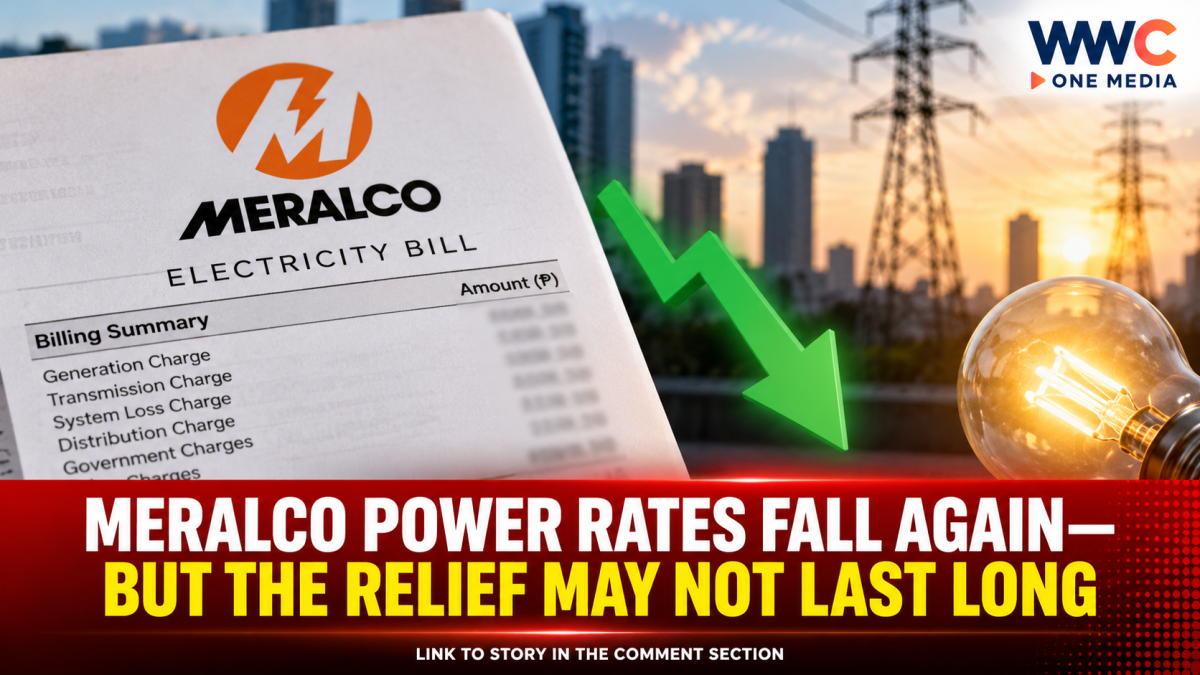
Metro Manila and nearby areas are getting another small break on their electricity bills, as Meralco power rates declined for a second consecutive month—but the latest reduction comes with an important catch.
The downward movement is being helped largely by regulatory refunds ordered by the Energy Regulatory Commission (ERC), rather than a broad-based collapse in the underlying cost of electricity.
That means consumers may see some relief on their monthly bills, but the reduction should not necessarily be interpreted as a permanent shift toward cheaper electricity.
Refunds are cushioning electricity bills
Meralco has been implementing ERC-approved Actual Weighted Average Tariff (AWAT) refunds, which return amounts previously collected from customers after regulatory true-up calculations.
The ERC previously ordered Meralco to refund ₱14.17 billion from an earlier true-up covering July 2022 to December 2024. The regulator accelerated the refund over 12 months, resulting in an average refund rate of ₱0.2511 per kWh.
A separate ERC decision later directed Meralco to return another ₱9.51 billion to customers following the true-up of distribution charges for January to December 2025. That refund carries an average rate of ₱0.3448 per kWh, with residential and General Service A customers receiving a refund rate of ₱0.5861 per kWh.
Together, these regulatory adjustments have played a major role in temporarily easing customers’ bills.
August already showed how complicated the picture is
The previous month provided a clear example of why a lower headline rate does not necessarily mean electricity has become substantially cheaper.
For August, Meralco reduced its overall rate by ₱0.0428 per kWh, bringing the rate for a typical household to ₱14.7833 per kWh, from ₱14.8261 in July. For a household consuming 200 kWh, that represented roughly a ₱9 reduction.
But without the ERC-approved refund, the reduction would have been considerably smaller.
Meralco said the refund amounted to ₱0.5861 per kWh for residential customers. At the same time, higher charges—including increases in ancillary services, taxes and other components—offset much of the benefit.
The National Grid Corporation of the Philippines’ higher ancillary-service costs were among the factors pushing bills upward, while the use of more expensive alternative fuel by a Meralco supplier also contributed to higher costs.
Wholesale electricity prices have also been moving
There is another factor worth watching: wholesale electricity prices.
Data from the Independent Electricity Market Operator of the Philippines showed that average wholesale electricity prices fell during the July billing period as electricity demand weakened.
Average demand declined by about 3.4%, while the average wholesale price fell roughly 13.1% to ₱8.31 per kWh from ₱9.56 per kWh in June. Luzon recorded an average wholesale price of ₱7.30 per kWh, down 8.2% from the previous month.
Cooler and wetter conditions were cited as factors behind weaker electricity demand.
That development can eventually help power costs, but wholesale-market movements do not automatically translate one-for-one into consumers’ monthly Meralco bills because the final rate contains several regulated and pass-through components.
The bigger question: What happens when the refunds end?
This is where consumers need to pay attention.
The current relief is partly tied to temporary regulatory refunds. Once those credits are completed, households could again become more exposed to movements in generation costs, transmission charges, fuel prices, reserve-market costs and other regulated components.
Meralco’s distribution charge itself has remained unchanged since the reduction implemented in August 2022; many of the month-to-month swings consumers see are therefore driven by other components of the bill.
Meanwhile, the ERC has also been evaluating Meralco’s application for a new rate reset. Meralco has proposed an increase in its average distribution charge as part of its requested revenue requirement for 2027 to 2030, meaning the longer-term direction of electricity costs remains an important issue for consumers and businesses.
What this means for households
For now, the message is straightforward: lower Meralco rates provide welcome short-term relief, but consumers should not assume that electricity prices are entering a sustained downward trend.
Refunds are helping reduce bills, while market conditions and other charges can push in the opposite direction.
For households already struggling with high electricity consumption, the best strategy remains to take advantage of the lower billing period while continuing to manage consumption—because the biggest question may not be how much Meralco rates fall this month, but what happens after the temporary refunds disappear.



Leave a Reply