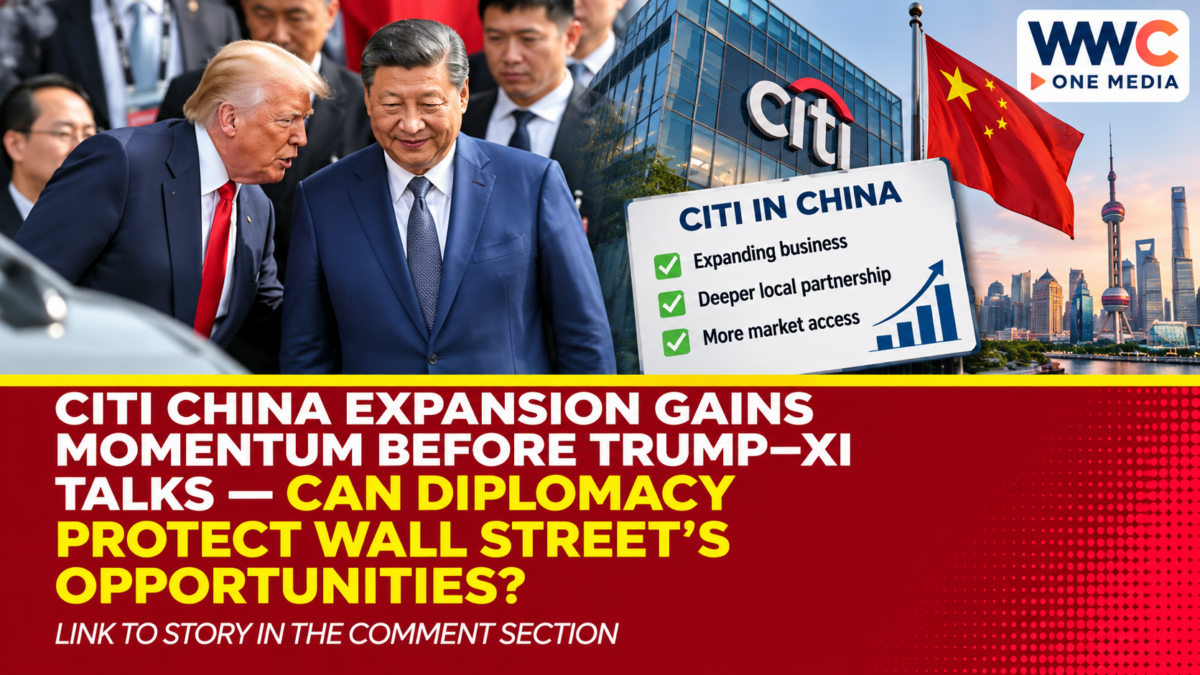
SHANGHAI, China — Citigroup’s China expansion gained a new foothold this month as the US bank prepared to develop a wholly owned securities business and brought international investors together in Shanghai and Shenzhen. Its Nov. 3 announcement confirmed Chinese regulatory approval to establish the company and identified Chair and CEO Jane Fraser as a participant in its Nov. 10–13 China conference, against a backdrop of renewed US–China economic talks.
Yet market-entry approval is not proof that every proposed service is already operating, and bilateral commitments do not remove all trade or investment risks.
Citi China Expansion Enters a New Regulatory Stage
Citi said the China Securities Regulatory Commission had approved the establishment of Citigroup Securities (China) Company Limited, a wholly owned securities business. The proposed services include onshore equities brokerage, securities underwriting, research and principal trading for domestic and foreign clients.
Those activities could extend the bank’s ability to participate directly in mainland capital markets. But the disclosed approval concerns establishing the company; it should not be mistaken for evidence that all services have commenced or that a particular revenue target has been achieved.
Citi’s Nov. 3 announcement described the licence development as central to discussions of market access and international capital raising at its annual conference.
WWC ONE MEDIA previously examined Citi’s securities approval alongside China’s changing cross-border payment landscape. The new securities company involves investment-market services rather than the consumer payment infrastructure covered by other institutions’ approvals.
Jane Fraser’s China Engagement Has an Official Record
Citi announced that Fraser would participate in its 21st annual China Conference, held across Shanghai and Shenzhen from Nov. 10 to Nov. 13. Its announcement anticipated 1,500 global institutional investors, policymakers and corporate leaders.
Marc Luet, Citi’s head of Japan, Asia North and Australia, and Wenjie Zhang, Citi China country officer and banking head, also outlined the bank’s interest in connecting multinational clients with Chinese markets.
These official disclosures do not independently verify Fraser’s reported remarks from a separate Nov. 18 interview, and no such quotation is reproduced here.
Why it matters: Multinational banks can serve corporations operating in several jurisdictions even when governments disagree on tariffs, technology controls or investment screening.
Citi’s Financial Results Provide a Stronger Starting Point
Citigroup’s Oct. 13 earnings release reported third-quarter revenue of US$23.8 billion, up from US$22.1 billion a year earlier. Net income rose to US$5.2 billion from US$3.8 billion on a reported basis, while diluted earnings per share reached US$2.85.
The bank said revenue growth was driven by Services, Wealth, Markets and Banking, partly offset by a decline in other operations. These are group-wide figures, not an estimate of revenue generated by the proposed mainland Chinese securities subsidiary.
Its September Form 10-Q reported US$22.1 billion in exposure to China within its country-risk table, compared with US$19.7 billion at year-end 2025. Country-risk exposure is a balance-sheet and risk-management measure, not the value of a new investment commitment or a prediction of losses.
Analysis: Citi’s financial capacity and global client network may help it pursue securities-market business, but profitability in China depends on regulatory completion, client mandates, competition, execution costs and market conditions. Company-wide earnings cannot establish the eventual profitability of a newly established operation.
Trump–Xi Economic Channels Offer Opportunity, Not Certainty
US government announcements document new channels for engagement between Washington and Beijing. During the May 2026 bilateral summit, the two governments established a Board of Trade and a Board of Investment to discuss commercial barriers and opportunities.
A September White House fact sheet said the boards had become operational. It described recommendations for more favourable tariff treatment for US$30 billion in non-sensitive goods in each direction, along with discussions of investment obstacles and rare-earth supply chains.
Those are official policy developments, but recommendations are not the same as completed customs changes. Nor does a diplomatic forum grant a bank permission to bypass Chinese securities regulations or American compliance obligations.
WWC’s coverage of Xi Jinping’s APEC comments on protectionism illustrates why speeches and negotiations need to be evaluated against enforceable rules. The same distinction applies to corporate expectations: dialogue may improve predictability without guaranteeing a particular banking deal.
China’s Capital Markets Present Opportunity and Competition
Citi’s announced onshore securities activities are separate from its overseas banking relationships and its earlier exit from consumer banking in China. Its 2026 proxy materials said the wind-down of its Chinese consumer business was complete, illustrating how the bank has repositioned itself toward institutional activities.
Serving Chinese issuers and international investors could generate underwriting, trading and research opportunities. Yet entering an established market also means competing for mandates, hiring specialist teams and complying with local disclosure and conduct standards.
WWC previously reported on the widening range of Chinese and Hong Kong IPO opportunities. That broader fundraising context helps explain the commercial interest, but an active IPO market does not automatically produce completed underwriting fees for Citi.
What this could mean: A better-functioning US–China economic relationship could reduce uncertainty for cross-border clients. Equally, renewed restrictions or stalled negotiations could complicate transactions. Citi’s actual market share will be established by executed business rather than conference attendance or diplomatic goodwill.
What Happens Next
The next evidence to watch is Citi’s disclosure of the securities company’s operational status, regulatory permissions, client activity and any measurable contribution to financial performance. Official developments from the US–China trade and investment boards will also show whether high-level engagement translates into specific rules.
Citi has publicly documented a significant step into mainland securities markets. The remaining question is whether that regulatory opening, combined with a cautiously developing bilateral relationship, produces durable commercial growth. Neither a completed Trump–Xi deal at the latest talks nor a guaranteed return for Citi is established by the records reviewed.
Frequently Asked Questions
What is Citi doing in China in 2026?
Citi received approval to establish a wholly owned securities company and held its annual China Conference in November. The planned securities services include brokerage, underwriting, research and principal trading.
Did Jane Fraser announce a new China investment amount?
No specific new investment amount from Fraser’s Nov. 18 remarks was independently verified in the primary records used for this article.
Has Citi’s new Chinese securities company started trading?
The official announcement confirms approval to establish the company, not independently verified commencement of every proposed business activity.
How are Trump–Xi talks relevant to Citi?
Bilateral discussions address trade and investment barriers that can influence cross-border business. They do not replace the bank’s separate legal and regulatory obligations.
How much did Citi earn in its latest reported quarter?
Citigroup reported US$5.2 billion in third-quarter 2026 net income on revenue of US$23.8 billion. Those figures cover the entire group, not just China.