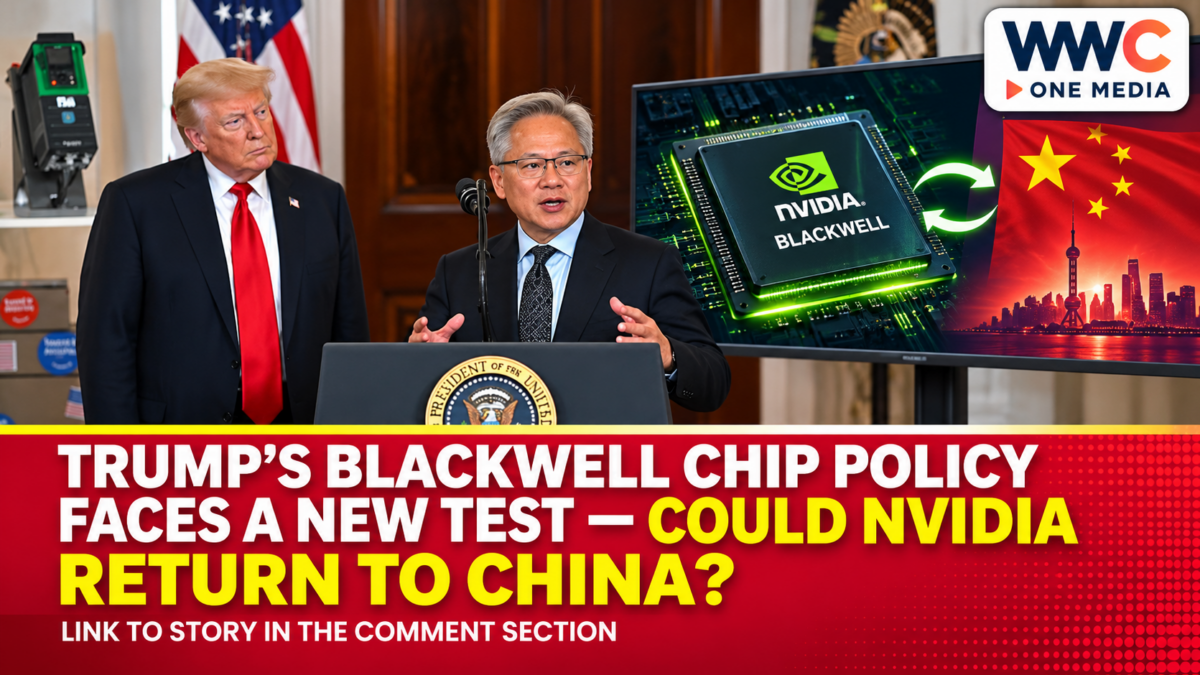
WASHINGTON — Nov. 19, 2026. Whether Nvidia’s Blackwell processors can eventually be sold to China remains an open US export-policy question after President Donald Trump discussed restrictions on advanced chips ahead of his Asia trip. Official Commerce Department decisions distinguish older H200 processors, which may qualify for case-by-case licences, from newer Blackwell technology; no verified government action reviewed for this story establishes a fresh general authorisation for Blackwell shipments.
The distinction matters for the world’s largest AI-chip supplier, for customers seeking computing capacity and for Southeast Asian data-centre operators. Political remarks, formal licensing decisions and completed commercial transactions are separate events, and none should be treated as proof of the others.
Nvidia Blackwell Exports: What Has Actually Changed?
On Jan. 13, 2026, the US Bureau of Industry and Security announced conditional case-by-case review for export applications covering Nvidia H200, AMD MI325X and comparable semiconductors destined for China. It required safeguards involving customer screening, independent testing in the United States and the availability of semiconductor capacity for American customers.
That announcement did not identify Blackwell as a product automatically eligible for sale. It did not promise that every Chinese buyer would qualify, or that a licence would guarantee a shipment.
A separate presidential record from November documented opposition to selling advanced Blackwell chips to China. It also discussed the prospect that technological progress could change how valuable existing chips remain. That is a public policy position, not a signed export licence or a newly effective regulatory exemption.
The precise new remarks attributed to Trump on Nov. 19 have not been authenticated in an official transcript or first-party recording reviewed for this article. Accordingly, this report does not quote those remarks or claim that they constitute an approval.
Why H200 and Blackwell Must Not Be Confused
H200 and Blackwell are distinct generations of Nvidia computing technology. Regulators can treat products differently according to their technical capabilities, end users and security risks. A decision to consider H200 applications individually does not automatically transfer to Blackwell.
Nvidia’s product material identifies Blackwell as a platform for large-scale accelerated computing. Its GB200 NVL72 rack design combines 72 Blackwell GPUs and 36 Grace CPUs, demonstrating why controls on these systems concern more than ordinary consumer graphics cards.
For companies contemplating purchases, the meaningful questions are whether a particular model is controlled, whether the customer and intended use qualify, and whether the competent agency has issued the necessary permission. A hypothetical future change in policy cannot replace those steps.
WWC has already examined the new US restrictions on advanced AI chips ahead of Trump–Xi discussions. Those rules add another layer of scrutiny beyond direct equipment sales.
Nvidia’s Earnings Show Why the Market Matters
Nvidia reported third-quarter fiscal 2027 revenue of $115.8 billion for the period ended Oct. 25, 2026, an increase of 103% from a year earlier. Its data-centre segment generated $107.6 billion in quarterly revenue, reflecting substantial demand for advanced computing products across its wider customer base.
Yet the company’s fourth-quarter outlook, issued Nov. 17, assumes no data-centre computing revenue from China. That is a forward-looking financial assumption, not a declaration that China will never purchase any Nvidia product again. Nor does it mean every previously approved transaction has been cancelled.
A possible future authorisation could create a commercial opening, but revenue would still depend on customer demand, Chinese restrictions, contractual terms, product availability and the timing of any approvals.
The legal scrutiny around the broader policy was examined separately in WWC’s report on congressional questions about Nvidia export-licensing decisions. Requests for records and allegations must not be confused with findings of misconduct.
Remote Computing Makes Export Controls More Complex
On Nov. 16, the Commerce Department announced an interim final rule addressing access to advanced American computing capacity through data centres outside restricted countries. The issue is that physical ownership of a chip and remote use of its processing power may involve different jurisdictions.
A processor might remain in an overseas facility while a customer elsewhere rents its computing power. Export policy therefore has to consider the ultimate user, not just the shipping address. The newly announced requirements are separate from a decision about whether Nvidia can sell a particular Blackwell model directly into China.
What this could mean: Even if physical shipments became possible under a future licensing policy, restrictions on remote computing could still affect cloud operators and their customers. Businesses would need to examine both sets of rules before treating a service or transaction as authorised.
The wider concern about access to advanced US AI technology is discussed in WWC’s coverage of official warnings about China-linked AI model extraction. Model-access security and hardware exports are related policy debates, but one does not establish violations of the other.
Why the Philippines and Southeast Asia Should Watch
Southeast Asian businesses increasingly rely on cloud and data-centre services for AI development and computing workloads. Changes in US licensing policies may affect providers’ equipment choices, customer-screening procedures and the cost of delivering compliant services.
The Philippines is not automatically subject to every destination-specific control directed at other countries. But transactions involving restricted customers or advanced computing may still require compliance analysis wherever the relevant equipment is installed.
For regional customers, the prudent distinction is between available processing capacity, lawful access to that capacity and a vendor’s future sales forecast. None can be inferred simply from a high-level diplomatic comment.
What Happens Next
The next decisive evidence would be a published US regulatory amendment, an authenticated export-licensing decision, or an official announcement clearly identifying Blackwell products, eligible customers and applicable conditions. Nvidia’s subsequent financial filings could show whether permission becomes actual revenue.
Until those documents appear, the verified conclusion is limited: Washington has allowed conditional review for certain H200 exports while maintaining a wider framework controlling advanced chips and remote computing. Blackwell sales to China remain a possible future policy question, not a completed commercial reopening.
Frequently Asked Questions
Has the US approved Nvidia Blackwell sales to China?
No new general approval was established by the primary records reviewed. The January licensing change explicitly addressed H200 and comparable products under conditions.
Can Nvidia sell H200 chips to China?
Applications may receive case-by-case review subject to security conditions. A review process does not guarantee a licence or a completed sale.
Why does China matter to Nvidia’s outlook?
China represents a potential market for data-centre computing equipment, but Nvidia’s fourth-quarter outlook assumes no data-centre computing revenue from China.
Will a presidential comment automatically change export rules?
No. Businesses must look for the relevant legal requirements, licences and official implementation measures before treating exports as authorised.