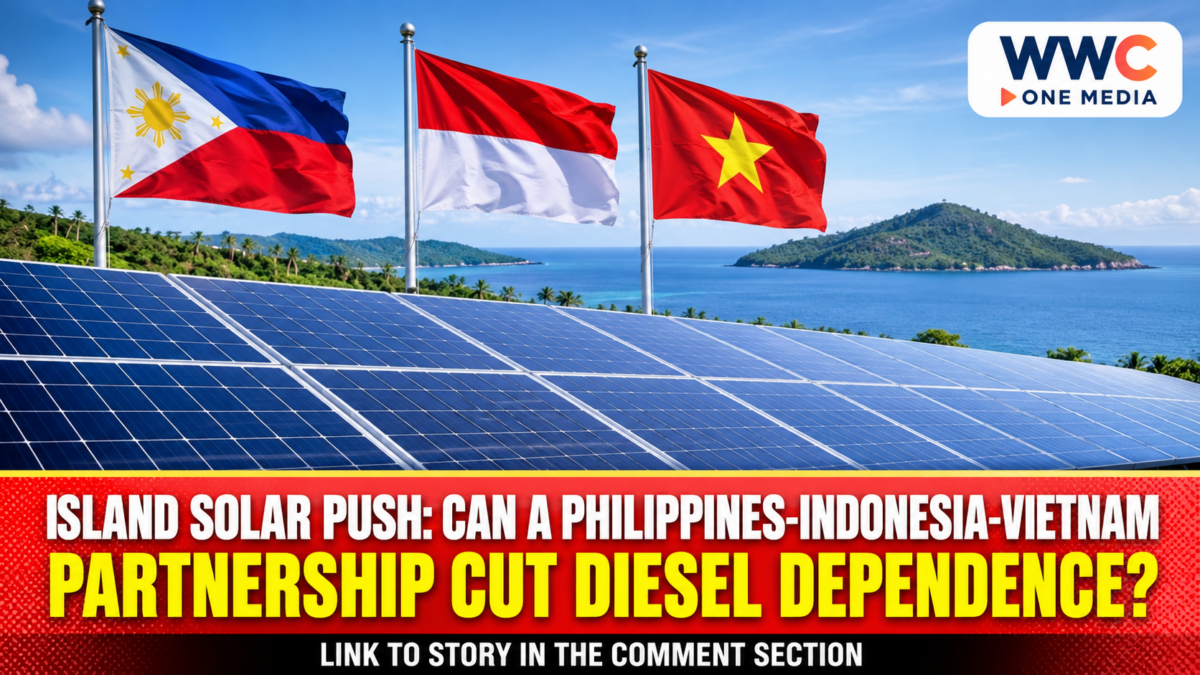
The Philippines, Indonesia and Vietnam have launched a regional initiative to expand solar power and battery storage in island and remote communities, bringing government and industry representatives together at the COP31 climate conference in Antalya, Türkiye, on Nov. 10, 2026.
The initiative places energy access and diesel dependence at the centre of a regional discussion, but its real test will be whether cooperation leads to bankable projects, workable regulations and electricity systems that communities can rely on after sunset.
For the Philippines, the timing matters. The Department of Energy (DOE) is already preparing a dedicated Green Energy Auction for off-grid islands served by the National Power Corporation (NAPOCOR). The auction is a separate government policy initiative, but it provides a possible route through which the wider push for solar and storage could translate into actual developments.
What the island solar partnership actually launched
The Philippine Solar and Storage Energy Alliance (PSSEA) described the Philippine–Indonesia–Vietnam Partnership as an initiative launched during a COP31 event organised around solar and battery storage for island and remote communities.
The event was spearheaded by the Asian Photovoltaic Industry Association (APVIA) and held at the Philippine Pavilion on Nov. 10. PSSEA’s event account identified Philippine Energy Undersecretary Felix William Fuentebella as a government participant and Maria Theresa “Tetchi” Capellan as chairperson of APVIA and PSSEA.
The stated objective is to advance practical cooperation on solar photovoltaic systems and battery energy storage. The emphasis is not simply on adding solar panels: storage is central to making electricity available when sunlight is unavailable.
That distinction matters for islands where power systems operate separately from large national grids. Solar generation can contribute electricity during daylight hours, while batteries can store some of that output for later use. The system’s actual performance, however, depends on its design, storage capacity, maintenance and the local electricity demand it must serve.
The public announcement establishes that the initiative was launched. It does not, by itself, establish a project list, investment commitment, construction timetable or installed capacity for the three countries.
Why diesel replacement is a difficult island power problem
Remote electricity systems face challenges that differ from those of large interconnected grids. Fuel must be transported to isolated locations, while generators require regular operation and maintenance. When supply depends heavily on delivered fuel, changes in fuel prices and logistics can affect the cost of producing electricity.
The DOE’s Aug. 4 announcement on its proposed off-grid Green Energy Auction described the financial pressure behind the policy. It said the average true cost of generation in off-grid areas was about ₱18 per kilowatt-hour, while costs on some remote islands could reach ₱62 per kilowatt-hour.
The department also explained how the Universal Charge for Missionary Electrification (UCME) helps cover the gap between regulated consumer rates and the actual cost of generation in these areas. The charge is collected from electricity consumers nationwide.
This means the issue extends beyond the communities that rely on isolated power plants. The cost of serving remote areas also has implications for the subsidy mechanism paid for by electricity users across the country.
For further context on the financing requirements of renewable developments, WWC has examined how a solar project in Isabela secured project financing. A project loan for a specific facility is different from a regional partnership announcement, but it illustrates why financing arrangements matter before proposed capacity becomes a functioning power plant.
The DOE already has a separate auction plan for off-grid islands
The government’s most concrete policy track is the DOE’s planned Green Energy Auction for off-grid island communities served by NAPOCOR.
In its Aug. 4 release, the department said it was initially targeting 20 of the country’s larger NAPOCOR-served islands. It also said it had conducted discussions with renewable energy developers, local government units and other stakeholders to refine the auction design.
The planned auction is intended to encourage renewable energy facilities combining solar photovoltaic generation and battery energy storage. NAPOCOR is expected to continue playing a central role in maintaining electricity service while winning developers build and commission their facilities.
The DOE said it was still finalising the eligible-island list and auction parameters, with the auction expected to be rolled out in 2027.
That timing is important. The policy announcement is not the same as an auction that has already selected winning developers. Until the eligible sites, bidding rules, awarded projects and construction schedules are published, the scale and pace of the transition remain uncertain.
The regional initiative could help create connections among policymakers, industry participants and potential investors. But it should not be confused with the DOE auction or described as having already secured projects under it.
Batteries are essential, but they do not remove every constraint
Solar generation is variable because output changes with daylight and weather. Battery storage can help shift electricity from periods of stronger generation to periods when solar output falls.
However, a solar-and-storage installation is not automatically a complete replacement for diesel generation. The required battery size depends on the community’s demand profile, the number of hours of backup required, the availability of other generation sources and the reliability standard expected by the local grid.
Projects also need suitable sites, equipment, grid connections, operating arrangements and long-term maintenance. In remote areas, the logistics of replacing components and maintaining technical systems can be as important as the initial construction.
WWC has previously covered the financing and development side of renewable energy through its report on Alternergy’s planned green bond programme and project expansion. The broader lesson is that announced investment plans still have to move through financing, construction and commissioning before they add operating capacity.
Regional cooperation needs measurable commitments
The Philippines, Indonesia and Vietnam have different electricity systems, island geographies, regulatory structures and investment conditions. A shared objective can create opportunities for knowledge exchange, but it does not guarantee that the same project design will work in all three markets.
The next stage should therefore be judged by practical information: which communities are being prioritised, what technologies are being considered, who will finance the projects, how electricity will be purchased and who will operate the systems.
The Philippines also has a wider renewable energy pipeline. In a separate report, WWC examined energy projects endorsed for grid impact studies. Grid-study endorsements are not the same as completed projects, just as a regional partnership announcement is not proof of new generation already operating.
The distinction is important for readers assessing the pace of the energy transition. Announcements, auction awards, financial close, construction and commercial operation are different stages. Reporting them accurately helps avoid overstating how quickly electricity costs or reliability may change.
What happens next
The next significant milestones are likely to come from the DOE’s off-grid auction process and from more detailed announcements by the organisations involved in the regional initiative.
For the Philippine government, the key items to watch are the final list of eligible islands, auction parameters, procurement timetable and the identity and capacity of winning projects. For the regional partnership, the public record needs to develop beyond the launch announcement to show specific work programmes, financing arrangements and implementation responsibilities.
Until those details are available, the most defensible conclusion is that the partnership has opened a channel for regional cooperation on island solar and storage. It has not yet demonstrated how many communities will receive projects, how much capacity will be installed or how much consumers may save.
For island households and businesses, the measure of success will not be the number of announcements. It will be whether electricity becomes more dependable and affordable over time.
Frequently asked questions
What is the Philippines-Indonesia-Vietnam solar partnership?
It is a regional initiative launched at a COP31 event on Nov. 10, 2026, focused on advancing solar power and battery storage for island and remote communities.
Who helped launch the initiative?
The event was spearheaded by the Asian Photovoltaic Industry Association (APVIA). The Philippine Solar and Storage Energy Alliance (PSSEA) documented the launch and identified Philippine Energy Undersecretary Felix William Fuentebella among the participants.
Will the partnership immediately lower electricity bills?
There is no verified public commitment establishing an immediate bill reduction. Any savings would depend on actual projects, operating costs, financing, electricity procurement arrangements and how those costs are reflected in consumer rates and subsidies.
What is the DOE’s off-grid Green Energy Auction?
It is a planned competitive process intended to encourage renewable energy and battery storage projects in off-grid island communities served by NAPOCOR. The DOE said it was initially targeting 20 larger islands and expected the auction to be rolled out in 2027.
Have the three countries announced specific solar project capacities?
The primary public announcement reviewed for this report confirms the initiative’s launch and broad purpose, but does not provide a verified list of projects, investment amounts, construction schedules or installed capacity across the three countries.