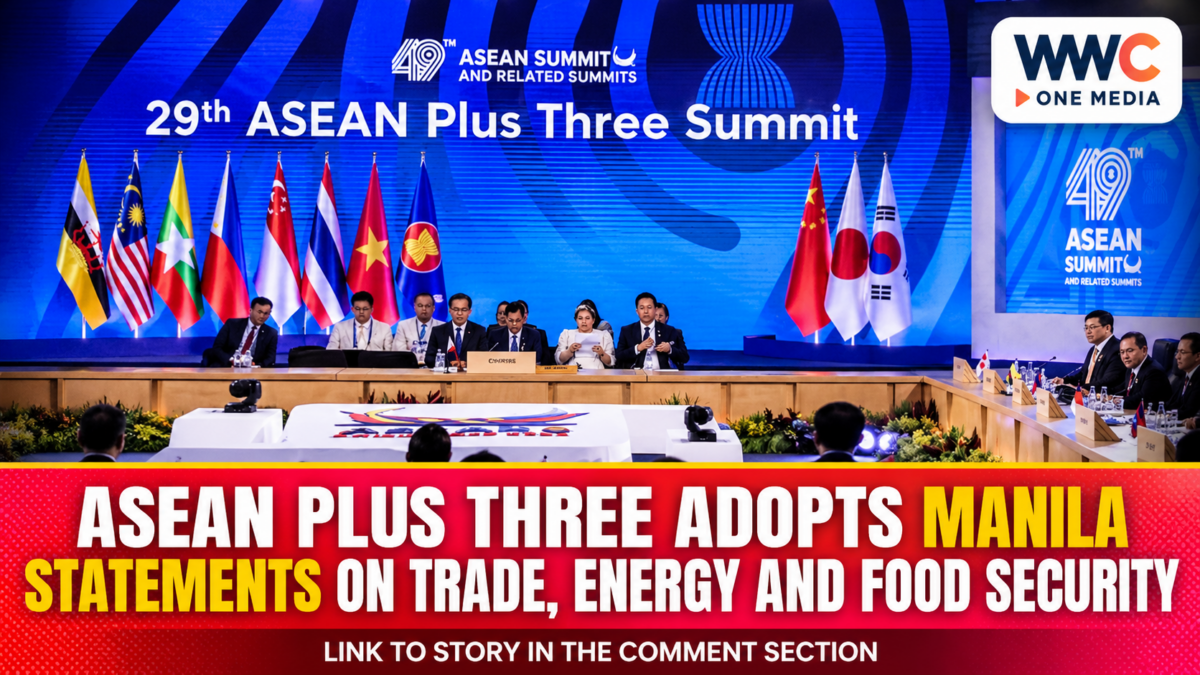
The 29th ASEAN Plus Three Summit took place in Manila on Nov. 17, 2026, with regional leaders adopting two statements covering maritime trade and logistics connectivity, as well as energy and food security resilience. The meeting brought together ASEAN leaders and their partners from China, Japan and South Korea as the Philippines concluded its 2026 chairmanship programme.
The decisions place practical regional cooperation back in focus at a time when supply-chain disruptions, energy uncertainty and economic pressures remain important concerns for Asian economies. For Singapore, the meeting also comes as Prime Minister Lawrence Wong prepares to lead the country’s regional diplomacy as Singapore moves towards its next ASEAN chairmanship.
Two Manila statements put trade and essential supplies in focus
The ASEAN Secretariat confirmed that leaders adopted two documents at the 29th ASEAN Plus Three Summit.
The first is the APT Leaders’ Statement on Maritime Trade and Logistics Connectivity. The second is the ASEAN Plus Three Leaders’ Statement on Strengthening Energy and Food Security Resilience Amid External Shocks and Supply Chain Disruptions.
The summit also reviewed implementation of the APT Cooperation Work Plan for 2023–2027 and discussed the framework’s future direction ahead of its 30th anniversary in 2027.
These outcomes are significant because they connect regional diplomacy with the systems that allow economies to function. Maritime transport supports the movement of goods, while energy and food supply arrangements affect production, distribution and household access to essential products.
The titles of the two statements identify the priorities leaders have chosen to address. Their practical value, however, will depend on the detailed commitments, national follow-through and resources that governments make available.
Why ASEAN Plus Three remains important
The ASEAN Plus Three framework began in December 1997, when ASEAN leaders met with China, Japan and South Korea during an informal summit in Malaysia.
The cooperation framework was institutionalised in 1999 through the Joint Statement on East Asia Cooperation. Its original purpose was to deepen cooperation across economic, social, political and other areas.
The framework has since developed into a wider regional mechanism. The official ASEAN Plus Three overview identifies 59 mechanisms coordinating initiatives across political-security, economic and socio-cultural areas.
This structure matters because regional challenges rarely fall within a single policy area. A disruption to maritime transport, for example, can affect trade, manufacturing, food distribution and energy supply at the same time.
The framework gives governments an established platform to coordinate discussions with partners that have substantial economic and strategic relationships with Southeast Asia.
The economic relationship behind the regional framework
The scale of the partnership is reflected in ASEAN’s published trade and investment figures.
Preliminary ASEAN statistics for 2024 show that two-way merchandise trade between ASEAN and the Plus Three countries reached US$1.2 trillion. Foreign direct investment from the Plus Three countries totalled US$44.4 billion.
These figures provide context for why the group continues to place importance on regional connectivity and economic cooperation.
Trade relationships are not sustained by agreements alone. Businesses also depend on transport links, predictable customs procedures, access to financing and reliable supply networks.
The official ASEAN Plus Three framework identifies trade facilitation, digital economy development, support for micro, small and medium-sized enterprises, private-sector engagement and sustainable development among its economic cooperation priorities.
For the Philippines, the relevance is direct. Regional trade and logistics arrangements can matter to exporters, importers, manufacturers and businesses that rely on goods moving through ports and across borders.
WWC has previously examined the Philippines’ efforts to strengthen regional energy cooperation, including proposed petroleum access arrangements and electricity connectivity initiatives, in its report on ASEAN energy security and the practical requirements of regional power cooperation.
Energy and food security are not separate challenges
The second Manila statement places energy and food security within the same regional resilience discussion.
That connection is important. Agriculture, food processing, storage, transport and retail distribution all depend on energy. Disruptions affecting fuel, electricity or transport can therefore create wider pressures across food supply chains.
ASEAN Plus Three already has mechanisms supporting cooperation in agriculture, fisheries and forestry. Its official framework also identifies the ASEAN Plus Three Emergency Rice Reserve as an established regional instrument intended to strengthen food security and help members respond to emergency needs.
The existence of these mechanisms does not mean that every country automatically receives supplies during a crisis. Their effectiveness depends on the relevant arrangements, national decisions and the ability to coordinate assistance when needed.
Energy cooperation also has an established regional structure. ASEAN Plus Three conducts regular discussions on oil and gas markets, energy security, renewable energy and energy efficiency.
For the Philippines, these areas have practical implications. The country needs reliable energy supplies to support transport, manufacturing, electricity generation and food distribution.
The broader issue is whether regional coordination can improve preparedness before disruptions become more difficult and expensive to manage.
WWC has also examined Singapore’s efforts to bring environmental cooperation into regional discussions, including its approach to transboundary haze, in its coverage of Singapore’s push for stronger cooperation at the ASEAN Summit.
Singapore’s next regional leadership period
Singapore Prime Minister Lawrence Wong was scheduled to attend the 49th ASEAN Summit and related meetings in Manila from Nov. 15 to 17, according to the Singapore Prime Minister’s Office.
The official announcement identified regional integration, economic cooperation, digital and green economies, energy security and engagement with external partners among the subjects for leaders’ discussions.
Singapore’s upcoming regional leadership period gives the country an opportunity to help maintain momentum on cooperation initiatives already established under ASEAN and ASEAN Plus Three.
The transition also comes ahead of two institutional milestones in 2027: ASEAN’s 60th anniversary and the 30th anniversary of ASEAN Plus Three cooperation.
For Singapore, the challenge will be to work with member states and external partners while maintaining ASEAN’s central role in regional cooperation.
For the Philippines, the Manila summit provides an opportunity to place its chairmanship priorities within a wider framework involving East Asian partners.
WWC’s earlier coverage of the ASEAN-United Nations partnership and Singapore’s approaching chairmanship examines another part of the regional agenda that will continue beyond the Philippine chairmanship.
What happens next
The two statements adopted in Manila establish the latest priorities for ASEAN Plus Three cooperation. The next test will be how participating governments translate those priorities into programmes, coordination arrangements and measurable progress.
For maritime trade, attention will turn to whether cooperation improves the reliability of regional logistics and connectivity. For energy and food security, the key question is whether existing mechanisms and new commitments strengthen preparedness for future disruptions.
The ASEAN Plus Three framework has operated for nearly three decades. Its next phase will be judged not simply by the number of meetings held, but by whether the region can make cooperation useful to businesses and communities.
Frequently asked questions
1. What is ASEAN Plus Three?
ASEAN Plus Three is a regional cooperation framework involving the 11 ASEAN member states, China, Japan and South Korea.
2. Where was the 29th ASEAN Plus Three Summit held?
The 29th summit took place in Manila, Philippines, on Nov. 17, 2026.
3. What statements did leaders adopt in Manila?
They adopted statements on maritime trade and logistics connectivity, and on strengthening energy and food security resilience amid external shocks and supply-chain disruptions.
4. When did ASEAN Plus Three cooperation begin?
The framework began in December 1997 and was institutionalised in 1999.
5. Why does the summit matter to the Philippines?
The discussions cover areas that affect regional trade, transport, energy and food supply. Their practical impact will depend on implementation by participating governments.