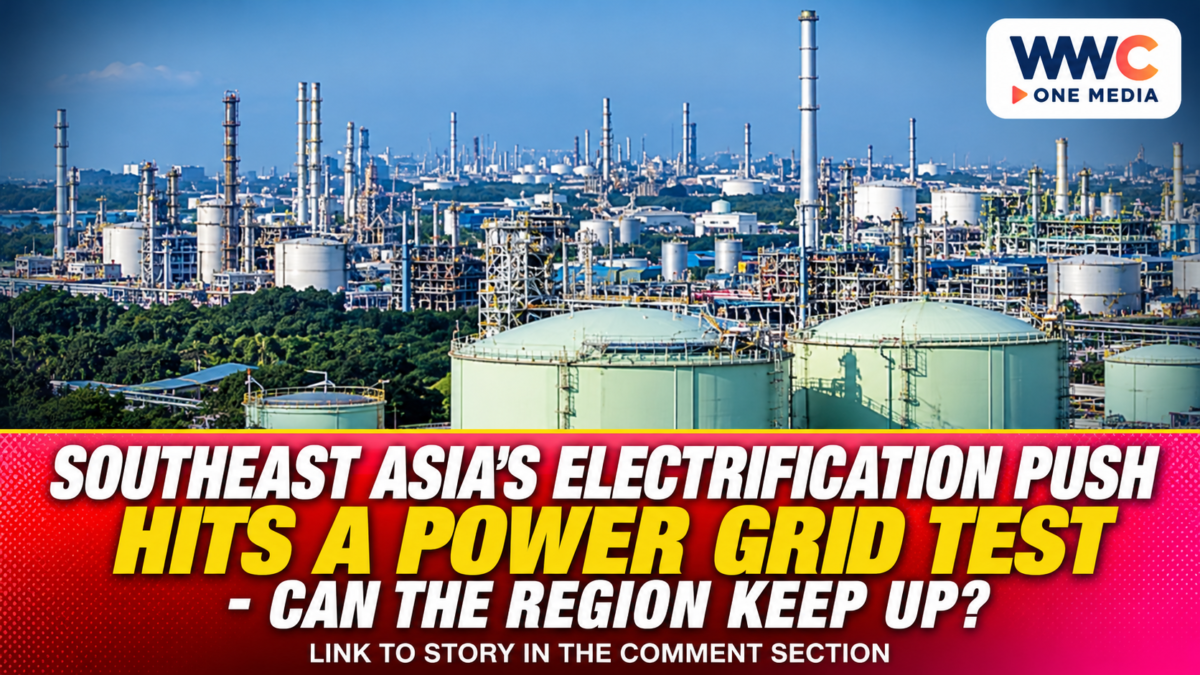
Southeast Asia’s shift towards electric vehicles, cleaner industries and electricity-powered buildings is gaining momentum, but the region faces a major challenge: expanding electricity use will deliver meaningful climate benefits only if power supplies and transmission networks can keep pace.
A new electrification package presented at the COP31 climate conference in Antalya, Türkiye, on Nov. 19 brought together initiatives involving governments, businesses, investors and cities. For Southeast Asia, the push comes as electricity demand continues to rise while coal and natural gas remain deeply embedded in the region’s power systems.
The issue is no longer simply whether more households, factories and vehicles can switch to electricity. It is whether countries can generate enough power, strengthen their grids and make cleaner electricity available at a cost that consumers and businesses can sustain.
COP31 puts electricity at the centre of the energy transition
The COP31 Electrification Delivery Package consolidates actions and announcements covering clean power investment, electricity networks, energy access, transport and industrial electrification.
The package involves more than 150 countries and the European Union, 37 cities and more than 260 businesses across six continents. It was presented to participating countries on Nov. 19 as part of the conference’s Global Climate Action Agenda.
Its priorities extend beyond electric cars. The programme links the expansion of electricity use with renewable power generation, stronger transmission and distribution networks, energy storage, buildings and industrial processes.
That distinction matters because replacing petrol or diesel vehicles with electric models is only one part of a much wider transition. Factories, commercial buildings and other major energy users must also find practical ways to replace direct fossil-fuel consumption with electricity.
The package itself acknowledges that the announced activities do not yet provide everything needed to electrify economies at the pace required by the Paris Agreement. Its significance lies in bringing existing projects, financing plans and new commitments into a common implementation framework.
Southeast Asia’s electricity demand is growing faster than its energy use
The region is entering a period in which electricity will account for a larger share of economic activity.
The International Energy Agency’s Southeast Asia Energy Outlook 2026 says electricity demand is already growing twice as fast as overall energy use. Electricity represents almost one-quarter of the region’s total final energy consumption.
Over the next decade, the increase in electricity demand is projected to be equivalent to Japan’s entire current electricity generation.
Several forces are contributing to that growth. More households are using air-conditioning, industrial activity is expanding, and data centres are becoming an increasingly important source of demand.
The IEA expects the number of residential air-conditioning units in the region to triple by 2035. That creates a substantial challenge for electricity providers, particularly during periods when high temperatures push demand towards peak levels.
The growth of electric mobility adds another layer. The agency reported that Southeast Asian electric vehicle sales more than doubled in 2025 to around half a million units, representing nearly 20% of vehicle sales.
However, higher electricity consumption does not automatically mean lower emissions. The environmental result depends heavily on how the electricity is generated.
The coal problem behind the electric vehicle boom
Southeast Asia’s power mix remains a major obstacle to cleaner electrification.
The IEA’s ASEAN Energy Security Review says coal currently provides nearly half of electricity supply across ASEAN member states, with particularly high shares in Indonesia, the Philippines and Viet Nam. Natural gas also remains important, dominating electricity generation in Brunei Darussalam, Singapore and Thailand.
This creates a difficult transition. Electric vehicles can reduce the use of petrol and diesel on roads, but the emissions benefits become less substantial if the electricity used to charge them comes predominantly from fossil-fuel power plants.
The same concern applies to factories and buildings. Replacing direct fuel consumption with electricity can improve efficiency, but the overall climate impact depends on the power supply behind the switch.
The IEA says solar capacity in the region reached nearly 38 gigawatts in 2025, more than 15 times its level a decade earlier. Wind and solar generation are also projected to expand rapidly by 2030.
Yet renewable generation must grow alongside electricity demand. If power consumption rises faster than cleaner generation, countries could become more dependent on existing coal and gas facilities to maintain supply.
Why the ASEAN Power Grid matters
One of the region’s potential advantages is the ability to connect national electricity systems and trade power across borders.
The ASEAN Power Grid is intended to strengthen regional electricity connectivity and support multilateral power trading. The ASEAN Centre for Energy identifies the initiative as a strategic priority for improving energy security, resilience and connectivity among member states.
Cross-border electricity links could allow countries with available generation to supply neighbouring markets facing tighter conditions. They could also help integrate renewable resources across a wider regional system.
The IEA estimates that planned cross-border interconnections under the ASEAN Power Grid will require about US$27 billion in investment by 2040.
But connecting national networks involves more than constructing transmission lines. Countries must also coordinate technical standards, market rules, regulations and commercial arrangements.
The ASEAN Centre for Energy has published work on minimum technical standards and the requirements for multilateral electricity trading, reflecting the institutional work needed to make regional power exchange more practical.
For the Philippines, this regional agenda connects with domestic efforts to expand generation and improve electricity infrastructure. WWC previously examined the country’s participation in regional energy security and electricity cooperation.
The Philippines has its own grid and investment challenge
The Philippines is pursuing additional renewable generation and energy storage, but new projects must still connect to a power network capable of delivering electricity to consumers.
A growing project pipeline does not automatically translate into operating capacity. Developers must complete technical studies, secure approvals, arrange financing and meet connection requirements.
That challenge was evident in the country’s renewable-energy pipeline. WWC previously reported on 17.8 gigawatts of Philippine energy projects entering the grid-study process. The projects included battery storage, wind, solar and other generation technologies.
Storage is particularly important because solar and wind output varies with weather and time of day. Batteries can help shift electricity availability and provide grid-support services, although they do not replace the need for adequate generation and transmission capacity.
Individual developments also show how generation and grid infrastructure must advance together. PetroGreen’s Isabela solar project, for example, involves both solar development and a dedicated transmission connection for its larger phase.
For island communities, the challenge is different again. WWC has also examined a Philippines-Indonesia-Viet Nam initiative involving solar power and battery storage for remote areas, where reliable electricity requires solutions suited to smaller and less-connected power systems.
Investment must translate into electricity people can use
The COP31 package highlighted several financing and infrastructure initiatives, but announced investment plans should not be confused with completed projects.
The Utilities for Net Zero Alliance reported plans for at least US$156 billion in combined annual investment across grids, renewable energy and storage. Its members also reported deploying more than 21,000 kilometres of new grid infrastructure in 2025.
Another development was the launch of the Asia Electrification Fund by Octopus Energy. The fund is targeting US$600 million for solar, wind, storage and electric vehicle charging projects, with US$50 million in initial backing from Japanese investors.
Its first investment supports a Philippine developer planning a pipeline of 450 megawatts of solar capacity and 350 megawatt-hours of battery storage.
These figures point to growing investor interest, but the distinction between a target, a financing commitment and an operating asset remains important. Projects still need to pass through development, construction, connection and commissioning before they can deliver electricity.
For consumers, the practical measure of success will be whether electricity becomes more reliable and affordable while the power mix becomes cleaner.
What happens next
The next test is implementation.
Governments and energy companies must expand renewable generation while upgrading transmission and distribution networks. They also need to improve storage, strengthen electricity-market arrangements and coordinate cross-border power trading.
For Southeast Asia, electrification is increasingly tied to energy security as well as climate policy. Greater use of domestic renewable resources could reduce exposure to imported fuels, but only if electricity systems can support the transition.
The COP31 package has brought together a broad set of initiatives. Whether these efforts change the region’s energy outlook will depend on how quickly announced plans become completed infrastructure and reliable electricity supply.
Frequently asked questions
What is the COP31 Electrification Delivery Package?
It is a collection of actions and updates presented at COP31 covering clean power, electricity grids, energy access, transport and industrial electrification.
Why is electrification important for Southeast Asia?
It can help reduce dependence on imported fossil fuels and replace direct fuel use in transport, buildings and industry. Its climate benefits depend on the cleanliness of the electricity supply.
Why does coal use matter for electric vehicles?
Electric vehicles use electricity instead of petrol or diesel. If that electricity is generated mainly from coal, emissions are shifted from vehicles to power plants rather than eliminated from the energy system.
What is the ASEAN Power Grid?
It is a regional initiative to connect electricity networks and support cross-border power trading among ASEAN countries, improving regional energy connectivity and flexibility.
Will the electrification push immediately lower electricity bills?
No immediate reduction is guaranteed. Electricity costs will depend on generation expenses, fuel prices, infrastructure investment, financing, market rules and how these costs are reflected in consumer rates.