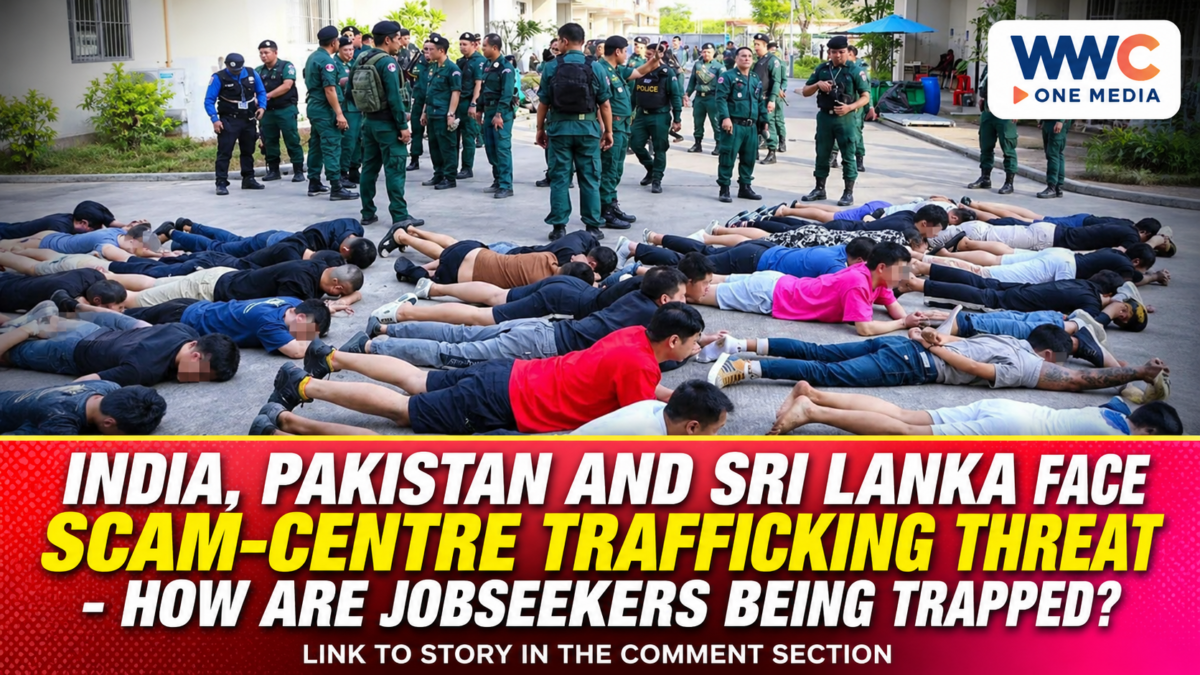
An overseas job offer promising attractive pay and office-based work can become a route into forced online fraud, with official records from India, Pakistan and Sri Lanka documenting nationals caught up in scam-centre operations across Southeast Asia.
The scale of the problem is reflected in a February 2026 response to India’s Parliament: the government reported that 6,998 Indian nationals had been rescued from scam centres in Cambodia, Laos and Myanmar between 2022 and 2025. Sri Lankan authorities have separately documented repeated rescues from Myanmar, while Pakistan’s embassy in Cambodia has warned its citizens about fraudulent recruitment leading to forced participation in online scams.
The cases reveal a criminal system that does more than steal money from people online. It can also exploit jobseekers, move them across borders and force some of them to become part of the fraud they were promised they would never have to commit.
Scam-centre trafficking is no longer a single-country problem
The United Nations Human Rights Office reported in February 2026 that people from multiple countries had been trafficked into scam operations, primarily in Southeast Asia. Its report drew on interviews with survivors from Bangladesh, China, India, Myanmar, Sri Lanka, South Africa, Thailand, Viet Nam and Zimbabwe.
The individuals interviewed had been trafficked into scam centres in Cambodia, Laos, Myanmar, the Philippines and the United Arab Emirates between 2021 and 2025.
The report also found that the operations were spreading beyond their traditional concentration in the Mekong region. Satellite imagery and on-the-ground information indicated that nearly three-quarters of identified scam operations were in the Mekong region, while others had appeared in parts of the Pacific, South Asia, the Gulf, West Africa and the Americas.
This geographical spread matters because recruitment, transportation, the scam operation itself and the financial transfers can take place in different countries. A person may be recruited at home, travel through a transit country and eventually be taken to a compound where the actual work is nothing like the advertised position.
The Financial Action Task Force’s 2026 report on illicit financial flows linked to scam compounds describes the industry as a transnational criminal ecosystem. It notes that people from at least 80 countries and territories have been identified in scam compounds in Southeast Asia.
India’s rescue figures reveal the scale of the recruitment pipeline
India’s Ministry of External Affairs provided a detailed breakdown in a written answer to Rajya Sabha Unstarred Question No. 716, answered on Feb. 5, 2026.
The government reported the following number of Indian nationals rescued:
- Cambodia: 44 in 2022, 207 in 2023, 982 in 2024 and 1,300 in 2025.
- Laos: 74 in 2022, 244 in 2023, 558 in 2024 and 1,421 in 2025.
- Myanmar: 338 in 2022, 89 in 2023, 147 in 2024 and 1,594 in 2025.
The combined total reached 6,998 across the three countries during the four-year period.
The figures show that rescues increased sharply in 2025 across all three destinations. Myanmar recorded the largest number that year, followed by Laos and Cambodia.
However, the government also made an important qualification: the exact number of Indian nationals stranded in these countries was not known. It said some people reached the scam centres through fraudulent or unscrupulous recruitment agents and illegal channels, making the full scale difficult to establish.
The figures therefore represent documented rescues, not the total number of people who may have been recruited, trapped or still missing.
India said its diplomatic missions worked with host governments and relevant agencies to secure rescues and repatriations. Its parliamentary response also described the issue as one raised with host governments at the political level.
Pakistan’s embassy issued a direct warning about fake overseas jobs
Pakistan’s government has also documented the recruitment methods used to draw its nationals into scam operations.
In a public notice, the Pakistan Embassy in Phnom Penh warned that agents operating in Pakistan and Cambodia were recruiting young Pakistanis for supposed employment in Cambodia.
The advertised positions included data entry, call-centre work, marketing and online jobs, often accompanied by attractive salary packages. The embassy said the agents arranged visas and air travel, after which recruits arriving in Phnom Penh could be deceived into signing contracts and sent to scamming companies.
The warning described workers being forced into online scams and financial fraud. It also said companies could torture those who refused to participate and demand thousands of US dollars from people who wanted to leave.
The embassy urged applicants to verify the credentials of companies claiming to offer employment in Cambodia before accepting a job.
A separate Pakistani Foreign Ministry statement dated April 28, 2026, addressed 54 Pakistani nationals detained in Cambodia after a raid on a scamming compound in Siem Reap Province. The ministry said Cambodian authorities had agreed to their early repatriation without legal proceedings under the country’s online-scam law.
In a May 7 briefing, Pakistan’s spokesperson said 49 of the 54 had returned and another three had secured tickets for that day. The briefing did not account for the remaining two.
These records demonstrate why a job offer should not be treated as legitimate simply because an agent can arrange travel documents or a flight.
Sri Lanka’s repeated rescues show the human cost
Sri Lanka’s Foreign Ministry has also documented multiple groups of nationals rescued from cybercrime centres in Myanmar.
On March 17, 2025, the ministry announced that 14 Sri Lankans who had been trafficked and forcibly employed in cybercrime centres in Myawaddy, Myanmar, had been rescued and were scheduled for repatriation.
On May 7, 2025, it announced another rescue involving 15 Sri Lankan nationals. The operation involved Sri Lankan diplomatic missions in Myanmar and Thailand, with cooperation from the governments of both countries and assistance from the International Organization for Migration.
A further announcement from Sri Lanka’s embassy in Bangkok recorded the repatriation of 25 nationals on Dec. 16, 2025, after they had been trafficked into cybercrime centres in Myawaddy.
The cases show that rescue operations can require cooperation among several governments, immigration authorities, diplomatic missions and humanitarian organisations. Getting people out of a compound is only one part of the process; arranging safe travel and supporting their return also require coordination.
Sri Lanka’s embassy in Yangon participated in the August 2026 launch of the “Lives Behind Scam” campaign, organised by the United States Embassy, the United Nations and IOM. The campaign focused on fraudulent overseas employment schemes and the risks of trafficking, forced labour and abuse in scam compounds.
Why people inside scam compounds must not automatically be treated as criminals
One of the most important findings in the UN Human Rights Office report is that people working inside scam operations may themselves be victims of trafficking.
Survivors described being recruited for jobs under false pretences and then forced to carry out online fraud. The abuses documented included confinement, violence, food deprivation, sexual exploitation and threats against workers and their families.
Some reported that they were subjected to punishment when they failed to meet imposed scamming targets. Others described being pressured to participate in fraud despite having originally travelled for legitimate employment.
This distinction has serious implications for law enforcement.
A person found inside a scam compound may have participated in fraudulent activity, but that fact alone does not establish whether the person joined voluntarily, was deceived or was forced to work under threat. Authorities need to investigate each person’s circumstances and identify the recruiters, controllers and people profiting from the operation.
The UN report urged governments to recognise forced criminality within anti-trafficking laws and apply the non-punishment principle to trafficking victims. It also called for safe rescue operations, rehabilitation and protection against retaliation or being trafficked again.
The issue is relevant to the Philippines, where authorities have also dealt with foreign nationals found inside suspected scam facilities. WWC previously examined Filipinos recruited through misleading job offers into Myanmar scam compounds, highlighting why the circumstances of workers must be established rather than assumed.
The recent Pasay scam-hub raid involving 159 foreign nationals also illustrates the cross-border nature of suspected scam operations and the need to distinguish alleged organisers from people who may have been exploited.
The money behind the scams is part of the investigation
The criminal networks cannot be understood only by looking at the people making calls or sending messages.
The FATF’s 2026 assessment explains that scam compounds depend on a wider system involving recruitment, technology, payment collection, money laundering and the movement of illicit proceeds. Different parts of an operation may be handled by separate groups or service providers across multiple jurisdictions.
That structure can make investigations difficult. Shutting down one building does not necessarily dismantle the financial and logistical network that supported it.
The FATF therefore calls for authorities to follow the money, identify the people controlling the operations, investigate recruitment networks and strengthen international cooperation. It also highlights the importance of financial institutions, digital-asset service providers and telecommunications companies in identifying suspicious activity.
For countries such as India, Pakistan and Sri Lanka, this means prevention cannot rely on public warnings alone. Governments need to investigate fraudulent recruiters, exchange information with destination countries and ensure that people rescued from scam centres can access protection and assistance.
What happens next
The records from the three South Asian countries point to a continuing need for coordinated action against fraudulent overseas recruitment and forced online fraud.
Jobseekers need reliable ways to verify employers and recruitment agents before travelling. Diplomatic missions need to respond quickly when nationals disappear or report coercion, while law enforcement agencies must identify the networks arranging travel, controlling compounds and moving money.
The Philippines also has a stake in this response. Regional cooperation on migrant-worker protection and safer recruitment is essential when a jobseeker can be recruited in one country and exploited in another. The new ASEAN migrant-worker recruitment framework reflects the wider regional effort to strengthen safeguards for people seeking work abroad.
The central lesson is that an online scam operation can have two sets of victims: the people defrauded through their screens and the people deceived into working behind them.
Until authorities can disrupt the recruitment and financial networks that sustain these operations, rescuing workers from individual compounds will remain only part of the solution.
Frequently asked questions
What are scam centres in Southeast Asia?
They are facilities or networks used to conduct online fraud, including impersonation, investment and romance scams. Some operations use trafficked workers who are forced to contact and deceive victims.
Which countries have reported nationals rescued from scam centres?
India, Pakistan and Sri Lanka have all documented cases involving their nationals in scam operations in Southeast Asia. The United Nations has also interviewed survivors from several other countries.
How are people recruited into scam compounds?
Recruiters may advertise fake overseas jobs through social media, online job platforms or intermediaries. Positions can be presented as data-entry, customer-service, marketing or information-technology work before recruits are transported and coerced into fraud.
Are everyone found working in scam centres criminals?
No. Some people may be trafficking victims who were deceived, confined or forced to participate in online fraud. Their individual circumstances must be investigated.
What should jobseekers do before accepting overseas employment?
Verify the employer and recruitment agency through the relevant government authority or embassy, confirm that the job and visa arrangements are legitimate, and be cautious of unusually attractive offers that cannot be independently verified.