PASAY CITY, Philippines — A suspected international scam operation hiding behind a seemingly ordinary office facility has been dismantled in Pasay City, after Philippine authorities arrested a Chinese national and two Malaysians allegedly linked to the operation and rescued more than 150 foreign nationals found inside.
The November 3, 2026 operation, led by the Criminal Investigation and Detection Group (CIDG), exposed an elaborate parcel scam operation that allegedly used fake police uniforms, staged police headquarters and intimidating video calls to steal money from victims in other countries.
Authorities said the facility targeted foreigners, particularly people in Indonesia and Vietnam, through a carefully coordinated scheme involving fake courier notifications, fabricated criminal investigations and threats that victims’ bank accounts and properties would be frozen.
The operation followed information from international law enforcement partners in Malaysia, Indonesia and Vietnam, as well as complaints from three Indonesian nationals who reportedly escaped from the facility and sought police assistance.
The discovery has raised two major concerns: how an international fraud operation allegedly operated inside the Philippines, and whether some of the foreign nationals found inside were recruited under false pretenses or forced to participate in the scams.
Three foreign nationals arrested as alleged scam operators
Authorities arrested one Chinese national and two Malaysians identified as alleged masterminds or operators of the Pasay scam hub.
The raid was conducted by the CIDG at a facility on the 15th floor of a building along Cuneta Avenue in Pasay City.
Interior and Local Government Secretary Jonvic Remulla and Philippine National Police (PNP) chief General Jose Melencio Nartatez Jr. oversaw the operation and inspected the premises.
According to police reports, the facility had been operating for approximately three months.
The operation reportedly involved foreign nationals who worked as callers or online agents, contacting potential victims overseas and carrying out different stages of the fraudulent scheme.
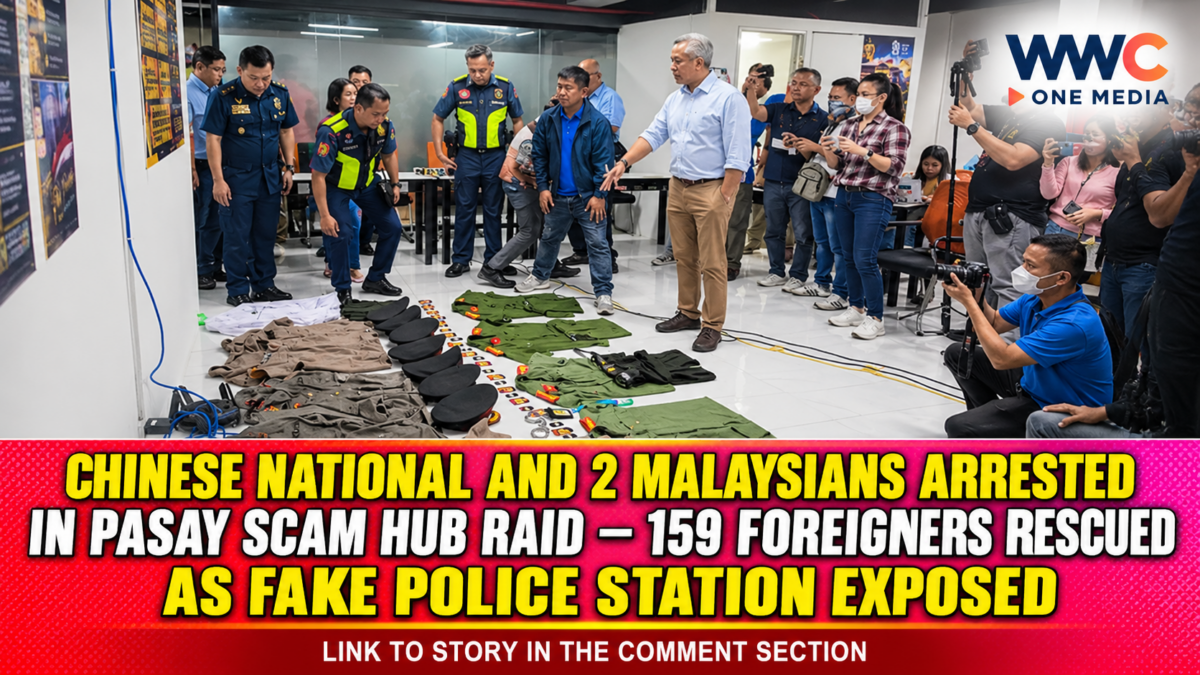
Police also recovered equipment and materials allegedly used to make the operation appear legitimate, including police uniforms, caps, patches, handcuffs and rooms designed to resemble police headquarters.
These props were reportedly used during video calls to convince victims that they were dealing with genuine law enforcement officers.
The three arrested suspects are facing investigation, and authorities are expected to establish their individual roles and the extent of their alleged involvement through evidence.
More than 150 foreign nationals found inside the facility
The operation resulted in the rescue or recovery of more than 150 foreign nationals, most of them reportedly Indonesian.
Philstar, GMA News and DZRH reported that 159 foreign nationals were rescued during the operation. Those found inside included Indonesian, Chinese, Malaysian and Vietnamese nationals.
However, the Daily Tribune separately reported that 166 foreign nationals were rescued and provided a different breakdown of their nationalities.
The discrepancy has not been reconciled in the reports reviewed, so the final number and nationality breakdown should be confirmed through an official consolidated accounting.
Authorities are also examining the circumstances of the people found inside the facility.
Their presence does not automatically establish that they were all willing participants in the alleged fraud. Some may have been recruited for what they believed were legitimate jobs, while others may have been subjected to coercion or exploitation.
The three Indonesian nationals who reportedly escaped from the premises played an important role in bringing the operation to the attention of authorities.
Their complaints helped trigger coordination between Philippine police and foreign law enforcement agencies.
How the four-stage parcel scam allegedly worked
CIDG-National Capital Region director Colonel John Guiagui described the operation as a four-stage parcel scam targeting people outside the Philippines.
The scheme relied on fear, impersonation and psychological pressure to persuade victims to surrender their money.
Stage 1: A fake courier notification
The operation allegedly began with a phone call from someone pretending to represent a courier or delivery company.
The caller would tell the target that a parcel was supposedly being delivered to their home or address.
However, no legitimate delivery would actually take place.
Stage 2: A fake police officer makes an accusation
A second caller would then contact the victim, pretending to be a police officer.
The impersonator would claim that the supposed parcel had been intercepted and contained illegal drugs or other prohibited items.
The victim would be told that they were connected to a criminal investigation and could face serious consequences.
The scammers allegedly threatened that the victim’s money, bank accounts and other properties could be frozen, confiscated or forfeited to the government.
Stage 3: Another fake officer offers help
After frightening the victim, another individual would allegedly contact them while pretending to be a senior or more sympathetic police officer.
This person would claim to offer assistance and suggest that the victim could avoid criminal charges or the freezing of assets by cooperating with an alleged investigation.
The fake officer would then ask for financial information, including bank statements, to assess how much money the victim had.
Stage 4: Victims are persuaded to transfer money
Once the scammers determined that a victim had accessible funds, they allegedly provided a bank account number and instructed the person to transfer money.
The transfer was presented as a way to protect the victim’s assets from government seizure.
In reality, the supposed safe account was allegedly part of the fraudulent operation.
Once the money was transferred, the victim would lose control of the funds.
The scheme relied on the impersonation of law enforcement officials and the fear of being accused of a serious crime.
Fake police uniforms and staged headquarters made the operation more convincing
One of the most disturbing discoveries was the facility’s elaborate setup.
Investigators recovered uniforms, caps and patches bearing insignia associated with Indonesian and Vietnamese police.
They also found rooms designed to resemble police headquarters.
These facilities were allegedly used during video calls to make victims believe that they were speaking with real officers conducting an official investigation.
The staged environment gave the scammers a way to reinforce their threats and make their fabricated accusations appear credible.
The operation reportedly included staged scenarios in which a courier was supposedly caught transporting illegal drugs.
By creating an entire fake law-enforcement environment, the group allegedly attempted to convince victims that the investigation was real and that immediate financial action was necessary.
The discovery illustrates how modern fraud operations can combine digital communication with physical props and staged environments to manipulate people across borders.
Three Indonesians who escaped helped expose the alleged operation
The investigation reportedly began after three Indonesian nationals managed to escape from the facility and seek assistance.
They approached authorities and provided information about the activities inside the premises.
Their complaints were coordinated with international law enforcement partners, particularly agencies in Malaysia, Indonesia and Vietnam.
PNP chief Nartatez said information from foreign counterparts and the three individuals who escaped helped authorities investigate the facility.
The case highlights the importance of international cooperation in investigating criminal operations that recruit workers from one country while targeting victims in several others.
It also raises questions about the recruitment methods used to bring foreign nationals into the Philippines.
Authorities are expected to examine whether people were offered legitimate employment, deceived about their actual duties or forced to participate in fraudulent activities.
PNP expands investigation to identify local financiers and recruiters
The investigation did not stop with the three foreign nationals arrested during the raid.
On November 4, Nartatez directed the CIDG to expand its investigation and identify possible Filipino financiers, recruiters, facilitators and other individuals who may have supported the operation.
The police are also examining possible links to financial networks and local businesses that may have provided assistance to the alleged syndicate.
Investigators want to determine who rented or controlled the premises, who arranged the recruitment of workers, how the operation was financed and where the proceeds from the alleged fraud were transferred.
The Daily Tribune also reported that authorities were looking into possible local connections and whether the operation had links to other criminal networks.
Police have not established that any particular Filipino individual or company was responsible for supporting the facility.
Any potential involvement must be determined through evidence and the proper legal process.
Was the Pasay facility connected to illegal POGO operations?
The discovery has also revived questions about the possible use of former Philippine offshore gaming operator (POGO) facilities or similar establishments for other forms of online fraud.
Philstar reported that the CIDG described the Pasay operation as a parcel fraud scheme rather than a POGO operation.
However, a November 5 Philstar report said authorities were also examining possible links between the suspects and banned POGO-related operations.
These are separate issues: the facility’s alleged parcel scam activity has been described by police, while any connection to former POGO operators or networks remains under investigation.
Authorities have not established that the raided facility was itself a licensed POGO or that a particular former POGO operator controlled it.
The broader investigation will need to establish whether the operation used corporate fronts, recruitment networks or financial arrangements connected to other establishments.
Authorities launch wider crackdown on scam hubs across Metro Manila
The Pasay raid has prompted a broader police campaign against suspected scam facilities.
On November 5, the National Capital Region Police Office (NCRPO) launched Operation: Break the Chain, a campaign targeting suspected scam hubs across Metro Manila.
The initiative covers the NCRPO’s five police districts and aims to identify not only alleged operators but also financiers, recruiters, property owners and financial networks that may support illegal operations.
Police units have been directed to coordinate with other government agencies to trace suspicious transactions, verify corporate identities and determine whether legitimate businesses are being used as fronts for criminal activity.
The campaign reflects a broader shift in enforcement: authorities are looking beyond the people making fraudulent calls and attempting to identify the networks that provide premises, workers, money and logistical support.
The Pasay case has become an important reference point for this effort.
What foreign jobseekers should watch out for
The investigation also carries a warning for people considering overseas employment or online job offers.
Police said some foreign nationals were allegedly recruited through social media platforms such as Telegram and Instagram, with advertisements offering virtual assistant or customer service positions.
These advertisements can appear legitimate, particularly when they promise attractive salaries and office-based work.
But applicants should be cautious when employers refuse to disclose the actual nature of the work, demand that passports be surrendered without a lawful reason, restrict workers’ movement or instruct them to participate in deceptive activities.
The PNP has urged jobseekers to verify employers, recruitment arrangements and job descriptions before accepting offers.
People who believe they have been deceived, threatened or forced into illegal work should seek help from the appropriate authorities and their embassies.
What happens next?
The CIDG is expected to continue examining the facility, interviewing individuals found inside and tracing the financial and recruitment networks allegedly connected to the operation.
Investigators must establish the identities and responsibilities of the people who organized the scam, determine whether local facilitators were involved and assess the circumstances of the foreign nationals found at the premises.
Authorities must also distinguish between alleged criminal operators and individuals who may have been trafficked, deceived or forced to work.
That distinction is critical because people who were exploited should receive appropriate protection and assistance rather than automatically being treated as offenders.
The Pasay operation has exposed an alleged fraud scheme that used fake police identities and staged headquarters to intimidate victims across Southeast Asia.
But arresting three alleged operators and securing the people found inside the facility may only be the beginning.
The fake police station has been exposed, and more than 150 foreign nationals have been accounted for—but who financed the operation, who recruited the workers and where did the stolen money go?