MANILA, Philippines — The Philippine National Police’s Metro Manila command operated a flexible security deployment during the 49th ASEAN Summit in November 2026, with commanders instructed to adjust personnel as conditions changed. Days after the Philippines handed the ASEAN chairship to Singapore on Nov. 17, the public record also showed an unresolved inquiry into the treatment of people apprehended during summit-related protests.
The distinction matters. Protecting foreign delegations, keeping roads passable and responding to emergencies are important operational responsibilities, but they do not by themselves establish whether every intervention against a demonstrator complied with Philippine law. Official police communications and the Commission on Human Rights’ (CHR) statement present different parts of that wider accountability picture.
ASEAN Summit Security Review: What Police Documented
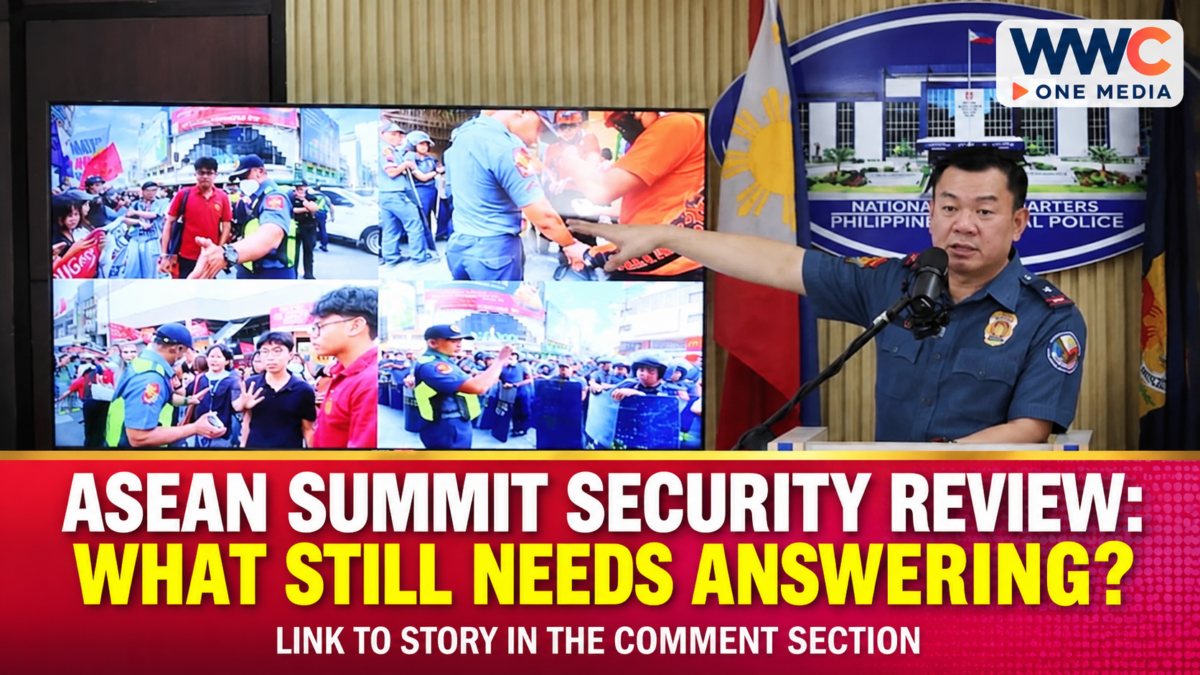
On Nov. 17, the National Capital Region Police Office (NCRPO) said its acting regional director, Police Brigadier General Christopher Abrahano, had ordered immediate assessments of deployment needs during the summit. District police leaders were directed to exchange information about crowd movements, congestion and potential security concerns so personnel could be repositioned when necessary.
That is a description of how commanders intended the operation to function, not a published final evaluation of its results. An assessment of effectiveness would also need to examine incidents, responses and the reasons for individual decisions. WWC previously examined security deployments and checkpoint safeguards ahead of the summit.
The advance preparations reached beyond the police force. A Nov. 12 government announcement recorded the mobilisation of 774 personnel and 119 specialised assets for a joint emergency-preparedness and response task group led by the Office of Civil Defense. Those assets included ambulances, fire engines, engineering equipment and communications systems.
These figures describe a specific emergency-response deployment, not a total headcount for all summit security services. Combining them with separate police deployment numbers would misrepresent the scope of the official announcement.
Why a Security Operation Needs More Than One Measure
In September, Malacañang declared Nov. 16 to 18 special non-working days across the National Capital Region under Proclamation No. 1447. The stated reasons included easing traffic congestion and enabling safety and security arrangements for summit participants.
That decision illustrates how a major international gathering can affect workers, commuters and businesses outside conference venues. It also means a useful post-event review would distinguish summit security from the broader effect of government measures on everyday mobility. WWC’s earlier report on the Metro Manila special non-working days explained the announced work-calendar changes.
Analysis: A deployment can accomplish its mission around diplomatic venues while still generating questions about traffic management or particular enforcement encounters. Measuring these aspects separately would give the public a clearer picture than a single, sweeping judgement about success or failure.
What the CHR Is Examining
The CHR’s Nov. 18 statement addressed protests held on Nov. 15 in Manila, Muntinlupa City and other locations. The commission said its teams had undertaken monitoring and quick-response visits, including at the Manila Police District and Camp Bagong Diwa.
Its initial monitoring recorded 11 people reportedly apprehended in Manila, including one minor, and more than 200 brought to Camp Bagong Diwa following the Muntinlupa demonstrations, including several minors. These were the commission’s preliminary descriptions; they were not a final consolidated police count, a list of people formally charged or a finding that every apprehension was unlawful.
The CHR also said its monitors observed people with visible injuries and raised concerns about congestion and ventilation at a temporary holding area. It was still examining allegations of mistreatment and restrictions on access to food. The commission reported that its team initially faced delayed access to Camp Bagong Diwa before being admitted late on Nov. 15.
Those observations justify examination but must not be confused with a final judgement against any identified officer. WWC has separately covered the CHR review of ASEAN protest arrests; this article focuses on how that review should be understood alongside the wider security operation.
The Legal Test for Arrests and Assemblies
Article III, Section 4 of the 1987 Constitution protects freedom of expression and peaceful assembly. Batas Pambansa Blg. 880, the Public Assembly Act of 1985, sets rules for public gatherings, police conduct and dispersal, including a requirement of maximum tolerance.
The law recognises circumstances in which permits are required and circumstances in which they are not. It also provides that attendance at an otherwise peaceful assembly cannot, by itself, be punished as a criminal offence under the law. Conversely, peaceful assembly rights do not exempt an individual from responsibility for independently unlawful conduct.
An accurate review must therefore look at the facts of each intervention: the conduct alleged, the legal provision invoked, warnings or other procedures required, and the person’s treatment after being taken into custody. Neither the existence of a large police deployment nor a broad description of crowd behaviour resolves those individual questions.
The Information Gap After the Summit
On Nov. 19, the NCRPO issued a separate warning about unverified social-media messages concerning summit security operations. Abrahano directed anti-cybercrime personnel to check the origins and authenticity of the material. The police command said enforcement should be impartial and grounded in applicable law and established procedures.
That position creates a practical standard for public communication. Claims circulating online require verification, but official assertions should also be supported by accessible records when they concern arrests, injuries or the treatment of detainees.
Analysis: A credible final review would distinguish operational incidents from unverified rumours, reconcile the different categories of people apprehended or charged, and explain how complaints were referred for independent assessment. Transparency would help both the public and police personnel avoid conclusions based on incomplete information.
What Happens Next
The CHR said it would gather police and medical records, seek accounts from affected individuals and examine the legal grounds for apprehensions before making an independent determination. It may recommend legal, administrative or policy measures if its findings warrant them.
As of Nov. 21, the primary records reviewed for this story did not establish a final, verified nationwide arrest total or a completed case-by-case CHR finding. The next meaningful measure of summit security will be whether official reviews provide a documented account of what happened, what was lawful and what should change.