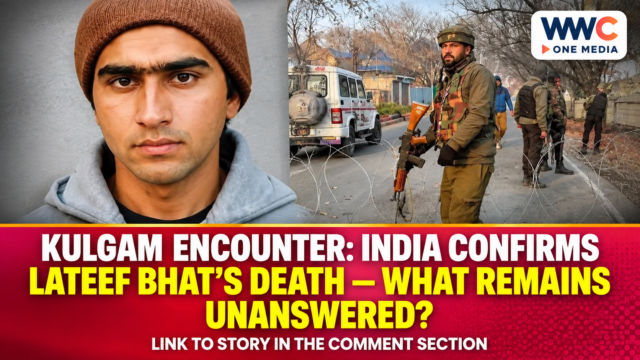
INDIA — Nov. 21, 2026. India’s established rules for fatal police encounters require independent scrutiny of the use of force, preservation of physical evidence and a formal inquiry. Those standards are especially important when public allegations involve a named suspect, purported criminal cases and an alleged exchange of gunfire.
An incident involving Wahid Ansari in Uttar Pradesh’s Ambedkar Nagar district has been described in news reporting, but this newsroom has not located an accessible, incident-specific police statement, first information report (FIR), medical record or judicial filing to verify that account from the public record. Consequently, the reported death and allegations of criminal conduct cannot be established to WWC ONE MEDIA’s primary-record standard. The publicly available legal framework, however, makes clear what official evidence should be examined before definitive conclusions are drawn.
Ambedkar Nagar Encounter: What India’s Rules Require
In its 2014 decision in People’s Union for Civil Liberties v. State of Maharashtra, India’s Supreme Court established a standard procedure for investigating police encounters resulting in death. The judgment requires that information or intelligence about grave criminal activity received by police be recorded in some form, subject to safeguards for sensitive details.
When police use firearms during an encounter and a death occurs, the judgment directs registration of an FIR and its forwarding to the appropriate court without delay. The record of a police operation is only the starting point. A lawful investigative process must be capable of testing what officers say happened against independent evidence.
The requirements are not an automatic conclusion that a particular shooting was lawful or unlawful. They are procedures designed to determine the circumstances fairly and preserve a record that can be scrutinised.
Why Independent Investigation Matters
The Supreme Court directs that the encounter be investigated by the Criminal Investigation Department or a team from another police station, supervised by an officer senior to the leader of the police party involved. This separates the officers who participated in the operation from the people responsible for assessing it.
The investigating team must identify witnesses, obtain statements and gather physical evidence. Investigators should establish the cause, manner, time and location of death, including through examination of the scene and available images or recordings.
In another context, WWC examined a fatal Manila police shootout and the planned examination of firearms. That incident does not establish anything about events in India. It illustrates why a description of an alleged exchange of gunfire and a completed forensic assessment are different kinds of information.
What Medical and Forensic Evidence Can Establish
Under the Court’s directions, a post-mortem examination must be conducted by two doctors at the district hospital and preserved on video. Evidence involving firearms, cartridges, projectiles and other materials must be recovered and kept for examination. Applicable tests can include gunshot-residue and trace-metal testing.
These steps can help test accounts of a fatal shooting. They do not guarantee a particular result, nor should a single forensic finding be presented as a substitute for the full investigation. Medical, physical and testimonial evidence need to be assessed together.
Where journalists cannot review such documents, responsible coverage should identify the information gap instead of filling it with purported precision about the number or location of wounds, the movements of those involved or the sequence of shots.
What Human Rights Oversight Adds
The National Human Rights Commission’s published procedures require state authorities to report deaths in police action, including encounters, within 48 hours. The commission explains that these reports should be followed by relevant documents, including post-mortem material, forensic laboratory findings, magisterial inquiry reports and independent investigation findings.
The Supreme Court also directs that a magisterial inquiry be held when a person dies during police firing and that the deceased person’s next of kin be informed promptly. These safeguards are relevant regardless of what accusations may have been made about the deceased.
The principle is applicable beyond one legal system. WWC’s coverage of police accountability during Philippine public demonstrations deals with different facts and domestic laws, but likewise considers the importance of records that permit public scrutiny of official action.
Why Allegations Must Be Kept Separate From Findings
A police allegation, a criminal complaint, an arrest warrant and a conviction are not interchangeable. Each records a different stage of proceedings, and none can be assumed simply because a person is named in a news report.
For any incident involving alleged arms trafficking or organised crime, case numbers, formal charges, warrants and court orders would help clarify the legal status of the claims. Without those records, counts of supposed pending cases or associations with named groups remain unverified for this article.
An investigation into a death during police action addresses a separate issue: what occurred in the confrontation and whether the use of force complied with law. Neither an allegation against the deceased nor an allegation against officers should be treated as established by assertion alone.
WWC’s earlier examination of accountability questions around an anti-drug police operation in Lucena concerned another jurisdiction and another incident. It underscores a general editorial distinction: an allegation or administrative proceeding is not itself a final finding of responsibility.
What Happens Next
For the reported Ambedkar Nagar incident to meet WWC’s primary-record publication threshold, an identifiable official police statement, FIR, court filing or equivalent incident-specific record must be obtained and read. Any claim about the identity of the deceased, alleged injuries to officers, recovered weapons or suspected criminal associations should be matched against that record.
If the incident is confirmed, the next questions concern whether the required investigation and magisterial inquiry were initiated, whether the human-rights reporting obligations were met and what evidence the responsible authorities can properly make public. Until the relevant records are available, the outcome remains unverified by this newsroom, and that limitation must be visible in any editorial decision.
Frequently Asked Questions
What rules govern deaths during Indian police encounters?
The Supreme Court’s 2014 encounter guidelines require an FIR, independent investigation, collection of evidence and a magisterial inquiry when death occurs during police firing.
Is an allegation of criminal activity proof of guilt?
No. Allegations, charges and findings of guilt have different legal meanings. The underlying public records must be examined before characterising a person’s criminal liability.
What does the NHRC require after a death in police action?
The NHRC requires reporting within 48 hours and subsequent investigative and medical documentation for scrutiny.
Has WWC independently verified the reported Wahid Ansari encounter?
Not from an incident-specific primary record available during this review. A definitive account should not be published under WWC’s stated standard until such a record is examined.