November 16, 2026 | WWC ONE MEDIA | National News
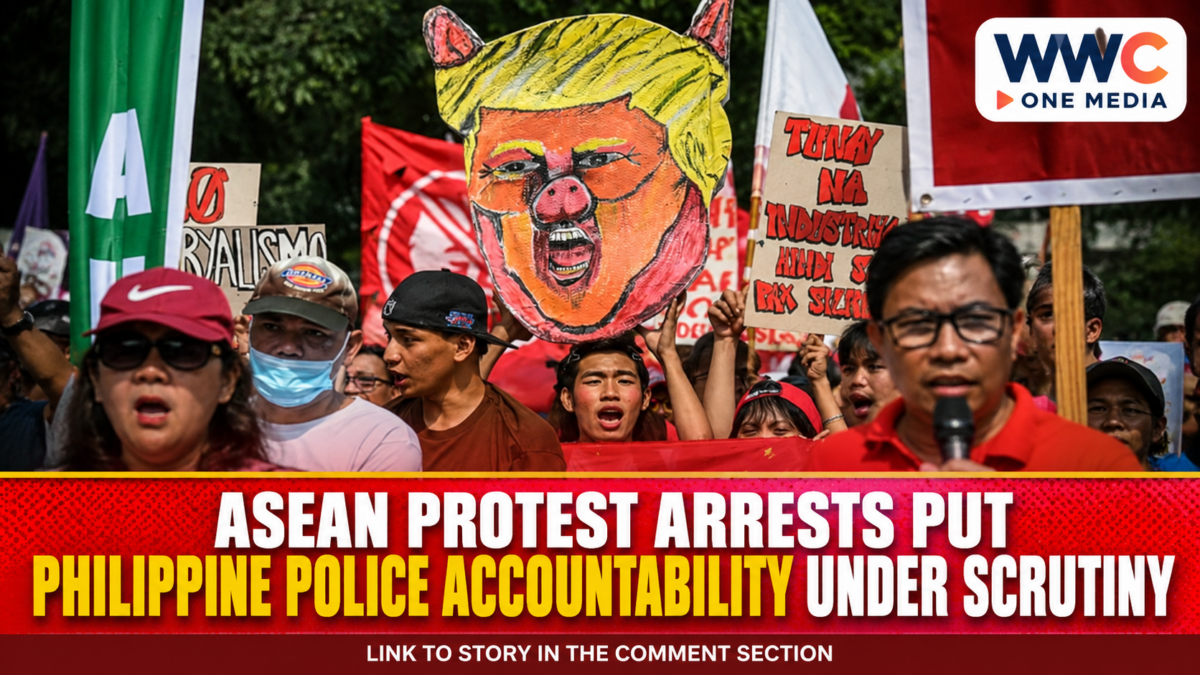
The November 15 demonstrations surrounding the 49th ASEAN Summit in Metro Manila have raised questions about police intervention, detention procedures and the protection of peaceful assembly after Amnesty International Philippines called for the release of protesters it said were detained during the rallies.
In a statement issued on November 15, the organisation cited reports of approximately 300 detained demonstrators, including nine people reportedly arrested at Liwasang Bonifacio in Manila. The figures remain attributed to the organisation and have not been independently established through a complete official arrest and detention record. Amnesty Philippines+1
The issue now extends beyond the demonstrations themselves. It concerns the responsibility of authorities to explain individual arrests, provide detainees with legal safeguards and demonstrate that security operations during major international events remain consistent with Philippine law.
ASEAN Protest Arrests Raise Questions About Detention Procedures
The demonstrations took place on November 15, during the opening of the Philippine-hosted ASEAN Summit.
Amnesty Philippines described two separate incidents in its public statement.
The first involved protesters at Liwasang Bonifacio who were attempting to march towards the Philippine International Convention Center, or PICC, in Pasay City.
The organisation reported that nine individuals were arrested during the encounter.
A second incident involved a police blockade near Sucat People’s Park in Parañaque City. Amnesty cited reports that approximately 300 protesters from Southern Luzon had been detained while attempting to join demonstrations in Manila. Amnesty Philippines
These figures require careful interpretation.
The approximately 300 figure is an estimate cited in Amnesty’s statement, not a verified final count of people formally arrested, charged or still detained.
Those categories are legally and administratively different. A person temporarily taken into police custody is not necessarily someone who has been formally charged with an offence.
For that reason, a complete accounting should identify where each person was taken, the legal grounds for the intervention and whether the individual remains in custody.
The Constitution Protects Peaceful Assembly
The events bring attention to Article III, Section 4 of the 1987 Philippine Constitution.
It protects freedom of speech, expression and the right of people to assemble peacefully and petition the government for redress of grievances.
This protection is not suspended simply because the country is hosting foreign leaders or an international summit. officialgazette.gov.ph
The Public Assembly Act of 1985, or Batas Pambansa Blg. 880, provides additional rules governing public demonstrations.
The law defines maximum tolerance as the highest degree of restraint that police and other peacekeeping authorities must observe during a public assembly or its dispersal.
It also provides that gatherings in duly established freedom parks do not require a prior permit, subject to applicable legal requirements.
The law further states that participation in an otherwise peaceful assembly is not, by itself, grounds for criminal liability simply because the gathering lacks a required permit. lawphil.net
This distinction is important when assessing arrests during public demonstrations.
Authorities may enforce legitimate laws and address specific unlawful conduct. However, the existence of a large gathering or disagreement with government policy does not automatically establish individual criminal responsibility.
Police Security Directives Must Be Matched With Accountability
Before the November 15 demonstrations, the Philippine National Police publicly called for peaceful and responsible expression during the summit.
PNP chief General Jose Melencio C. Nartatez Jr. also stated that police actions should remain lawful, impartial and professional.
The police leadership had emphasised the constitutional right to peaceful assembly while reminding organisers of the requirements under the Public Assembly Act. Philippine News Agency
Separately, Malacañang announced on November 14 that President Ferdinand R. Marcos Jr. had directed police to observe maximum tolerance when dealing with protesters.
Palace Press Officer Claire Castro also called for the circumstances surrounding reported incidents to be established before conclusions of police abuse were reached. Philippine News Agency
These official positions establish an important standard against which the November 15 incidents should be assessed.
The next step is to determine whether operational decisions, individual arrests and the treatment of detainees were consistent with those commitments.
That assessment requires more than competing public statements. It requires arrest records, incident reports, custody information and, where relevant, independent examination of available footage.
Access to Lawyers and Families Becomes a Critical Issue
Amnesty Philippines has called for people in custody to receive prompt access to lawyers, their families and necessary medical attention.
It has also demanded that authorities explain the specific legal grounds for each arrest and continued detention. Amnesty Philippines
These requests concern basic safeguards in the criminal justice process.
Under Article III of the Constitution, individuals have protections against unreasonable searches and seizures and are entitled to due process.
A person’s detention must have a lawful basis. Authorities must also follow the procedures governing arrest, custody and access to legal assistance.
The practical challenge is ensuring that these protections are available during large-scale security operations, when numerous individuals may be processed across different locations.
Families need reliable information about where detained relatives are being held. Lawyers need access to their clients so they can determine the legal circumstances of the detention and provide appropriate assistance.
For authorities, maintaining accurate and accessible custody records is an essential part of demonstrating that these procedures are being followed.
The ASEAN Summit Does Not Remove Domestic Legal Obligations
The Philippines is hosting the 49th ASEAN Summit and Related Summits from November 16 to 18, 2026.
The government has a legitimate responsibility to protect visiting officials, maintain security around official venues and manage possible disruptions.
However, these responsibilities operate alongside domestic constitutional protections.
WWC ONE MEDIA previously examined the security preparations and police deployment for the ASEAN Summit, including the challenge of maintaining public safety while respecting the rights of residents and demonstrators.
The current controversy makes that balance more immediate.
Earlier demonstrations involving the proposed Pax Silica initiative also generated debate over how authorities should respond to public opposition and criticism. WWC’s previous coverage of the Palace’s position on protests against Pax Silica provides additional context for the continuing discussion.
The issue is not whether the police should maintain security. They must.
The question is whether security measures are applied with clear legal justification, appropriate restraint and accountability when individual rights are affected.
What Happens Next?
The immediate priority is an official accounting of the people arrested or detained during the November 15 demonstrations.
Authorities should clarify:
- The total number of people arrested and the number subsequently released.
- The specific legal grounds recorded for individual arrests.
- The locations where detainees were brought and their current custody status.
- Whether detainees received timely access to legal counsel and family members.
- Whether complaints involving alleged excessive force or interference with journalists have been formally investigated.
Amnesty Philippines has also called for the unconditional release of people it believes were detained solely for exercising peaceful assembly and expression rights.
That demand should be considered alongside the legal circumstances of each detention rather than treating every person involved as having an identical case.
The government has an opportunity to address public concern through transparent documentation and an impartial review of the incidents.
The credibility of the country’s summit security operation will depend not only on protecting international delegates but also on demonstrating that the rights of Filipinos remain protected during the event.
Frequently Asked Questions
1. Why is Amnesty Philippines calling for protesters to be released?
Amnesty Philippines says approximately 300 protesters were reportedly detained during the November 15 ASEAN Summit demonstrations and is demanding the release of those detained solely for exercising peaceful assembly and expression rights.
2. How many protesters were reportedly arrested in Manila?
Amnesty’s November 15 statement cited nine individuals reportedly arrested at Liwasang Bonifacio and approximately 300 protesters reportedly detained near Sucat People’s Park. These figures have not been independently verified through complete official custody records.
3. Does Philippine law protect people who participate in rallies?
Yes. Article III, Section 4 of the 1987 Constitution protects peaceful assembly and expression. Batas Pambansa Blg. 880 also establishes rules governing public demonstrations.
4. Can police disperse a public demonstration?
Batas Pambansa Blg. 880 sets out circumstances and procedures governing dispersal. It requires maximum tolerance and provides different rules depending on whether an assembly has a permit where one is required and whether violence occurs.
5. What rights do arrested protesters have?
People in custody are entitled to constitutional and legal protections, including due process and applicable rights to legal assistance. Authorities must have lawful grounds for detention and follow established procedures.