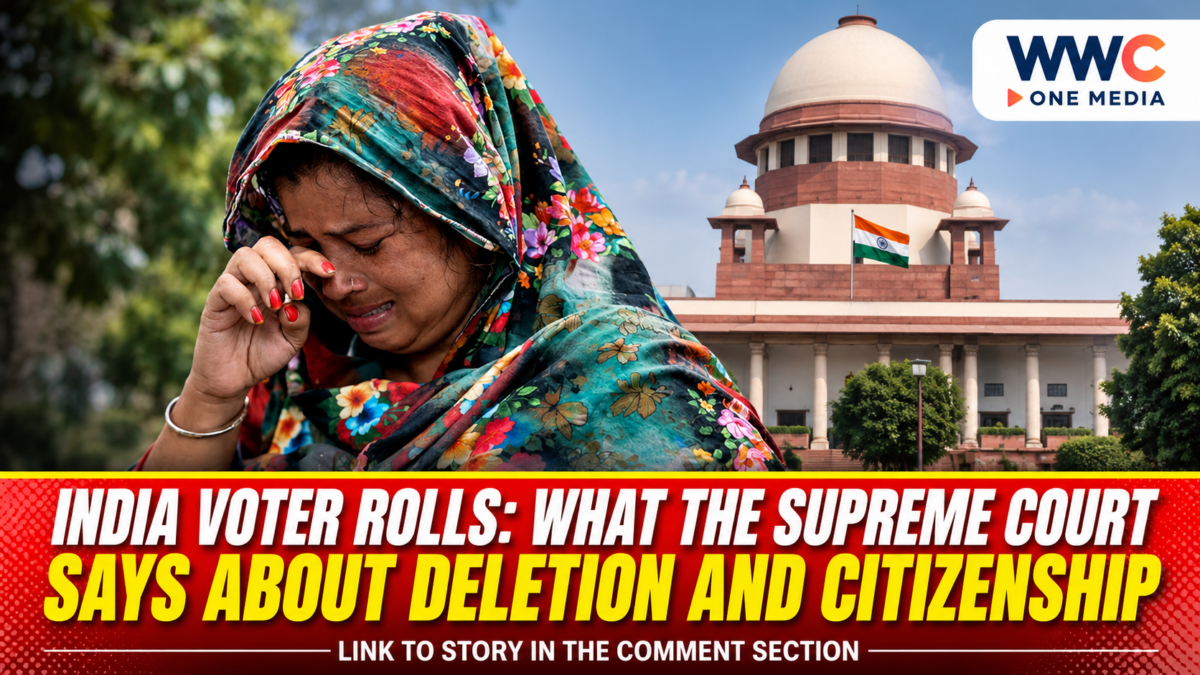
India’s voter-registration process has a legal boundary that is central to the debate over electoral-roll revisions: a person’s removal from a voter list does not, by itself, amount to a final declaration that the person is not an Indian citizen. The Supreme Court of India set out that distinction in a May 27, 2026 judgment arising from litigation over the Election Commission’s Special Intensive Revision in Bihar.
The ruling matters beyond the immediate Bihar proceedings because it explains the separate responsibilities of election officials and the authorities empowered to determine citizenship under Indian law. It also sets out procedural safeguards for voters whose registration is questioned.
The distinction is especially relevant as the Election Commission continues to publish revised electoral-roll information in several states. It provides a legal framework for understanding what a voter-list deletion can establish—and what it cannot establish on its own.
India voter rolls: the difference between registration and citizenship
The Supreme Court’s May 27 judgment in Association for Democratic Reforms and Others v. Election Commission of India and Others addressed challenges to the Special Intensive Revision conducted in Bihar.
The Court explained that the Election Commission may examine whether a person meets the statutory conditions for inclusion in an electoral roll. That inquiry is connected to voting eligibility, but it is not the same as a final determination of citizenship.
In its judgment, the Court said an electoral determination cannot assume finality on citizenship. Where the Commission is not satisfied that a person meets the conditions for enrolment, the matter must be referred to the competent authority within the Central Government for adjudication under the Citizenship Act, 1955. api.sci.gov.in+1
In practical terms, a voter may lose their place on an electoral roll following a lawful eligibility decision. But that decision does not automatically settle every separate question about the person’s citizenship status.
This distinction is important because electoral registration and citizenship are governed by different legal processes. Treating them as interchangeable could create confusion about the powers of election officials and the rights of individuals facing a citizenship inquiry.
What the Supreme Court said about notice and hearings
The judgment also examined the procedural protections available to people whose names are proposed for removal.
The Court discussed Rule 21A of the Registration of Electors Rules, 1960. It said the rule requires notice to the affected elector and an opportunity to be heard before an existing entry is deleted.
The Court’s review of the revision framework described several stages: household enumeration, preparation of a draft roll, claims and objections, examination by the Electoral Registration Officer, and an appeal mechanism.
Where an officer has doubts about an elector’s eligibility, the judgment says the process requires an inquiry and notice explaining the grounds for the proposed action. The affected person must have an opportunity to respond, and the officer must make a reasoned decision. api.sci.gov.in
The Court also distinguished draft-stage non-inclusion from final deletion. A name missing from a draft roll because an enumeration form was not received is not automatically the same as a completed decision to remove that person after the statutory process.
That difference matters to anyone checking their registration. A preliminary list should not be treated as the final outcome of an individual eligibility review.
The Bihar judgment does not decide every West Bengal case
The Supreme Court proceedings arose from the revision exercise in Bihar, not from the individual West Bengal detention and deportation accounts described in the story tip.
That limitation should remain clear when the judgment is used to explain the wider legal framework.
The Court’s ruling addressed the Election Commission’s authority, the revision procedure and the relationship between electoral eligibility and citizenship determination. Its legal reasoning provides guidance on those institutional boundaries, but it does not establish what happened in a separate police operation or decide the facts of an individual case in another state.
The Citizenship Act, 1955, separately provides for the acquisition and determination of Indian citizenship. It identifies routes including citizenship by birth, descent, registration and naturalisation. India Code
The distinction between identity, voter registration and citizenship documentation has also been examined in WWC’s earlier explainer on which documents can establish Indian citizenship.
For that reason, a report about detention or deportation requires its own official evidence: relevant court filings, orders, police records or government statements. A voter-list entry alone cannot prove the full sequence of events.
What the Election Commission reported about West Bengal’s rolls
The Election Commission’s March 15, 2026 press note provides an official snapshot of the electoral-roll revision in West Bengal and four other states or territories preparing for assembly elections.
The Commission said the Special Intensive Revision had been conducted in West Bengal, Tamil Nadu, Kerala and Puducherry, while Assam underwent a Special Revision. It listed Feb. 28, 2026, as the date of final publication for West Bengal’s electoral roll.
The same press note reported 6,44,52,609 general electors and 1,08,543 service voters in West Bengal, for a total of 6,45,61,152 electors in the published roll.
The Commission added that supplementary lists for West Bengal would follow in accordance with Supreme Court orders. The figures therefore describe the position reported in that March 15 document, not necessarily every subsequent update to the state’s electoral register. Election Commission of India
The published figures establish the size of the roll at that reporting point. They do not, on their own, identify the religion of people whose names were removed, explain the reasons for each individual deletion, or demonstrate whether any community was disproportionately affected.
Those conclusions would require separate, appropriately disaggregated official data.
Why citizenship and deportation require separate legal records
India’s legal framework distinguishes citizens from foreigners.
The Citizenship Act, 1955, governs the acquisition and determination of citizenship. The Foreigners Act, 1946, defines a foreigner as a person who is not a citizen of India and sets out powers concerning the entry, presence and departure of foreigners. India Code+1
These statutes make clear why a voter-list change should not be treated as a deportation order.
A decision about electoral enrolment concerns eligibility to appear on a voter register. A decision concerning a person’s status as a foreigner and any action affecting their presence in India must rest on the applicable immigration and citizenship laws and the relevant legal procedures.
That separation is not merely technical. It determines which authority is responsible, what evidence is relevant and what process an affected person may challenge.
It also means that a report alleging detention or removal across an international border should be supported by the underlying official records, rather than inferred from a change in voter-registration status.
The wider political debate over voter-list revision
Electoral-roll revisions have become a major political issue in India, with opposition parties and campaigners questioning the impact of large-scale verification exercises.
WWC has previously covered Rahul Gandhi’s detention during protests over India’s voter-list revision, as well as the detention and release of a youth movement organiser involved in demonstrations against the process.
Those reports concern the political response to the revision. They are separate from the legal questions decided in the Supreme Court judgment and do not establish the circumstances of individual citizenship or deportation cases.
The central policy challenge is balancing the Election Commission’s responsibility to maintain accurate electoral rolls with the need to protect eligible voters from wrongful exclusion.
The Court’s judgment recognises both sides of that responsibility. Electoral registers must meet legal eligibility requirements, but the process must also include notice, a meaningful opportunity to respond and access to the prescribed review mechanisms.
What happens next
The Election Commission’s March 15 release recorded the final publication date and elector totals for West Bengal, while noting that supplementary lists were expected under Supreme Court directions.
For individual voters, the practical issue is whether their names appear in the current electoral roll and whether any proposed deletion has been handled through the required procedure.
For cases involving citizenship doubts, the Supreme Court’s judgment says the competent Central Government authority must decide the citizenship question under the applicable law. The Court also directed that the relevant cases involving people deleted from Bihar’s 2003 roll on citizenship grounds be referred within four weeks, with notice and an opportunity of hearing. That specific direction arose from the Bihar proceedings. api.sci.gov.in
Further reporting on individual detention or deportation cases requires the relevant court records and official government documents. Until those records are available and examined, claims about particular individuals, the number of people affected or the role of religion should not be presented as established findings.
Frequently asked questions
Does removal from an Indian voter list mean someone is not an Indian citizen?
No. The Supreme Court said an Election Commission decision about electoral eligibility does not, by itself, constitute a final determination of citizenship.
Can an Indian voter challenge a proposed deletion?
The Supreme Court discussed safeguards requiring notice and an opportunity to be heard before an existing electoral-roll entry is deleted. The applicable appeal process may also be used to challenge an adverse decision.
Which authority determines Indian citizenship?
Citizenship questions are governed by the Citizenship Act, 1955, and are to be adjudicated by the competent authority under that law.
What did the Election Commission report about West Bengal’s voter roll?
Its March 15, 2026 press note listed 6,45,61,152 total electors in West Bengal, including general electors and service voters. It also said supplementary lists would follow under Supreme Court orders.
Does a voter-list deletion automatically lead to deportation?
No. Electoral-roll removal and action concerning a person’s status as a foreigner are separate legal matters. Deportation cannot be inferred from a voter-list change alone.