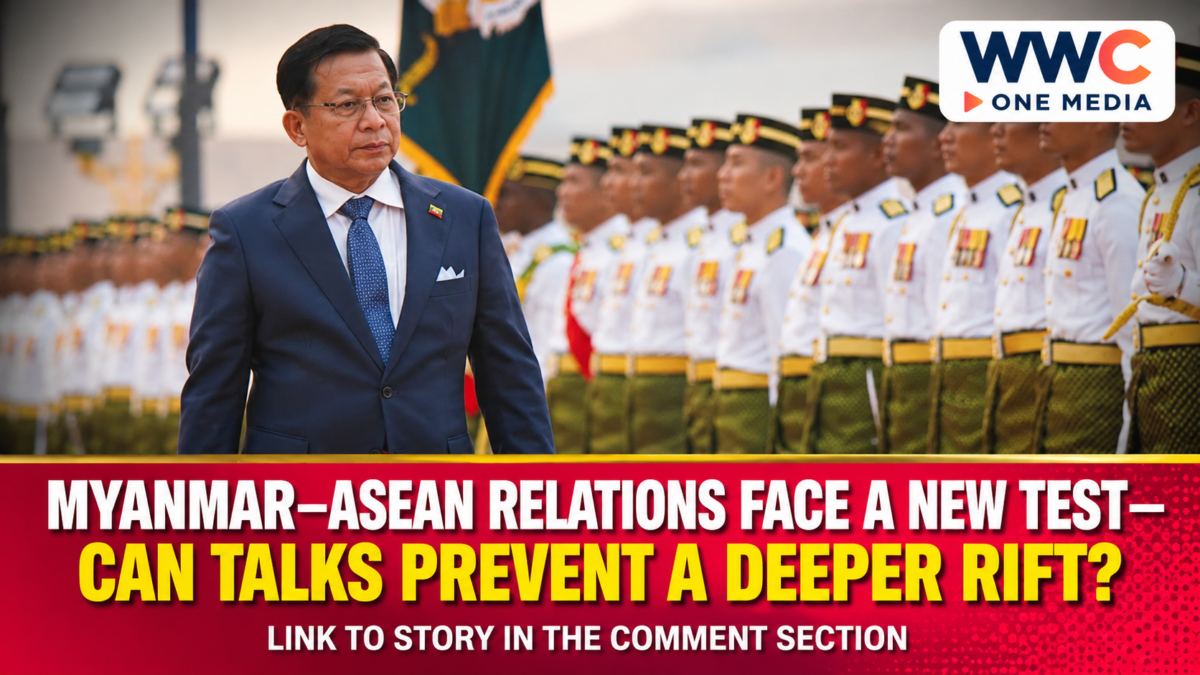
Myanmar’s President Min Aung Hlaing told the country’s parliament on Nov. 18, 2026, that his government would review its future engagement with the Association of Southeast Asian Nations (ASEAN). The announcement came three days after ASEAN leaders meeting in Manila reaffirmed their peace framework for Myanmar and maintained restrictions on the country’s representation at the bloc’s highest political meetings.
The disagreement places Myanmar–ASEAN relations at a sensitive point, but neither official document announces Myanmar’s withdrawal from the regional organisation. The central question is whether the two sides can continue talking while disagreeing over the conditions for restoring full political representation.
Myanmar–ASEAN relations: What the president actually announced
A government-published account of Min Aung Hlaing’s parliamentary address, carried in the Nov. 19 edition of The Global New Light of Myanmar, records his objection to recent ASEAN summit statements. He argued that the outcomes did not reflect the complete agreement of member states and announced a review of Myanmar’s future dealings with the organisation.
The same account says Myanmar would continue discussions with individual ASEAN members about normalising relations while maintaining its position on sovereignty. That distinction is important: a decision to reconsider the relationship is not the same as a formal decision to leave ASEAN.
The official account also refers to the president’s assessment of assistance after recent disasters. Those assessments are claims made in his address, rather than independent findings about the full scale of international support, and they do not establish any change in ASEAN membership.
What ASEAN decided in Manila
ASEAN leaders adopted their latest review of the Five-Point Consensus on Nov. 15, 2026. They reaffirmed the framework as the principal reference for responding to Myanmar’s political crisis and called on parties involved to reduce violence, protect civilians and create conditions for humanitarian assistance and inclusive dialogue.
The leaders recorded insufficient overall progress in implementing the framework. They nevertheless acknowledged limited advances in humanitarian work, showing that their assessment of the political process and aid delivery was not identical.
Critically, the decision continued Myanmar’s non-political representation at ASEAN summits and foreign ministers’ meetings until meaningful progress under the consensus. It also said Myanmar should be able to participate without restriction at all levels in other ASEAN sectoral ministerial bodies and mechanisms.
This is a restriction on representation at specified meetings, not a blanket removal of Myanmar from the organisation. WWC has separately examined the wider outcomes of ASEAN’s Manila summit, which illustrates why this dispute sits alongside a larger regional cooperation agenda.
The conditions for a political return
ASEAN’s November decision leaves a route towards restored representation, but it does not promise an automatic return. The leaders said they may consider a gradual restoration of Myanmar’s full political representation if there is sustained, concrete progress in implementing the Five-Point Consensus.
There is no fixed restoration date in the decision. Nor does it specify that one bilateral meeting, a government announcement or the passage of an election is sufficient to change the representation policy.
What this could mean: Myanmar can continue diplomatic contact without immediately gaining access to the bloc’s highest political meetings. Conversely, ASEAN can maintain its conditions while still supporting engagement through other channels. The practical test is whether contact produces developments that member states can assess against the agreed framework.
That distinction also shapes the questions facing neighbours. WWC’s coverage of Thailand’s diplomatic engagement with Myanmar explains how bilateral discussions may continue even when the broader regional dispute remains unresolved.
Humanitarian access is a separate measure of progress
The Manila decision welcomed an ASEAN Monitoring Team mission on Oct. 28 that marked the beginning of a month-long programme intended to reach more than 11,000 households, including four priority townships the ASEAN disaster-assistance centre had not previously reached.
ASEAN also noted Myanmar’s willingness to consider wider humanitarian access. At the same time, its leaders called for assistance to reach displaced people and underserved communities safely, effectively and without discrimination.
The figures record the scope of a programme beginning, not a verified final count of households that have received aid. They also do not demonstrate that the wider political crisis has been settled.
For an explanation of this distinction, WWC has previously examined why humanitarian progress does not automatically produce political change.
Why the dispute matters beyond summit invitations
The representation issue is one measure of a broader institutional challenge: how ASEAN maintains a common position while continuing to work with a member government that disputes aspects of the regional approach.
The November decision directs foreign ministers to keep engaging Myanmar, including through informal discussions. It also calls for coordination among successive ASEAN chairs and encourages engagement with the United Nations and neighbouring countries.
These provisions matter because the bloc has not presented diplomatic isolation as its only tool. Its formal approach combines pressure for progress with continued opportunities for dialogue and humanitarian cooperation.
The leaders also identified displacement, trafficking, cyber threats and online scams among the wider security risks connected to the region’s response. Those concerns help explain why the relationship cannot be reduced to a single disagreement over attendance at summits.
What happens next
ASEAN foreign ministers must monitor implementation of the November decision and report progress to the next ASEAN summit. Senior officials are also expected to continue exploring arrangements for a longer-term special envoy and ways to assess developments in Myanmar.
Myanmar’s official account says its government intends to keep discussing normal relations with other ASEAN members. Whether that contact leads to a change in the government’s stance, progress under the peace framework or a revision of representation rules remains unresolved.
For now, the records establish a disagreement accompanied by continued channels for negotiation. They do not establish an ASEAN exit, a newly agreed peace deal or an unconditional restoration of Myanmar’s political representation.
Frequently asked questions
Is Myanmar leaving ASEAN?
No withdrawal decision appears in the official records reviewed. Myanmar announced a review of future engagement, while ASEAN’s Nov. 15 decision describes Myanmar as an integral member of the organisation.
Why is Myanmar’s political representation restricted?
ASEAN has tied full political representation at its summits and foreign ministers’ meetings to meaningful progress on the Five-Point Consensus, its framework for addressing the crisis.
Can Myanmar officials still join ASEAN meetings?
Yes, depending on the meeting. ASEAN maintained non-political representation for summits and foreign ministers’ meetings but said participation in other sectoral bodies and mechanisms should remain unrestricted at all levels.
What could change ASEAN’s decision?
The bloc said sustained and concrete progress on the Five-Point Consensus could lead it to consider restoring full political representation gradually. It set no automatic deadline.