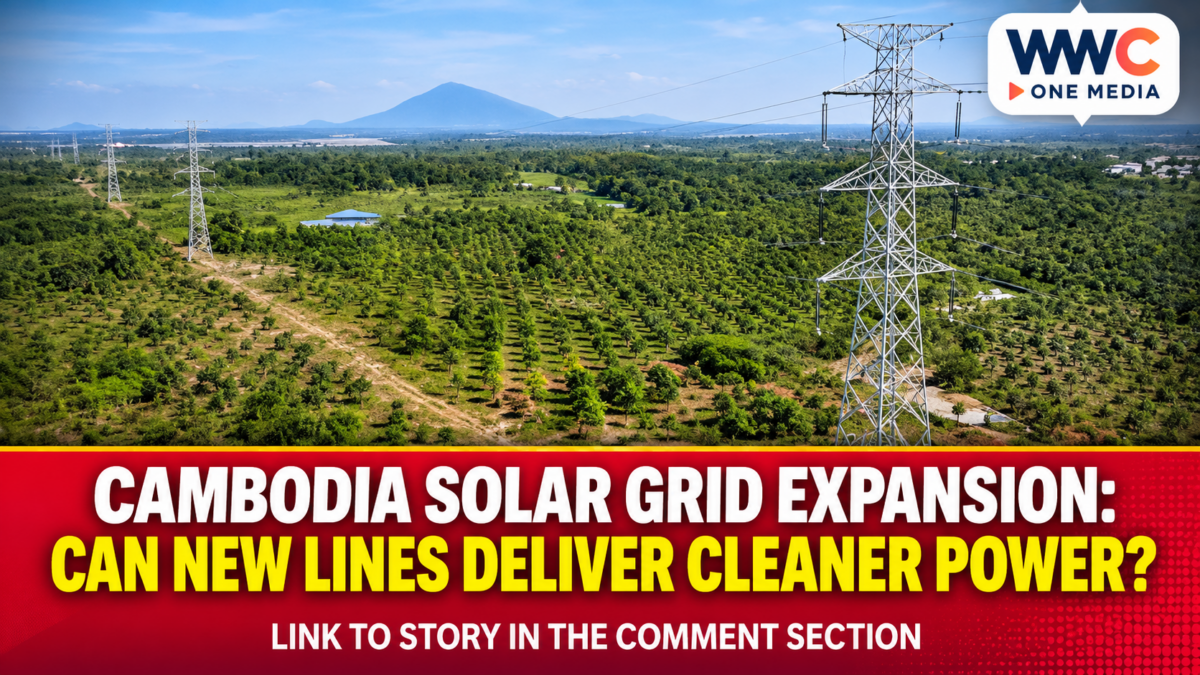
PHNOM PENH, Cambodia — Nov. 21, 2026. Cambodia’s electricity network is undergoing a documented expansion designed to carry more renewable power from western provinces towards major demand centres. The Asian Development Bank (ADB) approved a US$52.72-million loan in September 2025 for a grid project that includes a 55-kilometre, 230-kilovolt transmission line between Pursat and Kampong Chhnang and upgrades to nine substations.
The infrastructure is important because building a solar farm does not, by itself, ensure that its electricity reaches customers. Generators need transmission capacity, functioning substations and a stable network. Those requirements make grid investment a crucial test of Cambodia’s wider energy transition.
Cambodia Solar Grid Expansion: What Is Officially Approved?
ADB’s project announcement identifies two major types of investment: a 55-kilometre, 230-kilovolt line connecting Pursat and Kampong Chhnang, and upgrades to nine substations across Cambodia. The bank describes the objective as increasing the grid’s ability to accommodate renewable generation while meeting growing electricity demand.
A 230-kilovolt line is a high-voltage route used to move substantial quantities of electricity over distance. It is different from the lower-voltage networks that deliver electricity to individual homes and businesses. The nine substation upgrades matter because equipment at these points connects parts of the network and helps electricity move through it.
The project’s approved financing is not the same thing as its completed construction cost, nor does approval demonstrate that all works have already been commissioned. Any assessment of delivery must distinguish between financing, procurement, installation and operation.
Why Pursat and Kampong Chhnang Matter
ADB’s project documents identify Pursat and Kampong Chhnang as provinces with significant renewable-energy potential and describe Phnom Penh as a major demand centre. In practical terms, electricity produced where land and renewable resources are available must have a reliable path to where households, factories and commercial services use it.
Without adequate connections, an otherwise viable power project can face restrictions on how much electricity it may send to the network. Transmission expansion does not automatically remove every restriction, but it can address an important physical bottleneck.
The approach fits the larger regional challenge examined in WWC’s report on Southeast Asia’s electricity-grid investment gap. As electricity use expands, generation plans and the networks carrying that power must advance together.
Cambodia’s Electricity Supply Is Already Changing
ADB reported that Cambodia’s domestic electricity generation increased from 8.68 terawatt-hours in 2020 to 17.85 terawatt-hours in 2024. Over the same period, imported electricity declined from 3.06 terawatt-hours to 1.57 terawatt-hours.
Those numbers show a substantial shift in the amount of electricity produced domestically, but they do not establish that every additional unit came from solar power. Nor do they establish a precise future effect on household electricity bills. Generation mix, network costs and electricity tariffs are separate questions.
Cambodia’s Ministry of Mines and Energy identifies increasing renewable energy, improving efficiency and expanding electrification as central energy priorities. Its published rural-electrification indicators show village electrification at 99.15% and household connections at 95.24% in 2024.
A high rate of connection also does not tell the whole story about continuity or affordability of service. A connection can exist while the system still needs investment to handle rising demand, seasonal variations and new generating facilities.
Why Transmission and Storage Have Different Jobs
Transmission lines move electricity between places. Batteries can store energy for later use and provide services that support grid stability. The two kinds of infrastructure are complementary, not interchangeable.
A separate Cambodian grid-reinforcement project backed by ADB includes transmission and substation improvements and a pilot utility-scale battery energy storage system. That programme illustrates why renewable integration is a systems problem rather than a matter of simply adding more generating panels.
WWC’s coverage of solar and battery options for Southeast Asian islands addresses a different network setting, but it highlights the same basic lesson: useful renewable electricity depends on supporting infrastructure that matches local conditions.
Cambodia’s government has also described a World Bank-supported sustainable energy transition programme involving transmission, substations, batteries, distribution expansion and advanced metering. These investments should not be casually combined with the ADB’s 55-kilometre project; they are described in separate official programme records.
What This Could Mean for Consumers and Investors
Analysis: More robust transmission could help Cambodia use additional domestic renewable generation, reduce constraints on power flows and support reliability as demand grows. These are plausible benefits of the investment objectives, not confirmed outcomes of completed construction.
Businesses considering a new factory or industrial expansion need more than an announcement of power-generating capacity. They need dependable connections and clarity about when infrastructure will operate. Similarly, solar developers need credible grid-connection arrangements before forecast production becomes marketable electricity.
For consumers, lower generation costs do not automatically translate into lower bills. Financing, regulated charges, operating costs and the timing of new infrastructure all matter. WWC has also examined ASEAN energy-security cooperation and the difficulty of converting plans into functioning networks.
The appropriate test is therefore whether the planned improvements produce measurable capacity, reliability and the ability to connect renewable projects—not simply how many kilometres are announced.
What Happens Next
For the verified ADB grid expansion, the next milestones are contracting, construction progress, substation upgrades and eventual operational reporting. Project documents and subsequent implementation updates can show whether its financing is translating into installed assets.
A separate report has described a newly announced 120-kilometre, 230-kilovolt transmission proposal. However, the primary records reviewed for this article do not independently establish its route, financing or project identity. The confirmed ADB commitment discussed here covers 55 kilometres and must not be presented as proof of the reported 120-kilometre proposal.
Additional official project notices would be needed before describing the longer line as a verified new commitment. For now, the independently documented development is clear: Cambodia is investing in the grid infrastructure required to carry more renewable electricity to consumers.
Frequently Asked Questions
What is Cambodia’s verified solar-related grid expansion?
ADB approved a US$52.72-million project in September 2025 that includes a 55-kilometre, 230-kilovolt transmission line between Pursat and Kampong Chhnang and upgrades to nine substations.
Has a 120-kilometre transmission line been independently verified?
Not from the official primary records reviewed for this report. The documented ADB line is 55 kilometres; any separate 120-kilometre proposal requires its own official confirmation.
Why does a solar farm need a transmission line?
Solar panels generate power where they are installed. Transmission equipment helps move that electricity to substations and demand centres elsewhere in the grid.
Will this investment immediately reduce electricity bills?
No reduction is guaranteed. Bills depend on multiple factors, including generation costs, network investment, tariffs and how completed infrastructure is used.