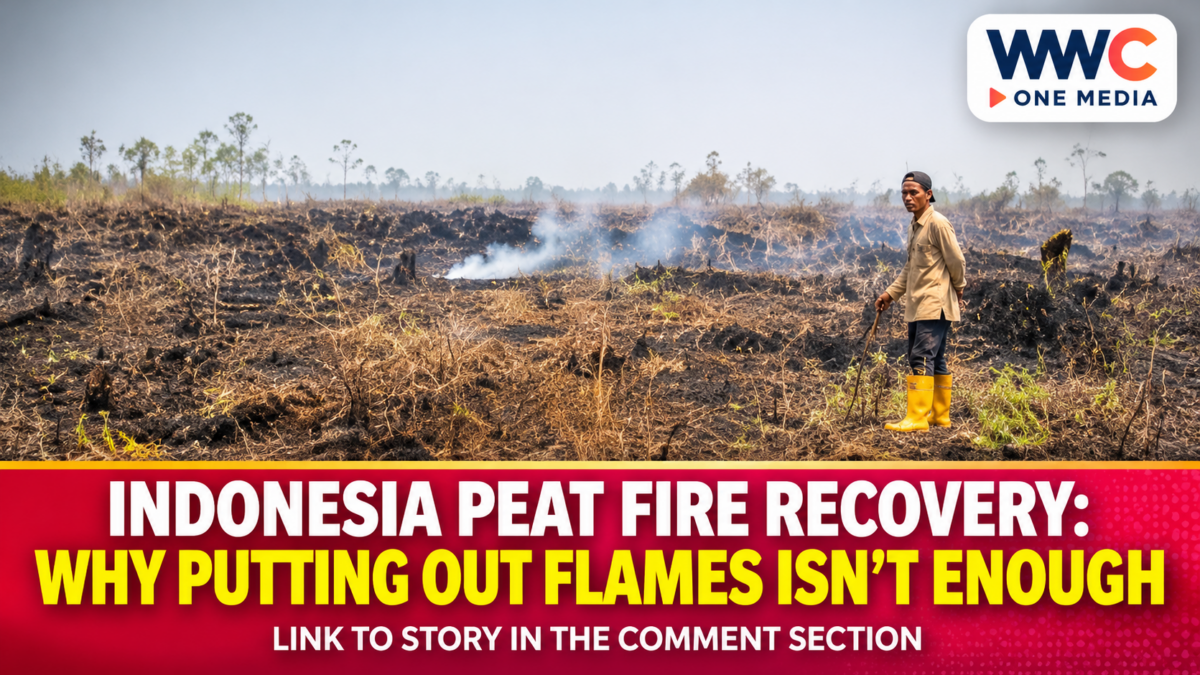
JAKARTA, Indonesia — Indonesia’s National Research and Innovation Agency (BRIN) outlined new findings on Oct. 6, 2026, explaining why extinguishing peatland fires does not necessarily restore the ecosystems they damage. The research highlights a central challenge for Indonesia peat fire recovery: restoring the water conditions that protect underground organic material from repeated burning.
The distinction matters because fire suppression and environmental restoration address different problems. Emergency crews can stop visible flames, but damaged peatlands may remain vulnerable if drainage systems continue to remove the water that historically kept them wet.
Why Indonesia’s Peatlands Are Difficult to Restore
Peatlands are wetlands where partially decomposed plant material accumulates over long periods. Unlike ordinary mineral soils, peat contains substantial organic matter formed under persistently wet conditions.
BRIN researcher Dony Rachmanadi explained in October that peat formation can be extraordinarily slow. Under ideal conditions, approximately one millimetre of peat may take about a year to develop.
That does not mean every burned peatland requires a fixed number of years to recover. The pace depends on the depth of damage, remaining vegetation, water conditions and the ecological functions being restored.
The distinction is important when discussing recovery estimates measured in centuries.
Losing a layer of peat accumulated over hundreds of years is not equivalent to losing vegetation that can regrow within a shorter period. A restoration project may establish new plants and improve water management without immediately replacing the organic material destroyed by fire.
For Indonesia, this creates a challenge extending beyond any single wildfire season.
Indonesia Peat Fire Recovery Starts With Water
BRIN identifies disrupted hydrology as one of the fundamental drivers of peatland fire vulnerability.
Healthy peat acts like a natural reservoir. Its ability to hold moisture helps maintain the conditions under which organic material accumulates rather than rapidly decomposing.
When canals or drainage systems lower water levels, peat can become dry enough to ignite. Fire may then continue beneath the surface, where it is difficult to locate and extinguish completely.
This means an area can appear safer after visible flames disappear while still requiring careful monitoring.
The agency’s research also suggests that repeated burning weakens the ecosystem’s ability to retain water.
Rachmanadi reported that one fire can reduce peat’s water-holding capacity by approximately 15%, while repeated burning across four incidents can bring the reduction close to 30%.
These findings help explain why prevention and restoration must be considered together. A landscape that burns repeatedly may become increasingly difficult to stabilise.
The implications extend to neighbouring countries. WWC ONE MEDIA previously examined Indonesia’s changing wildfire risk and the possibility of smoke reaching Mindanao, illustrating why regional environmental monitoring remains relevant.
Millions of Hectares Present a Restoration Challenge
Indonesia’s peatland system covers a substantial area, although official figures differ depending on what is being measured.
BRIN distinguishes approximately 13.4 million hectares of peat soil from roughly 24 million hectares of wider peat ecosystems defined through their hydrological characteristics.
The larger figure includes connected landscapes where water management in one location can affect conditions elsewhere.
Earlier research published by BRIN in February 2024 identified approximately six million hectares of degraded peatland with restoration potential.
The assessment highlighted Riau, Central Kalimantan and South Sumatra as major priorities.
Crucially, that six-million-hectare estimate is not a measurement of land burned during 2026. It represents a broader restoration opportunity identified through earlier research.
Treating these figures as interchangeable would exaggerate the known scale of recent fire damage.
The research also highlighted practical restoration methods, including rewetting, revegetation and supporting local livelihoods compatible with healthier wetland conditions.
Why the Economic Stakes Extend Beyond Burned Forests
Peatlands perform several environmental functions simultaneously.
They store carbon, help regulate water and support ecosystems that depend on wetland conditions. Their deterioration can therefore create costs that are not immediately visible in a burned-land assessment.
A fire that damages peat may affect carbon storage and future water retention even after surface vegetation begins returning.
This presents a difficult economic question: how should restoration programmes measure success?
Counting hectares planted with new vegetation provides one indicator. Measuring water levels, the risk of renewed ignition and the recovery of ecological functions offers a more complete picture.
Those measures can also help evaluate whether public spending is producing lasting improvements rather than temporary visual recovery.
The regional consequences are familiar to Philippine readers. WWC previously reported on Metro Cebu’s unhealthy air conditions during an Indonesian haze episode.
The connection underlines why preventing repeated fires can have value beyond the immediate restoration site.
Technology Could Help, but Prevention Remains Essential
BRIN is developing monitoring and suppression technologies to improve Indonesia’s response to peatland fires.
Its October research presentation described satellite-based monitoring that can identify hotspots, temperature abnormalities, land-cover conditions and burned areas.
The agency also discussed an experimental firefighting formulation called Singkong-APP, designed to address burning within peat material.
Initial tests described by BRIN showed promising results against residual combustion, but laboratory or early-stage findings should not be treated as evidence of nationwide operational effectiveness.
Technology can help authorities detect problems earlier and improve their response. It cannot independently restore the water systems on which peatland health depends.
Indonesia has also previously used weather modification in its fire response, a separate intervention discussed in WWC’s report on cloud-seeding efforts during the country’s wildfire crisis.
The broader policy issue is how emergency response, land management and long-term ecological restoration fit together.
What Happens Next
The central question is whether Indonesia can convert scientific findings into measurable restoration outcomes.
BRIN’s research points towards continued hydrological management, monitoring of degraded landscapes and cooperation among government agencies, land users and local communities.
Future assessments will need to distinguish between extinguished fires, stabilised peatlands and ecosystems that have recovered important ecological functions.
These are not identical milestones.
A reliable national assessment of the 2026 fire season would also require verified burned-area measurements, information on peat damage and consistent recovery indicators.
Until those findings are established, any single nationwide recovery timeline should be treated cautiously.
For Indonesia, the lasting test is not simply how quickly the fires can be extinguished. It is whether damaged landscapes can be made resilient enough to avoid burning again.
Frequently Asked Questions
1. How long does Indonesia’s burned peatland take to recover?
There is no verified single recovery period for all peatlands damaged in 2026. Recovery depends on the depth of damage, water conditions, vegetation and the ecological functions being measured.
2. Why are peat fires difficult to extinguish?
Peat contains organic material that can continue burning beneath the surface after visible flames disappear. Dry conditions and reduced groundwater levels increase the difficulty of suppression.
3. How much peatland could Indonesia restore?
BRIN’s 2024 research identified approximately six million hectares of degraded peatland with restoration potential. This is not the area burned in 2026.
4. What is the most important step in restoring peatlands?
Restoring suitable water conditions is essential. Rewetting, appropriate revegetation and effective landscape management can reduce vulnerability to further damage.
5. Why should the Philippines monitor Indonesia’s peat fires?
Smoke from regional fires can cross national borders under suitable atmospheric conditions. Monitoring fire activity, wind patterns and local air quality helps authorities assess potential impacts.