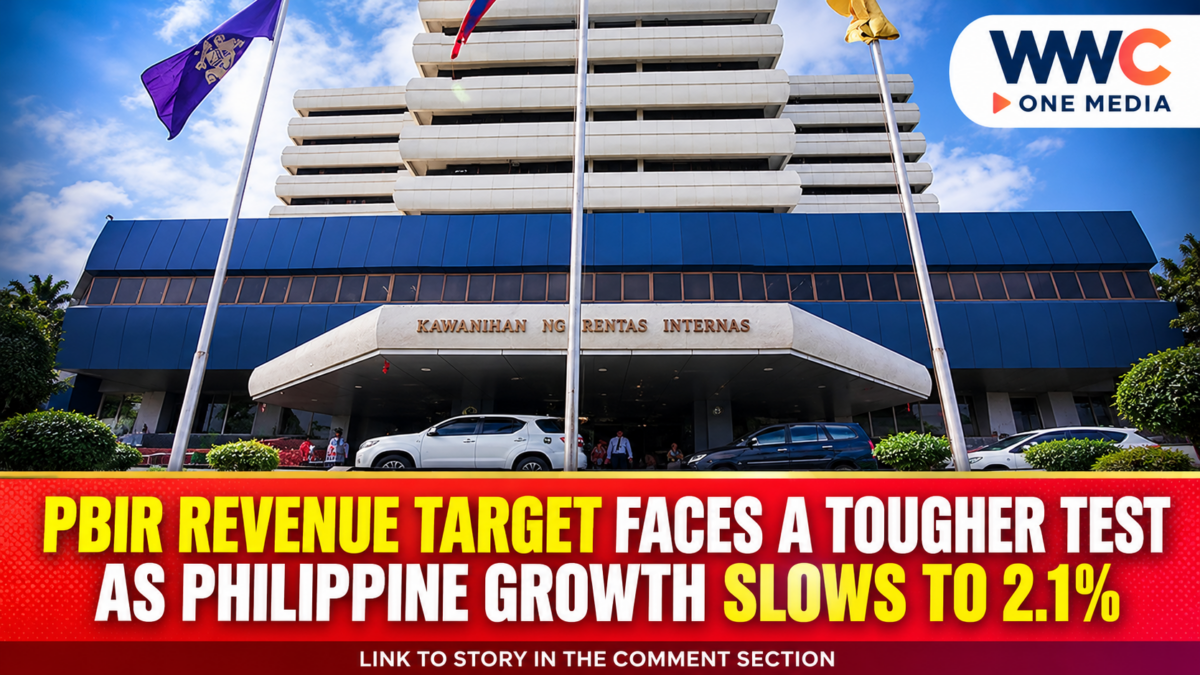
The Bureau of Internal Revenue (BIR) is entering the final stretch of 2026 with a demanding revenue collection challenge as official economic data show Philippine gross domestic product (GDP) growth slowing to 2.1% in the third quarter. Government treasury figures also show that the agency collected approximately ₱2.44 trillion during the first nine months of the year.
The figures put the government’s revenue expectations under greater scrutiny. Tax collections have continued to increase in peso terms, but the pace of economic activity matters because income, business transactions, consumption and corporate earnings all contribute to the country’s taxable economic base.
The latest figures do not establish that weaker growth has directly caused a collection shortfall. They do, however, highlight the challenge of maintaining revenue growth when economic expansion is considerably slower than the government’s earlier expectations.
BIR revenue target meets a slower economic environment
The Philippine Statistics Authority (PSA) reported that the country’s economy expanded by 2.1% year-on-year in the third quarter of 2026.
The performance came alongside a 3.7% increase in Services, while Agriculture, Forestry and Fishing contracted by 4.8%. Industry also recorded a slight year-on-year decline of 0.003%.
Household final consumption expenditure, an important indicator of consumer spending, increased by 2.4%.
These figures matter to tax collection because economic activity helps determine the income earned by businesses and individuals, the volume of taxable transactions and the level of consumption across the country.
A slower economy does not automatically translate into lower tax collections. However, it can make it more difficult for the government to generate the additional revenue needed to meet ambitious annual targets.
The government had already adjusted its economic assumptions earlier in the year. In its July 8 fiscal review, the Development Budget Coordination Committee (DBCC) lowered its 2026 GDP growth projection to a range of 3.5% to 4.5%.
The third-quarter result indicates that economic performance remained below that revised growth range on a year-on-year basis. Philippine Statistics Authority+1
Treasury figures reveal the scale of BIR collections
The Bureau of the Treasury’s September 2026 Cash Operations Report provides a clearer picture of how much the BIR contributed to government revenues.
The report recorded cumulative BIR collections of ₱2.441 trillion from January through September.
September alone contributed ₱203.420 billion.
The monthly figures also show considerable variation throughout the year.
| Month | BIR collections |
|---|---|
| January | ₱358.671 billion |
| February | ₱173.235 billion |
| March | ₱187.259 billion |
| April | ₱422.243 billion |
| May | ₱279.134 billion |
| June | ₱210.693 billion |
| July | ₱358.439 billion |
| August | ₱248.360 billion |
| September | ₱203.420 billion |
Source: Bureau of the Treasury, National Government Cash Operations Report, September 2026. Amounts are in current pesos.
The figures demonstrate why monthly comparisons alone can produce an incomplete picture of collection performance.
Some months generated considerably higher receipts than others. April, for example, recorded more than twice September’s collection.
The cumulative figure is therefore more useful when examining the agency’s contribution to the national government’s finances.
The report also recorded total national government revenues of ₱3.535 trillion during the first nine months, with tax revenues accounting for ₱3.225 trillion. Bureau of the Treasury
Why economic growth matters to tax collection
The connection between economic performance and government revenue is important, but it is not automatic.
When businesses expand, they may generate more taxable income and transactions. When household spending increases, consumption-related taxes can also benefit.
The reverse can happen when companies experience weaker sales, households become more cautious about spending, or investment activity slows.
However, the actual effect depends on several factors, including tax rates, exemptions, compliance, collection enforcement and the timing of payments.
This is why the BIR cannot rely exclusively on economic growth to meet its revenue objectives.
The agency also has to improve collection efficiency, reduce tax leakage and make compliance easier for individuals and businesses.
The BIR has been pursuing a more targeted approach to enforcement. Its cooperation with the International Monetary Fund on compliance risk management was previously examined in WWC’s report on the BIR’s data-driven tax enforcement programme.
The approach is intended to help identify areas where compliance risks require closer attention rather than applying the same enforcement strategy to every taxpayer.
Government has already revised its fiscal assumptions
The DBCC’s July 2026 review shows that the government has adjusted its fiscal expectations in response to changing domestic and international conditions.
The committee projected total national government revenues of ₱4.807 trillion for 2026.
It also projected government disbursements of ₱6.466 trillion, leaving a programmed fiscal deficit of approximately ₱1.659 trillion, equivalent to 5.4% of GDP.
These figures show why revenue collection remains important beyond the performance of one government agency.
The BIR is the country’s principal internal tax collection agency, while the Bureau of Customs and other government offices contribute additional revenue.
When collections fall short of expectations, the government may face greater pressure to manage its spending, borrowing and fiscal priorities.
The distinction is important: a BIR collection gap does not automatically translate into an equal increase in the national budget deficit because other revenue sources and expenditure movements also affect the final fiscal result.
The government’s revised fiscal programme also identifies digitalisation, tax administration and enforcement as important revenue-support measures. Department of Budget and Management+1
Tax administration becomes more important as growth slows
The economic environment puts additional importance on how efficiently the BIR administers the country’s tax system.
Better digital services can make it easier for taxpayers to register, file returns and settle obligations. More effective risk assessment can also help the agency concentrate enforcement resources where non-compliance is more likely.
The BIR’s work on artificial intelligence provides another example of its administrative modernisation efforts.
WWC previously examined Ayala’s development of an AI-powered tax assistant for BIR personnel, a project intended to help revenue officers retrieve and analyse tax regulations and related materials.
Such technology does not directly guarantee higher collections. Its potential value lies in improving access to information and supporting more consistent tax administration.
There is also a balance to maintain between stronger enforcement and reasonable taxpayer treatment.
Businesses need clear rules, predictable procedures and accessible services to comply with their obligations. WWC has also examined this issue in its coverage of proposed tax increases and their potential impact on businesses and households.
A tax system that collects efficiently while maintaining public confidence is more sustainable than one that depends primarily on aggressive enforcement.
What happens next
The next important development will be the BIR’s subsequent monthly collection reports and the national government’s updated fiscal performance figures.
Three indicators deserve attention:
- Cumulative collections: Whether BIR receipts continue increasing at a pace consistent with its annual collection programme.
- Economic activity: Whether consumer spending, business activity and overall GDP growth improve in the final quarter.
- Collection efficiency: Whether digitalisation, compliance programmes and enforcement measures translate into stronger actual receipts.
The government must also distinguish between higher nominal collections and stronger underlying economic activity.
An increase in peso collections does not necessarily mean businesses and households are experiencing stronger real purchasing power, particularly when inflation remains elevated.
For now, the official figures point to a difficult balancing act: sustaining tax revenue growth while the economy expands more slowly than previously projected.
The final months of 2026 will provide a clearer indication of whether improved tax administration can help compensate for the weaker economic environment.
Frequently asked questions
1. How much did the BIR collect in the first nine months of 2026?
The Bureau of the Treasury recorded approximately ₱2.441 trillion in BIR collections from January to September 2026.
2. What was the Philippines’ GDP growth in the third quarter of 2026?
The Philippine Statistics Authority reported year-on-year GDP growth of 2.1% in the third quarter.
3. Why can slower economic growth affect BIR collections?
Slower economic activity can affect business income, household spending and taxable transactions, potentially making revenue growth more difficult to sustain.
4. Does slower GDP growth automatically mean lower tax collections?
No. Tax collections also depend on compliance, enforcement, tax policies, payment timing and other administrative factors.
5. What can help the BIR improve its collections?
Improved digital services, stronger compliance monitoring, targeted enforcement and simpler tax procedures can help improve collection efficiency.