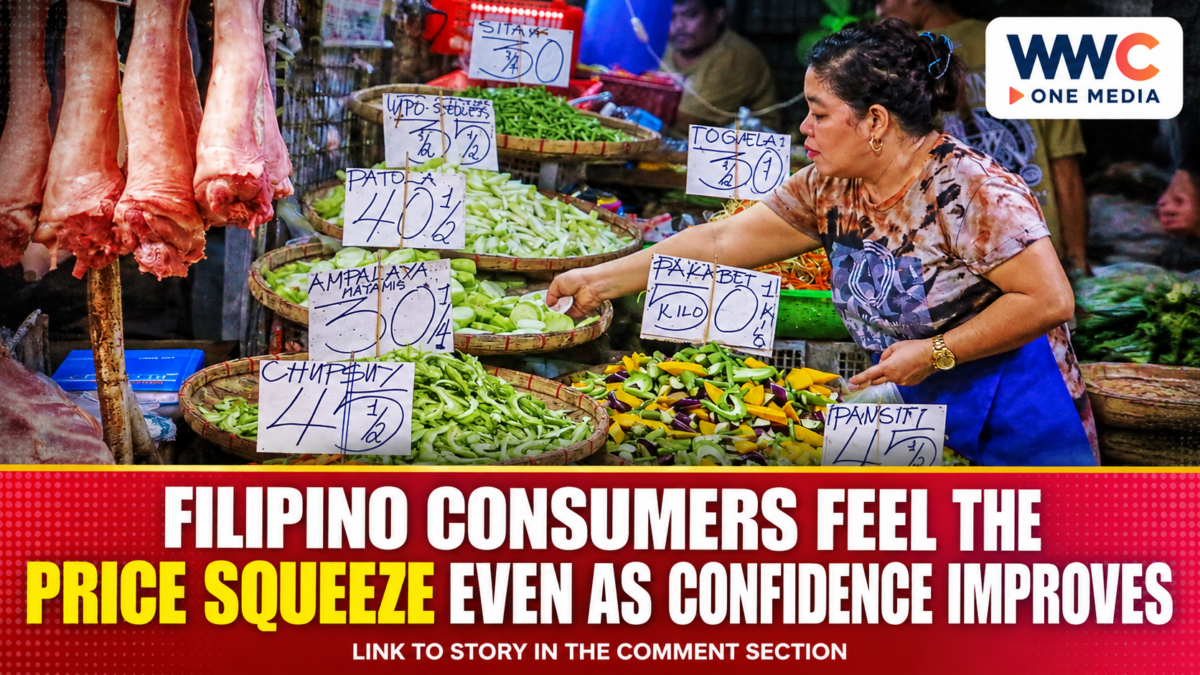
Filipino households entered the final quarter of 2026 facing higher living costs, even as consumer confidence improved during the third quarter, according to government economic and central bank data. Household final consumption expenditure increased by 2.4% year-on-year in Q3, while October inflation accelerated to 7.8%.
The figures reveal an important distinction between how consumers feel about their financial prospects and how much they are actually spending. Although the Bangko Sentral ng Pilipinas (BSP) recorded less pessimism among households, rising prices and cautious spending plans continue to present challenges for retailers, service providers and businesses that depend on domestic demand.
For the Philippine economy, this matters because household consumption remains an important component of economic activity. Improving confidence is encouraging, but it does not necessarily translate into stronger purchases when essential expenses absorb a larger portion of household budgets.
Consumer spending faces pressure despite improving confidence
The Philippine Statistics Authority (PSA) reported that household final consumption expenditure grew by 2.4% year-on-year in the third quarter of 2026.
On a seasonally adjusted basis, however, household consumption increased by just 0.4% compared with the preceding quarter.
These measurements describe different comparisons. The 2.4% figure compares spending with the same quarter a year earlier, while the 0.4% figure measures the change from the previous quarter after seasonal adjustments.
Both indicate that household spending continued to expand, but the quarter-on-quarter increase was modest.
The broader economy grew by 2.1% year-on-year during the same period. This placed household consumption in a difficult environment where overall economic expansion remained subdued.
The figures suggest that consumer demand continued contributing to economic growth, although its momentum was limited. Philippine Statistics Authority+1
BSP survey shows households becoming less pessimistic
The BSP’s third-quarter 2026 Consumer Expectations Survey offers another perspective on household behaviour.
Released on Sept. 28, the survey showed that consumer confidence improved across all three reference periods compared with the second quarter.
The current-quarter confidence index improved from -42.0% in Q2 to -29.8% in Q3.
The next-quarter index moved from -16.3% to -0.8%, while the outlook for the next 12 months increased from 0.2% to 9.1%.
BSP Consumer Expectations Survey, Q2 and Q3 2026.
The distinction between positive and negative confidence readings is important. A negative index means more respondents were pessimistic than optimistic. Therefore, the current-quarter and next-quarter results still reflected overall pessimism, despite their improvement.
The longer-term outlook, meanwhile, was positive.
The survey also revealed a more cautious approach to household finances. Stronger saving prospects, weaker spending plans for day-to-day household expenses and lower borrowing intentions indicated that improved confidence did not automatically mean households were ready to spend more.
The survey covered 5,476 households nationwide and was conducted from July 1 to 13, 2026.
These results provide evidence of improving sentiment, but they should not be interpreted as proof that actual household purchases have already accelerated. Philippine Information Agency
October inflation adds pressure to household budgets
The latest inflation report provides a reason why consumers may remain careful with their spending.
The PSA recorded headline inflation of 7.8% in October, up from 7.2% in September. Average inflation from January to October reached 5.6%.
Core inflation also accelerated to 5.4% from a revised 4.8%.
Transportation was among the major sources of pressure. Its annual price increase reached 20.1% in October, compared with 14.6% in September.
Housing, water, electricity, gas and other fuels recorded inflation of 9.3%, up from 8.4%.
Food and non-alcoholic beverages recorded 6.1% inflation, lower than September’s 6.7%.
The figures show that price increases were not uniform across household expenses. Some categories experienced faster inflation, while food inflation eased.
However, slower food inflation does not mean grocery prices returned to previous levels. It means that the annual rate of increase became slower.
For households, the practical issue is how much money remains after paying for food, transportation, electricity and other essential expenses. Philippine Statistics Authority+1
Why better confidence does not immediately mean stronger purchases
Consumer confidence measures household expectations and perceptions. Actual consumption measures spending recorded across the economy.
The two are connected, but they do not always move at the same pace.
A family may become more optimistic about employment or future income while still postponing a major purchase because current expenses remain high.
Another household may decide to save additional income or reduce borrowing rather than increase discretionary spending.
The BSP survey’s findings on saving prospects and day-to-day expenditure plans illustrate this distinction.
For businesses, this creates a more complicated consumer environment. Retailers may encounter customers who remain interested in shopping but compare prices more carefully, prioritise necessities and delay non-essential purchases.
This does not establish that all retail businesses are experiencing declining sales. Actual performance varies by product category, pricing, location and customer segment.
WWC previously examined the pressure on retailers in its coverage of O!Save’s expansion to 1,000 Philippine stores amid rising living costs.
The growth of value-focused grocery formats provides an example of how retailers are competing in a market where affordability remains important.
What the spending slowdown means for businesses
Household consumption affects businesses well beyond supermarkets.
Restaurants, transport operators, clothing retailers, electronics sellers, entertainment providers and other consumer-facing industries depend on household purchasing decisions.
When families allocate more money to essential expenses, they may have less flexibility for optional purchases.
Businesses may respond by adjusting product ranges, offering different price points, reviewing promotional strategies or focusing on essential goods.
However, companies should not assume that every consumer will react identically. Higher-income households and families with more stable earnings may maintain different spending patterns from those facing tighter budgets.
The economic implications also extend to investment and employment.
If businesses anticipate weaker demand, some may become more cautious about expanding operations or hiring additional workers. Such decisions could influence future household income and consumption.
WWC has also examined the wider economic pressures in its coverage of the BSP’s monetary-policy tightening and its implications for Philippine growth.
The challenge is balancing price stability with conditions that allow businesses to invest and households to maintain purchasing power.
What happens next
The next several months will help establish whether improved consumer confidence translates into stronger household expenditure.
Three indicators deserve attention:
- Inflation: Whether transportation, food, housing and utility costs begin increasing more slowly.
- Household consumption: Whether subsequent national accounts show stronger spending growth.
- Consumer expectations: Whether the BSP’s next surveys show continued improvement in household confidence and spending intentions.
The November and December inflation releases will also help determine whether the October acceleration represents a continuing pattern.
For businesses, the most useful signal will be actual consumer demand rather than sentiment alone. For households, the immediate concern remains whether income growth can keep pace with essential expenses.
The latest evidence presents a mixed picture: consumers are becoming less pessimistic about the future, but their spending decisions remain cautious.
The difference between those two developments could shape the Philippine retail and consumer economy as 2026 draws to a close.
Frequently asked questions
1. How much did household consumption grow in the Philippines in Q3 2026?
Household final consumption expenditure increased by 2.4% year-on-year and 0.4% quarter-on-quarter on a seasonally adjusted basis.
2. Did Filipino consumer confidence improve in Q3 2026?
Yes. The BSP reported improvements in all three consumer confidence indices compared with Q2, although current-quarter and next-quarter confidence remained negative.
3. What was Philippine inflation in October 2026?
Headline inflation reached 7.8%, compared with 7.2% in September.
4. Why are households still cautious about spending?
Higher living costs, essential expenses, saving preferences and lower borrowing intentions can influence household purchasing decisions even when confidence improves.
5. Does improved consumer confidence mean retail sales will increase?
Not automatically. Consumer confidence reflects expectations, while retail sales and household expenditure measure actual economic activity.