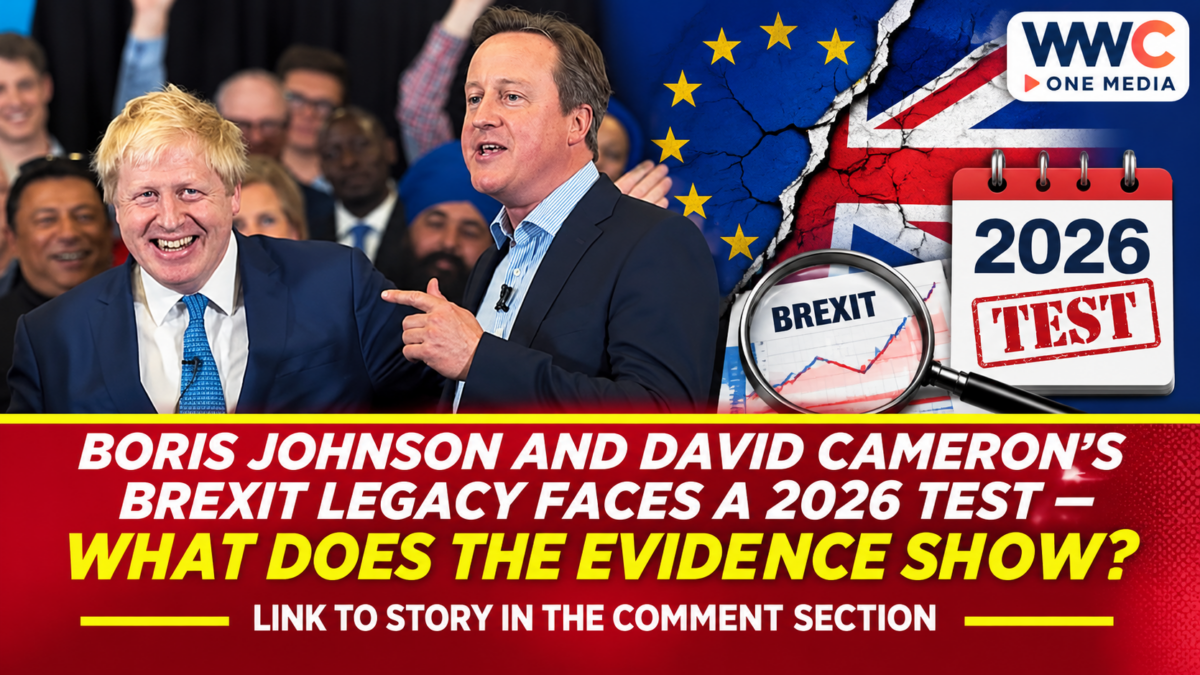
LONDON — Nov. 18, 2026. Ten years after Britain voted to leave the European Union, the economic legacy of former prime ministers David Cameron and Boris Johnson is returning to the centre of UK policy discussions. The government is preparing for a Nov. 20 UK–EU summit, while official records show that the referendum mandate and the subsequent trade arrangement remain different questions.
The distinction matters as Britain weighs closer cooperation with Europe without a formal return to EU membership. The referendum result, economic forecasts and new agreements require separate assessment.
Brexit Economic Legacy: Two Leaders, Different Decisions
Cameron served as prime minister from 2010 to 2016. His administration oversaw the June 23, 2016 referendum, in which 17,410,742 voters chose Leave and 16,141,241 chose Remain. The shares were 51.9% and 48.1%, respectively.
Johnson served as prime minister from July 24, 2019 to Sept. 6, 2022. Britain formally left the EU on Jan. 31, 2020, and began trading under the post-transition arrangements from Jan. 1, 2021. The Trade and Cooperation Agreement provided zero tariffs and quotas on goods meeting its origin requirements, but leaving the single market meant a different system of regulatory and customs procedures.
These are separate decisions: voters determined whether the UK should remain a member, while successive governments determined how withdrawal and future relations would work. Holding both stages up to scrutiny does not require dismissing the referendum result or assuming every economic difficulty since then was caused by Brexit.
What the Economic Forecast Actually Measures
Britain’s Office for Budget Responsibility maintains an assumption that the post-Brexit trading relationship will reduce long-run productivity by 4% relative to continued EU membership. It expects greater trade barriers to weigh on trade intensity and, over time, the economy’s capacity to produce goods and services.
That figure is not a verified statement that GDP fell by 4% in a particular year. It compares estimated future productivity under two different policy paths, only one of which can occur. The estimate can be reassessed as fresh evidence emerges.
The government’s current approach also cannot erase all effects simply by signing a limited sectoral agreement. More efficient food trade or energy cooperation might narrow individual costs without reproducing the economic conditions of full single-market participation.
WWC’s earlier analysis of the November UK–EU summit agenda explains which negotiations are under consideration. The economic assessment here asks a different question: how should policymakers judge the cumulative choices made since 2016?
The Trade Figures Show Pressure, Not a Single Cause
The Office for National Statistics reported a UK goods-trade deficit, excluding precious metals, of £61.5 billion in the third quarter of 2026. A services surplus of £51.1 billion partly offset that shortfall, leaving a total goods-and-services deficit of £10.4 billion.
Those are official quarterly trade balances. They are not a calculation of the losses caused by Brexit. Imports and exports also respond to energy prices, currency movements, demand and wider international conditions. The whole deficit cannot be assigned to one political decision.
The European Commission’s published account of its trading relationship with Britain confirms that the Trade and Cooperation Agreement preserves tariff-free, quota-free access for eligible originating goods. Yet that does not eliminate every document, inspection or regulatory requirement associated with exporting and importing.
This helps explain why a country can continue conducting substantial EU trade and still seek to make that trade less costly. Both realities can be true simultaneously.
What Britain Wants to Change in November
A British government factsheet issued on Nov. 17 outlines proposals for food and drink trade, emissions-market cooperation and a youth experience scheme ahead of the Nov. 20 summit. It estimates that a food-trade agreement could add up to £5.1 billion annually to the economy, while emissions-market linking could add up to £3.8 billion annually.
These are government estimates of potential benefits, not money already earned. Final agreements, eligibility rules and dates of implementation will determine whether businesses experience the projected improvements.
The government also says its current policy excludes returning to EU membership, the customs union, the single market or freedom of movement during this Parliament. That makes the proposed approach a negotiation over selected practical barriers rather than a reversal of withdrawal.
WWC’s previous coverage of Britain’s wider Brexit-reset debate sets out the political context. The test for the new arrangements should be their measurable effect on costs and opportunities, not whether they allow either side to claim rhetorical victory.
Why the Argument Matters to Businesses Outside Europe
The UK–EU relationship affects the decisions of international companies that sell through British and European supply chains. Changes to product certification, border formalities or carbon-related compliance could alter the relative costs of different routes to customers.
For Philippine exporters, this does not mean a new automatic concession or market entitlement. Any benefit depends on the product, its country of origin and the specific requirements applying to an individual transaction.
Britain is also seeking commercial relationships beyond Europe. WWC reported on the British Chamber and ASEAN business partnership, a separate initiative that illustrates the continued importance of business networks across Southeast Asia.
What this could mean: The central policy challenge is not choosing between national autonomy and economic cooperation as absolute concepts. It is assessing which powers Britain wants to exercise independently, what that independence costs in particular sectors, and where negotiated alignment would produce benefits worth the trade-offs.
What Happens Next
The summit scheduled for Nov. 20 will provide an immediate test of how much the UK and EU can agree. Watch for the precise texts, whether measures are signed or still proposed, their implementation dates and the evidence behind projected savings.
A longer-term assessment will require more than a summit announcement. Updated trade data, productivity analysis and business experience should inform whether the new arrangements address real costs. The referendum settled membership in 2016; it did not eliminate the need to evaluate the choices that followed.
Frequently Asked Questions
What role did David Cameron play in Brexit?
Cameron was prime minister when Britain held the June 23, 2016 EU membership referendum. The official result was 51.9% Leave and 48.1% Remain.
What role did Boris Johnson play in Brexit?
Johnson was prime minister when Britain formally withdrew from the EU in January 2020 and during the transition to the new trading relationship that began in January 2021.
Did Brexit cause a 4% fall in the UK economy?
Not as a directly measured event. The 4% figure is the fiscal watchdog’s estimate of the long-run productivity difference compared with a hypothetical path in which Britain remained in the EU.
Is Britain rejoining the EU at the November summit?
No. The current government says its proposed deals do not involve rejoining the EU, single market or customs union.
Can a new UK–EU deal remove all Brexit trade costs?
No single limited agreement would necessarily remove every barrier. Any benefit depends on the scope and implementation of the arrangements agreed.