TAIPEI, TAIWAN — November 10, 2026 — The threat of a Chinese invasion is becoming part of everyday life in Taiwan as the self-governing democracy expands military exercises, trains civilians for emergencies and prepares businesses and critical infrastructure for the possibility of war.
From simulated attacks on airports to deliberate disruptions of mobile internet services, Taiwan is increasingly bringing ordinary citizens, private companies and local governments into its national defense preparations.
The growing sense of urgency comes as China intensifies its military activities across the Western Pacific.
On Tuesday, Taiwan’s Defense Minister Wellington Koo said China’s People’s Liberation Army was conducting exercises involving the Liaoning aircraft carrier group and other naval formations, rehearsing operations intended to prevent outside military forces from entering a potential conflict zone.
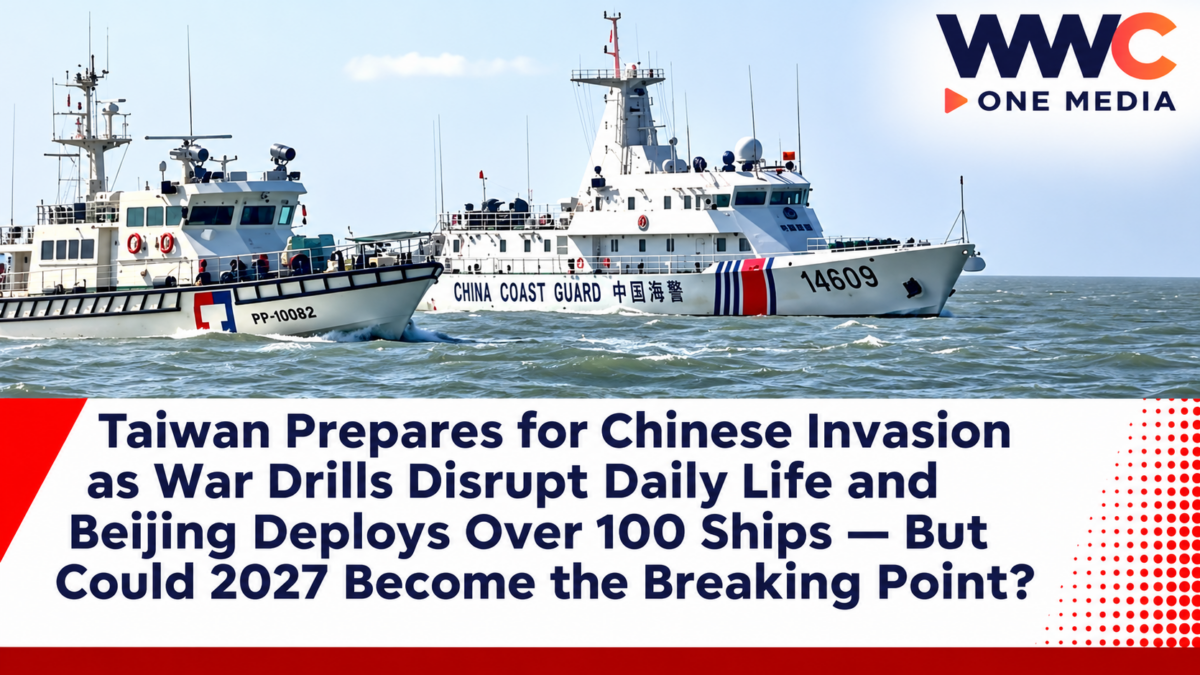
The announcement followed reports of more than 100 Chinese naval and coast guard vessels operating across the region, including waters near Taiwan, the South China Sea and the Pacific Ocean.
Bloomberg’s November 10 feature highlights how Taiwan’s preparations for a possible Chinese attack are extending beyond military bases and into civilian life.
But the shift raises a troubling question.
As Taiwan prepares its population for the possibility of a Chinese invasion, could the island’s increasingly realistic war simulations help prevent a conflict—or signal that the threat of military confrontation is becoming more difficult to ignore?
China’s Growing Military Presence Raises Alarm in Taiwan
Taiwan’s defense authorities reported a significant increase in Chinese military activity in early November.
According to Reuters, Taiwan’s National Security Council Secretary-General Joseph Wu disclosed deployments involving more than 100 Chinese naval and coast guard vessels across waters near Taiwan and elsewhere in the Western Pacific.
The number refers to a broad regional deployment, not a verified count of vessels encircling the island.
Taiwan also reported a sharp increase in Chinese military aircraft activity.
On November 10, Defense Minister Wellington Koo confirmed that Beijing was conducting anti-access and area-denial exercises involving the Liaoning carrier group and other naval formations.
These operations are designed to complicate or prevent the movement of opposing forces into designated areas.
In a potential Taiwan conflict, such capabilities could be used to challenge intervention by the United States or regional allies.
However, Beijing had not formally announced that the latest movements constituted an invasion exercise.
China previously described the Liaoning’s Western Pacific activities as routine training intended to improve long-range operational capabilities.
Taiwan’s government views the growing military presence as a threat to regional stability.
Beijing maintains that Taiwan is part of China and has not ruled out using force to achieve unification.
Taiwan’s government rejects Beijing’s sovereignty claim and maintains that its people must determine their own future.
Taiwan’s War Preparations Are Moving Into Civilian Life
For decades, Taiwan’s defense planning largely focused on military preparedness.
Today, authorities are placing greater emphasis on what officials describe as whole-of-society resilience.
The strategy recognizes that a major conflict would affect far more than soldiers and military equipment.
Hospitals, communication networks, transportation systems, banks, businesses and local governments would all need to continue functioning.
Reuters reported in July that more than 370 military and government officials participated in a major crisis simulation in Nantou County.
The exercise presented a cascading emergency involving a Chinese blockade, an earthquake, sabotage, compromised television broadcasts, banking disruptions, civil unrest and an eventual invasion.
The objective was to determine whether local authorities could maintain essential services during several simultaneous emergencies.
The scenario also reflected lessons from Ukraine, where attacks on civilian infrastructure have demonstrated the importance of maintaining communications, transportation and public services during wartime.
For Taiwanese residents, such preparations are making the possibility of conflict an increasingly visible part of ordinary life.
Taiwan Deliberately Slows Mobile Internet to Simulate Wartime Disruption
One of Taiwan’s most unusual exercises took place in August.
During the annual Han Kuang military drills, authorities deliberately reduced mobile internet speeds in selected areas to simulate communication problems that could occur during a Chinese attack.
Reuters reported that the exercise affected portions of central and northern Taiwan.
During the simulated disruption, high-bandwidth mobile services became difficult or unavailable.
The exercise was designed to test how people and emergency services would respond if normal communications were restricted.
However, fixed-line internet and other essential systems continued operating during the reported tests.
The distinction is important because the authorities were conducting a controlled simulation, not responding to an actual Chinese cyberattack.
Officials wanted to identify vulnerabilities and improve emergency communication procedures.
In a real conflict, damaged telecommunications infrastructure could complicate emergency warnings, family communications and the coordination of public services.
The exercise demonstrated why Taiwan considers digital resilience an increasingly important part of national defense.
Businesses and Factories Are Preparing for a Possible Chinese Attack
Taiwan is also examining how its industrial sector could continue operating during wartime.
In July, the defense ministry announced plans to test the relocation of weapons production and the conversion of civilian factories for military use.
The measures were incorporated into the August Han Kuang exercises.
Reuters reported that the military planned to simulate relocating production lines from its 202nd Arsenal and mobilizing private factories after an emergency order.
The objective was to maintain essential defense manufacturing if existing facilities were damaged or targeted.
Such preparations reflect a broader challenge facing smaller countries confronting militarily larger adversaries.
A successful defense may depend not only on weapons available at the beginning of a conflict but also on the ability to repair equipment, maintain supplies and replace losses.
Civilian manufacturers could potentially provide important support.
However, preparing factories for emergency production does not mean Taiwan has already placed its entire economy under wartime controls.
The exercises are intended to test contingency plans for scenarios that have not occurred.
Airports, Ports and Transportation Networks Become Defense Priorities
Taiwan’s defense preparations extend to key transportation infrastructure.
Airports, ports and major roads would be strategically important during a military emergency.
They could support evacuations, emergency supplies, military movements and the delivery of humanitarian assistance.
In August, Taiwanese forces conducted a simulated response to an enemy airborne assault on an airport.
Armored vehicles and military personnel practiced deploying rapidly to defend critical infrastructure.
WWC ONE MEDIA previously covered the exercise in Taiwan Simulates Enemy Airport Attack — What Happened Next Shows How the Island Is Preparing for War.
The drill illustrated Taiwan’s emphasis on rapid response and protecting strategically important locations.
But an actual attack could involve far more complicated conditions.
Missiles, electronic warfare, cyberattacks and disrupted transportation could create simultaneous challenges for military and civilian authorities.
That is why Taiwan is increasingly rehearsing overlapping emergencies rather than isolated incidents.
Taiwan’s Leaders Warn That Chinese Pressure Is Becoming Routine
Chinese military activity around Taiwan has become a frequent occurrence.
Taiwan’s defense ministry regularly reports movements involving People’s Liberation Army aircraft, warships and other vessels.
Some operations involve aircraft crossing the Taiwan Strait’s median line, an unofficial boundary that historically helped reduce military encounters between the two sides.
In September, Taiwan reported another deployment involving Chinese military aircraft, naval vessels and official ships.
WWC ONE MEDIA covered the development in China Sends Warships and Fighter Jets Toward Taiwan Again — But Taipei Was Ready.
Former Taiwanese President Tsai Ing-wen has also warned that China’s military patrols, cyber operations and economic pressure are creating sustained security challenges.
Speaking during a visit to Stanford University in October, Tsai described the threat as increasingly immediate.
Read WWC ONE MEDIA’s related report, Former Taiwan President Tsai Warns of Sustained Chinese Pressure During US Visit.
The concern is that repeated military pressure can become normalized.
When aircraft and vessels operate near Taiwan almost daily, distinguishing routine activity from preparations for a larger operation can become more difficult.
That uncertainty places additional demands on military surveillance and emergency planning.
Could China Use a Blockade Instead of Launching an Invasion?
An amphibious invasion is not the only scenario Taiwanese authorities are preparing for.
China could potentially attempt to isolate Taiwan through a maritime or aerial blockade.
Such a strategy could disrupt shipments of energy, food, industrial materials and other essential goods.
Taiwan depends heavily on international trade.
Its economy is deeply integrated into global manufacturing and technology supply chains.
A prolonged blockade could therefore create significant economic pressure even without an immediate large-scale landing operation.
Taiwan’s recent military exercises have included simulations of naval escorts, protection of important shipping routes and cooperation between the navy and coast guard.
Authorities have also examined how to maintain critical supplies under disrupted conditions.
China’s reported anti-access and area-denial exercises are particularly relevant because similar capabilities could be used to complicate attempts by foreign forces to reach Taiwan.
However, the latest Chinese exercises do not prove that Beijing has decided to impose a blockade.
They demonstrate capabilities and military preparations that could be relevant to several possible scenarios.
Why 2027 Remains a Critical Year in Taiwan’s Defense Planning
The year 2027 continues to feature prominently in international discussions about Taiwan’s security.
US officials have previously said Chinese President Xi Jinping wants the People’s Liberation Army to possess the capability to conduct a successful invasion by that year.
But developing military capability is different from deciding to launch an attack.
A US Congressional Research Service report updated in February 2026 explicitly distinguished Beijing’s military-readiness objective from evidence of an intention to invade.
In October, reporting also indicated that some US officials considered an invasion before 2028 increasingly unlikely.
Potential factors included difficulties in China’s military preparations, leadership disruptions and Beijing’s interest in Taiwan’s 2028 presidential election.
WWC ONE MEDIA examined those assessments in US Officials Say Chinese Invasion of Taiwan Before 2028 Increasingly Unlikely.
Yet the strategic uncertainty remains.
A November report by Axios cited US Army Pacific Commander General Ronald Clark as maintaining that the military must continue preparing for a possible conflict around 2027 and beyond.
These assessments are not necessarily contradictory.
Military planners must prepare for dangerous scenarios even when intelligence analysts do not believe an attack is imminent.
There is no independently confirmed date for a Chinese invasion of Taiwan.
Taiwan’s Civilian Defense Movement Is Growing
Beyond government-organized drills, some Taiwanese residents are taking a more active role in emergency preparedness.
Civilian organizations have conducted training involving first aid, evacuation and disaster response.
An August report by The New York Times described residents participating in exercises designed to prepare for possible military emergencies.
But Taiwanese society is far from united in its response.
Some people believe increased preparedness is essential to deterrence.
Others worry that highly visible training could increase public anxiety or intensify tensions with Beijing.
Many residents continue their normal routines despite the military activity.
Schools operate, businesses remain open and communities continue everyday activities.
That contrast is central to Taiwan’s current situation.
The possibility of war is increasingly visible, yet civilian life continues.
Taiwan’s challenge is preparing people for emergencies without creating the impression that conflict is inevitable.
Taiwan’s Semiconductor Industry Raises the Global Stakes
A conflict involving Taiwan would carry consequences far beyond East Asia.
The island is home to Taiwan Semiconductor Manufacturing Company (TSMC), one of the world’s most important producers of advanced semiconductors.
Its technology supports smartphones, data centers, artificial intelligence processors and many other electronic products.
Disruption to Taiwan’s chip production could affect companies throughout the global economy.
Advanced semiconductor manufacturing involves complicated facilities, specialized equipment and highly integrated international supply chains.
These operations cannot be transferred to another country overnight.
A military blockade or sustained disruption to electricity, transportation and logistics could therefore create serious challenges for the technology industry.
In September, the top American representative in Taiwan, Raymond Greene, warned that a cross-strait conflict could have devastating economic consequences.
WWC ONE MEDIA reported on those concerns in US Diplomat Warns Taiwan Conflict Would Be Economically Devastating.
However, estimates of the potential economic damage vary considerably.
The precise impact would depend on the nature, duration and geographical extent of any conflict.
What the Growing Taiwan Crisis Means for the Philippines
Taiwan’s security has direct relevance to the Philippines because of their geographical proximity.
The Philippines’ northernmost islands lie close to Taiwan, making the surrounding waterways strategically important.
Batanes is particularly significant because it sits near the Luzon Strait, a major maritime passage connecting the South China Sea and the Pacific Ocean.
Any severe military crisis in nearby waters could affect commercial shipping, aviation and regional security arrangements.
The Philippine government has also expressed concern about Chinese activity near its northern maritime approaches.
On November 8, WWC ONE MEDIA reported Defense Secretary Gilberto Teodoro Jr.’s criticism of Beijing amid renewed controversy surrounding Batanes.
Read the related report, Teodoro Blasts Beijing Over Batanes Claims as Chinese Research Ship Standoff Raises Alarm.
The Batanes dispute is separate from Taiwan’s invasion preparations.
It does, however, illustrate why developments in the Taiwan Strait are closely watched in Manila.
A serious regional emergency could require the Philippines to address security, humanitarian and economic consequences.
Can Taiwan’s Military Preparations Prevent War?
Taiwan’s growing defense efforts are intended partly to strengthen deterrence.
Deterrence seeks to convince a potential aggressor that the costs and risks of military action would outweigh any expected benefits.
For Taiwan, preparedness includes military modernization, civilian resilience and the protection of critical infrastructure.
A society capable of maintaining communications, essential services and basic supplies during an emergency may be more difficult to coerce.
The same principle applies to armed forces that can continue operating after initial attacks.
But preparedness does not eliminate the possibility of miscalculation.
Increased military activity can also raise the risk of accidents or unintended confrontations.
Taiwan and its international partners therefore face the challenge of maintaining credible defenses while avoiding unnecessary escalation.
China, meanwhile, continues asserting its sovereignty claim and opposing what it regards as separatist activity and foreign interference.
The fundamental political dispute remains unresolved.
What Happens Next?
Taiwan’s security authorities will continue monitoring Chinese military activity and preparing for various emergency scenarios.
Several developments deserve close attention.
The first is whether China increases the scale or frequency of naval and air operations around Taiwan.
The second is whether Beijing conducts exercises that more explicitly simulate a blockade or major amphibious operation.
The third is Taiwan’s continued investment in civilian preparedness, communications resilience and defense production.
The fourth is the state of US-China relations, particularly ahead of diplomatic meetings involving Presidents Donald Trump and Xi Jinping.
Political developments inside Taiwan will also matter.
The island’s local elections are scheduled for November 28, while its presidential election is due in 2028.
These events may affect the broader political environment, although they do not determine whether China will use force.
No official announcement establishes that a Chinese invasion is imminent.
The Bigger Picture: A Society Learning to Live With the Possibility of War
Taiwan’s latest preparations reveal how deeply the security challenge has entered civilian life.
War games are no longer confined to soldiers practicing on military bases.
They increasingly involve factories, telecommunications systems, emergency responders, government officials and ordinary residents.
At the same time, China’s military continues expanding its operations around the island and across the Western Pacific.
The combination creates a dangerous sense of uncertainty.
For Taiwan’s government, the objective is to ensure that society can survive major disruptions while convincing Beijing that military aggression would be extraordinarily costly.
For civilians, the challenge is balancing emergency preparedness with the need to live normal lives.
For the wider international community, Taiwan’s security matters because of the island’s position in global technology, maritime commerce and regional stability.
The 2027 military-readiness benchmark has intensified public concern, but it should not be mistaken for a confirmed invasion deadline.
As Taiwan conducts increasingly realistic war drills and China expands its military presence across nearby waters, the question is whether these preparations will succeed in preventing conflict—or whether the possibility of war will become an even more permanent part of life for Taiwan’s 23 million people.