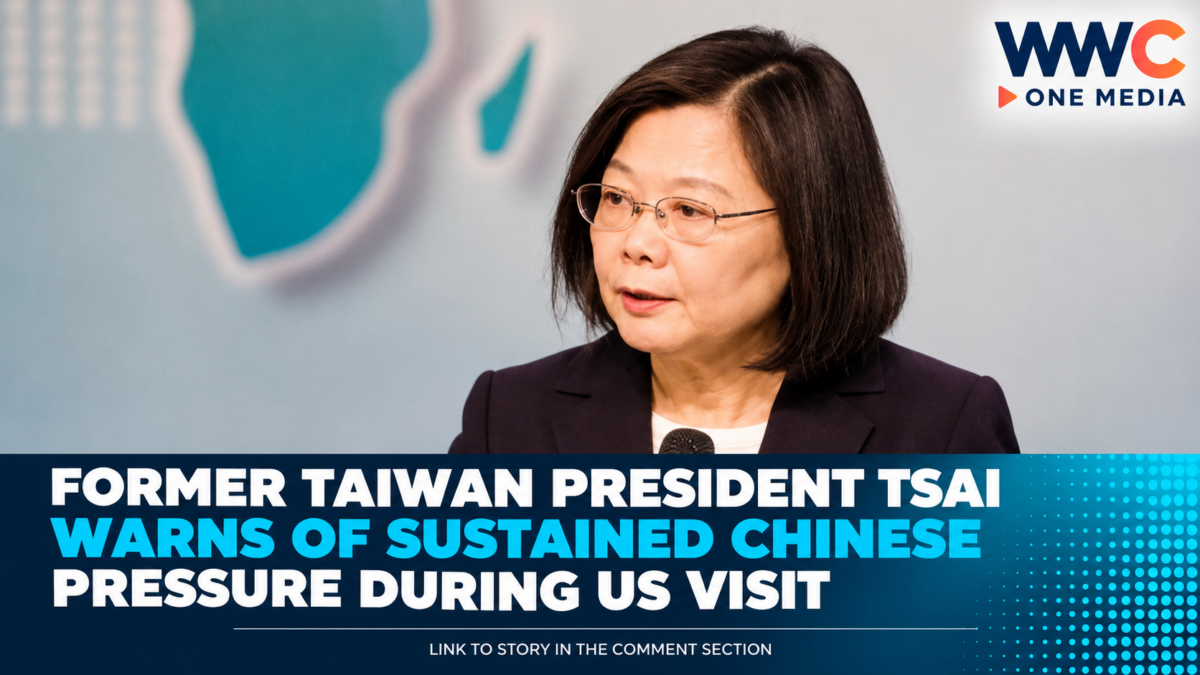
STANFORD, California — Former Taiwan President Tsai Ing-wen has warned that China is maintaining sustained pressure on Taiwan through military patrols, cyberattacks, economic coercion and information operations designed to gradually change the island’s security environment without triggering an open conflict.
Speaking at a defence and technology forum at Stanford University on Wednesday, Oct. 7, Tsai said Taiwan faces a “particularly immediate” security challenge as Chinese military and coast guard activities around the island become increasingly routine.
Her visit marks Tsai’s first trip to the United States since leaving office in 2024, underscoring her continued engagement with Washington and international security issues after eight years as Taiwan’s president. The United States remains Taiwan’s most important international security partner despite having no formal diplomatic relations with Taipei.
Tsai Warns of China’s ‘Grey Zone’ Pressure
Tsai described China’s activities around Taiwan as “grey zone” operations — actions intended to exert pressure and test Taiwan’s responses while remaining below the threshold of an outright military confrontation.
She said Taiwan faces daily cyberattacks, cognitive warfare, information manipulation and economic coercion, alongside attempts to compromise critical infrastructure.
Chinese military aircraft and naval vessels also operate regularly around Taiwan, while coast guard activity and other operations near Taiwan’s waters have become increasingly common, she said.
According to Tsai, the purpose of these activities is not necessarily to trigger an immediate conflict.
Instead, they can impose costs on Taiwan, test how its government and military respond and gradually alter the surrounding security environment.
That creates a difficult challenge for Taipei because responding too aggressively could increase tensions, while failing to respond could allow pressure to become normalised.
Taiwan Wants to Strengthen Deterrence
Tsai said Taiwan must respond to the pressure while preserving its confidence and freedom of action.
She argued that Taiwan needs to continue strengthening its ability to defend itself in case deterrence fails.
Her comments come as Taiwan continues to expand defence spending and modernise its armed forces amid concerns about China’s growing military capabilities.
Taiwan’s government has repeatedly said its objective is to maintain peace and stability across the Taiwan Strait while making any attempt to use force against the island more difficult and costly.
Tsai’s successor, President Lai Ching-te, has similarly called for greater resilience against military, economic and information-based pressure from Beijing.
China, however, rejects Taiwan’s separate political status and regards the island as part of its territory. Beijing has never renounced the use of force to bring Taiwan under its control, although it says it prefers peaceful “reunification.”
Beijing Opposes US-Taiwan Official Contacts
Tsai’s appearance at Stanford also drew attention because of China’s longstanding opposition to official interactions between Taiwan and the United States.
China’s embassy in Washington reiterated this week that Beijing “firmly opposes” official interactions of any kind between the United States and what it describes as China’s Taiwan region.
Beijing has refused to engage in dialogue with either Tsai or Lai, both of whom reject China’s sovereignty claims over Taiwan.
The Chinese Foreign Ministry did not immediately respond to Reuters’ request for comment on Tsai’s latest remarks.
The former president’s visit therefore comes at a sensitive time in US-China relations, particularly following President Donald Trump’s recent summit with Chinese President Xi Jinping.
Taiwanese officials have sought assurances that Washington’s policy toward Taipei remains unchanged despite Trump’s efforts to stabilise relations with Beijing.
Taiwan Says Its Security Matters Beyond the Island
Tsai also framed Taiwan’s security as an international economic and technological issue rather than solely a military dispute between Taipei and Beijing.
She pointed to Taiwan’s central role in global manufacturing and technology supply chains, particularly the semiconductor industry.
The Taiwan Strait itself is also one of the world’s major trade and energy routes. Tsai warned that a serious disruption there would therefore have consequences extending far beyond Taiwan and China.
“A serious disruption would be felt throughout the Indo-Pacific and beyond,” Tsai said, according to a transcript released by her office.
She argued that stronger international cooperation with Taiwan would consequently contribute not only to Taiwan’s own security but also to wider regional stability.
Taiwan’s Semiconductor Industry Adds Strategic Weight
Taiwan’s importance to the global economy has become increasingly intertwined with its security position.
The island is home to major semiconductor manufacturers, including Taiwan Semiconductor Manufacturing Co., whose advanced chips are critical to artificial intelligence, smartphones, computers and other technologies.
Tsai highlighted the relationship between technology and national security during her Stanford speech, arguing that economic resilience and military security can no longer be treated as separate issues.
She noted that the United States accounts for a large share of global AI computing capacity, while Taiwanese companies play a dominant role in manufacturing advanced AI chips and servers.
That dependence has made Taiwan an increasingly important part of discussions in Washington about supply-chain security and the future of artificial intelligence.
Tsai’s Visit Comes Amid Questions Over US Support
The former president’s appearance in the United States comes as Taiwan closely watches the Trump administration’s approach to its defence needs.
Washington has approved major arms packages for Taiwan, but the administration is currently holding back a proposed US$14 billion weapons package, with Trump describing the deal as a potential negotiating tool in dealings with Beijing.
Taiwan’s de facto ambassador to Washington, Alexander Yui, said this week that US-Taiwan relations remain “robust” despite the delay and stressed the importance of timely delivery and effective training for maintaining credible deterrence.
Taiwan’s defence minister Wellington Koo also said Taipei had not received information that the proposed arms package would be divided into smaller batches, while stressing that Washington’s commitment to Taiwan’s self-defence had not changed.
The issue illustrates the delicate balance Washington is attempting to maintain: supporting Taiwan’s ability to defend itself while managing a broader strategic and economic relationship with Beijing.
No Single Date for a Possible Conflict
Tsai’s remarks also come amid continuing debate over when China might potentially attempt military action against Taiwan.
Some analysts and officials have focused on 2027 as a possible benchmark because Chinese President Xi Jinping has instructed the People’s Liberation Army to be capable of carrying out an operation against Taiwan by that time.
But neither Tsai nor Taiwan’s current leadership is basing its defence preparations around a single predicted invasion date.
Taiwanese officials have instead emphasised maintaining readiness regardless of whether a potential conflict is expected in 2027, 2028 or much later.
That approach was echoed this week by Yui, who said Taiwan’s responsibility was to become stronger, more resilient and harder to coerce regardless of the timeline.
A More Complicated Security Environment
Tsai’s speech reflects how Taiwan’s security challenge has evolved beyond the possibility of a conventional invasion.
Military aircraft and ships operating around the island are highly visible manifestations of Chinese pressure, but cyberattacks, disinformation, economic restrictions and attempts to influence public opinion can create pressure without a single shot being fired.
That makes deterrence more complicated.
Taiwan must maintain military readiness while also protecting critical infrastructure, strengthening cybersecurity, preserving economic resilience and maintaining public confidence.
Tsai argued that international cooperation is essential because Taiwan’s security is increasingly connected to the stability of the wider Indo-Pacific.
Taiwan Seeks Deeper International Cooperation
For Tsai, the answer is not simply for Taiwan to acquire more weapons.
She called for deeper cooperation with partners that share an interest in maintaining peace, secure supply chains and technological resilience.
Her message in the United States was therefore broader than a warning about Chinese military activity.
It was also an argument that Taiwan has something to contribute to the international community — particularly through its technology sector, manufacturing capacity and role in global supply chains.
“Deeper cooperation with Taiwan,” Tsai said, strengthens not only Taiwan’s security but also the stability of the Indo-Pacific and the resilience of the broader democratic community.
Pressure Continues Without Open Conflict
Tsai’s appearance at Stanford highlights a central dilemma facing Taiwan and its international partners.
China continues to exert pressure around the island without crossing into open warfare, while Taiwan seeks to prevent those actions from becoming a new normal.
For Taipei, the challenge is to respond strongly enough to preserve deterrence without escalating tensions into a conflict.
For Washington and other partners, the question is how much support is needed to help Taiwan remain secure while avoiding a direct confrontation with Beijing.
As Tsai’s latest US visit demonstrates, Taiwan’s security is no longer viewed solely through the lens of a potential military crisis.
Its semiconductor industry, global supply chains, trade routes and technological importance have made the island’s stability an issue with consequences far beyond the Taiwan Strait.
For now, Tsai’s message is clear: China’s pressure may remain below the threshold of war, but Taiwan sees the cumulative effect as a serious and continuing challenge that requires sustained international attention.