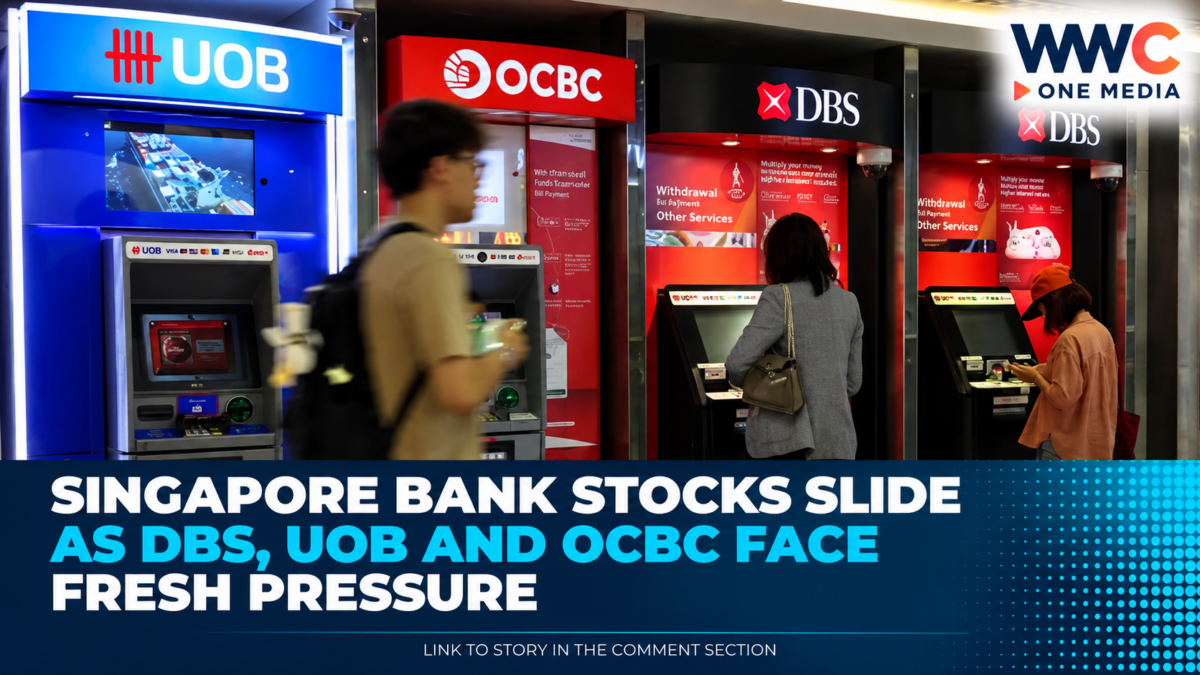
SINGAPORE — Shares of Singapore’s three major banks fell sharply on Thursday, extending a sell-off that has erased billions of dollars from the market value of DBS, OCBC and UOB as investors reassessed the outlook for interest rates, bond yields and bank earnings.
The declines came as broader Singapore stocks also weakened, with the Straits Times Index falling nearly 2.2% in early trading on Oct. 8. DBS, OCBC and UOB were among the biggest drags on the benchmark.
At about 10am, DBS Group Holdings was down 3.2% at S$74.98, while UOB fell 4.8% to S$40.39 and OCBC dropped 4.2% to S$29.02, according to The Business Times.
The latest losses followed another difficult session on Wednesday, when the three banks also fell sharply.
OCBC Leads Two-Day Bank Sell-Off
OCBC suffered the steepest decline among the three lenders on Wednesday, falling 5.9% to S$30.30.
DBS dropped 1.4% to S$77.49, while UOB declined 2.9% to S$42.44.
The moves came after Citi downgraded OCBC from “neutral” to “sell”, citing concerns that the bank’s third-quarter earnings could fall short of market expectations. Citi also maintained its “sell” rating on UOB.
The weakness has continued into Thursday, suggesting that investors are becoming more cautious after a strong run for Singapore bank shares earlier in the year.
All three banks had recently reached record or near-record levels, making them vulnerable to profit-taking as expectations for earnings and interest rates changed.
Rising Bond Yields Add to Pressure
One of the main concerns now facing Singapore banks is the sharp increase in global bond yields.
The benchmark 10-year US Treasury yield climbed to around 5.3%, close to its highest level in more than two decades, after minutes from the US Federal Reserve’s latest meeting showed that most policymakers considered another interest-rate increase likely before the end of the year.
Higher global yields can affect banks in several ways.
Although higher interest rates can support lending margins, rapidly rising long-term yields can also hurt the value of bond portfolios and increase funding costs. Investors are therefore assessing whether the latest increase in rates will ultimately benefit or hurt banks’ earnings.
JPMorgan has warned that surging long-term bond yields could weigh on third-quarter earnings for Southeast Asian lenders, adding another reason for investors to reduce exposure to the sector.
Investors Question Strong Earnings Expectations
The sell-off is also being driven by concerns that expectations for the banks’ third-quarter results may have become too optimistic.
Singapore’s major banks benefited strongly during the first half of 2026 from wealth management, trading and other non-interest income.
But analysts expect some of that exceptional performance to normalise.
Jefferies said loan growth and wealth-management income should remain supportive, while the biggest moderation could come from trading and other non-interest income.
That matters particularly for OCBC, which had benefited from strong wealth and insurance-related businesses.
Citi expects OCBC’s third-quarter earnings to be broadly flat year on year and believes optimism surrounding the bank’s growth prospects could be reduced.
Bank Fundamentals Have Not Suddenly Collapsed
Despite the sharp share-price declines, analysts have stressed that the sell-off does not necessarily mean Singapore’s banks are facing a fundamental deterioration.
Macquarie Capital’s Jayden Vantarakis said investors could simply be taking profits after the banks’ strong performance this year.
Other analysts similarly described the move as being driven more by valuations and expectations than by a sudden deterioration in the banks’ underlying businesses.
That distinction is important.
Singapore’s three largest banks remain among the country’s most profitable and financially significant companies, with strong capital positions and large regional operations.
The immediate concern is whether future earnings can justify the premium valuations investors had been willing to pay.
DBS Still Seen as a Defensive Choice
DBS has continued to attract support from analysts because of its strong capital position and dividend profile.
Jefferies maintained a “buy” rating on DBS with a target price of S$91, while RHB also retained a positive view.
RHB’s latest assessment placed DBS among its preferred Singapore banks, citing its capital strength and dividend appeal.
DBS has also been supported by a return on equity of more than 18%, according to Macquarie’s assessment.
The bank’s diversified business across Singapore and the wider region provides additional sources of revenue beyond traditional lending.
UOB Offers Valuation Appeal
UOB has suffered a particularly sharp decline during the latest sell-off, but some analysts believe its lower valuation could make the stock attractive if the broader market stabilises.
UOB has a relatively high proportion of Singapore-dollar loans, while net interest income makes up a larger share of its revenue than at DBS and OCBC.
Macquarie preferred UOB among the three banks, followed by DBS and OCBC, while Jefferies retained a “buy” rating with a S$48 target price.
UOB also trades at a significant valuation discount to its two major domestic rivals, potentially giving it greater upside if investor confidence returns.
OCBC Faces the Most Divided Views
OCBC has become the most closely watched of the three banks after its sharp decline.
Citi’s downgrade has made the stock a focal point for concerns about whether its exceptional first-half performance can be repeated.
But other analysts remain considerably more positive.
RHB named OCBC its top Singapore bank pick, citing its balance-sheet strength, wealth-management business and earnings momentum. It maintained a “buy” rating and raised its target price to S$33.70.
The disagreement illustrates the uncertainty surrounding the sector.
Some investors see OCBC’s decline as a buying opportunity following an excessive sell-off, while others believe the recent rally pushed expectations too high.
Fed Policy Is Becoming a Bigger Issue
The direction of US monetary policy is particularly important for Asian financial markets.
The Federal Reserve raised its policy rate by 25 basis points in September to a target range of 3.75% to 4%, its first increase in three years.
Fed minutes released this week showed that most officials considered another rate hike likely before the end of 2026, although policymakers remained divided over the timing and necessity of further tightening.
Markets currently assign a relatively low probability to another increase at the Fed’s October meeting, but expectations for a December hike have increased significantly.
That uncertainty has pushed bond yields higher and contributed to volatility across global equity markets.
Oil Prices Add Another Inflation Risk
The bank sell-off is taking place against a wider backdrop of market anxiety.
Oil prices surged again on Thursday as attacks on shipping in the Gulf raised concerns about energy supplies.
Brent crude rose above US$102 a barrel, while US crude climbed toward US$90.
Higher oil prices create another problem for central banks because they can reignite inflation.
If inflation remains elevated, interest rates could stay higher for longer than investors had previously expected.
That could increase borrowing costs and weigh on economic growth, creating a more complicated environment for banks.
Singapore Market Takes a Broader Hit
The pressure on banks has dragged the wider Singapore market lower.
The STI had already fallen 1.6% on Wednesday, losing 93.1 points to close at 5,608.44. OCBC, UOB and DBS were responsible for much of the decline.
By Thursday morning, the index had fallen another 1.66% shortly after the opening bell, with the three banks again leading the decline.
The weakness mirrors a broader retreat across Asian markets.
Japan’s Nikkei, South Korea’s Kospi and other regional benchmarks have also fallen as investors contend with higher oil prices, elevated bond yields and concerns about government finances.
What Investors Will Watch Next
The immediate focus will now turn to the banks’ third-quarter results, which are expected in the first week of November.
Investors will be looking closely at loan growth, net interest margins, wealth-management fees, trading income and credit costs.
They will also be watching whether the recent rise in interest rates improves lending income or instead creates greater pressure on bond portfolios and borrowers.
For now, the sharp decline in DBS, OCBC and UOB shares appears to reflect a combination of profit-taking, stretched valuations, weaker expectations for some areas of earnings and renewed concern about global interest rates rather than a collapse in the health of Singapore’s banking system.
But with oil prices rising, bond yields near multi-decade highs and investors questioning how much further bank earnings can grow, the sector’s record-breaking run has entered a more uncertain phase.
The key question for investors is no longer simply whether Singapore’s banks remain profitable. It is whether their earnings can continue to justify the lofty valuations that helped push their shares to record highs earlier this year.