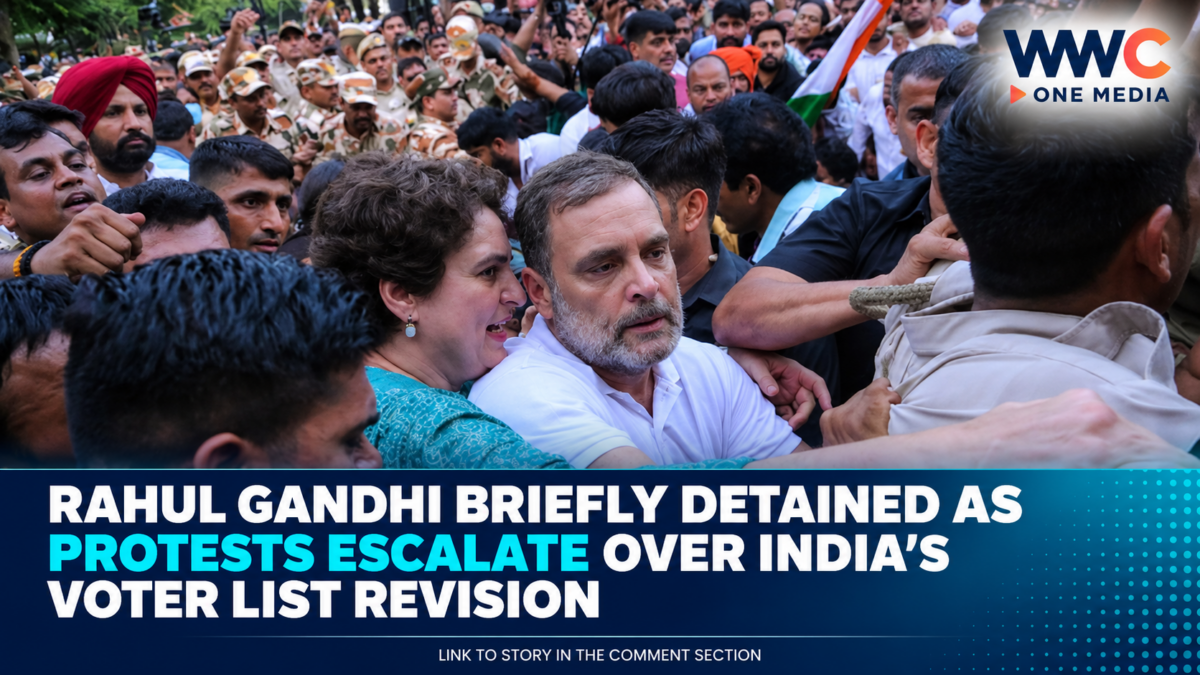
Indian opposition leader Rahul Gandhi was briefly detained by police in New Delhi as protests intensified over a controversial nationwide revision of electoral rolls that has removed more than 130 million names from voter lists.
Gandhi and other opposition lawmakers were stopped on Oct 7 while marching towards Jantar Mantar, a designated protest site in the Indian capital. Video streamed by Gandhi’s Congress party showed police placing him in a vehicle before he was later released.
The detention came a day after Gandhi was also detained during an opposition protest, making it his second detention in two days, according to the Associated Press.
The demonstrations are part of a growing political confrontation between Prime Minister Narendra Modi’s government, opposition parties and the Election Commission of India over the country’s electoral-roll revision process.
Opposition Demands Election Chief’s Resignation
Gandhi and opposition lawmakers are demanding the resignation of Chief Election Commissioner Gyanesh Kumar, accusing the Election Commission of manipulating voter registrations in a way that could benefit Modi’s ruling Bharatiya Janata Party.
The opposition has described the campaign as an attempt to remove legitimate voters from the electoral rolls and has demanded that voters whose names were wrongly deleted be restored.
Congress and other opposition parties have also called for greater transparency over how the names were removed and how affected voters can challenge the decisions.
The Election Commission and the BJP reject the allegations.
They say the revision is intended to clean up electoral rolls by removing duplicate, deceased or otherwise ineligible entries, while ensuring that legitimate voters remain registered.
More Than 130 Million Names Removed
At the centre of the dispute is the Election Commission’s Special Intensive Revision, or SIR, of electoral rolls.
The exercise began last year in the eastern state of Bihar before local elections and has since expanded to most of India’s states and federally administered territories.
More than 130 million names have been removed from voter lists as part of the nationwide exercise, according to recent reports, while millions of affected voters have appealed against the deletions.
The scale of the revision has made it a major political issue ahead of upcoming elections in several Indian states.
Opposition parties argue that the process could disenfranchise eligible voters if people are removed without adequate notice or a practical way to prove their eligibility.
The government and Election Commission maintain that the process is necessary to improve the accuracy and integrity of India’s electoral rolls.
Gandhi Confronts Police Barricades
During the latest protest, Gandhi and other opposition lawmakers attempted to march towards Jantar Mantar but were stopped by police.
Authorities detained several lawmakers and protesters after the group was blocked from proceeding.
Gandhi’s sister and fellow lawmaker Priyanka Gandhi Vadra was also among those detained during the protests. Several other opposition figures were subsequently released.
The demonstrations have featured opposition lawmakers carrying India’s national flag and placards criticising Kumar and the Election Commission.
The protests have also included slogans accusing the government and election authorities of undermining voters’ rights.
Protests Spread Beyond Main Opposition Parties
The dispute is no longer limited to India’s established opposition parties.
Student groups and a youth movement known as “Cockroach” have also joined the campaign against the voter-roll revision.
The movement has emerged as another source of pressure on Modi’s government after earlier demonstrations over examination paper leaks contributed to the resignation of an education minister.
Opposition groups are seeking to turn the voter-list dispute into a broader campaign over electoral transparency and democratic institutions.
The BJP, however, has accused opposition leaders of deliberately attacking India’s institutions and attempting to create political instability.
Why the Voter Revision Is So Controversial
India has one of the world’s largest electorates, with about 969 million people eligible to vote in the 2024 general election.
Any large-scale change to the electoral rolls therefore has the potential to affect millions of voters.
The Election Commission says the SIR process is designed to ensure that electoral rolls contain eligible voters and exclude people who have died, moved away or otherwise no longer qualify.
Opposition parties counter that even legitimate efforts to update voter lists can become problematic if documentation requirements are difficult for ordinary citizens to satisfy.
They have particularly raised concerns about people from poorer or marginalised communities who may lack easily accessible documentation proving their eligibility.
The political dispute has therefore become a debate not only over the number of names removed, but also over how voter eligibility is verified and how people can challenge their removal.
Election Commission Rejects Political Allegations
The Election Commission has rejected accusations that the voter-roll revision is politically motivated.
Authorities say the exercise is part of their constitutional responsibility to maintain accurate electoral rolls.
The BJP has similarly denied allegations that the process is designed to remove supporters of opposition parties.
According to AP reporting, government and election officials say the revision has no political motive and is intended to remove duplicate and ineligible entries while preserving the registrations of eligible voters.
The disagreement has nevertheless deepened distrust between the ruling party and opposition over the independence and functioning of India’s election institutions.
Gandhi Turns Voter Lists Into a Major Political Campaign
Gandhi has made the issue a central part of his opposition campaign, repeatedly accusing the government and election authorities of what he calls “vote theft.”
The Congress leader has argued that voters should not lose their right to participate in elections because of an opaque or flawed verification process.
The opposition has also sought meetings with Election Commission officials and submitted demands concerning the SIR exercise.
During Tuesday’s protest, opposition lawmakers attempted to meet election officials and deliver a memorandum. The confrontation eventually turned into a prolonged standoff before Gandhi and other leaders were detained.
Political Pressure Builds on Modi Government
The protests represent a fresh political challenge for Modi, whose BJP has dominated Indian national politics for more than a decade.
Although the voter-list dispute is primarily focused on the Election Commission, opposition leaders are increasingly framing it as a broader question about the health of India’s democratic institutions.
For Gandhi and the opposition, restoring allegedly deleted voters is now closely linked to their efforts to challenge the BJP’s political dominance.
For the government and election authorities, the central argument remains that accurate electoral rolls are essential to preventing fraud and ensuring that only eligible citizens participate in elections.
A Dispute With Major Electoral Consequences
The confrontation is unlikely to end with Gandhi’s latest detention.
With more than 130 million names removed from electoral rolls and millions of appeals reportedly pending, the SIR process has created one of India’s most significant election-related disputes in recent years.
The opposition is demanding that the revision be halted and that voters it believes were wrongly removed be restored.
The Election Commission insists that the exercise is aimed at improving the integrity of the electoral system, while the BJP says the opposition’s accusations are politically motivated.
As protests continue, the dispute over voter lists is becoming a much larger battle over who gets to vote, how voter eligibility is determined and whether India’s electoral institutions can maintain public trust.
For Gandhi, the latest detention has only added momentum to a campaign that is rapidly becoming one of the opposition’s biggest political challenges to Modi’s government.