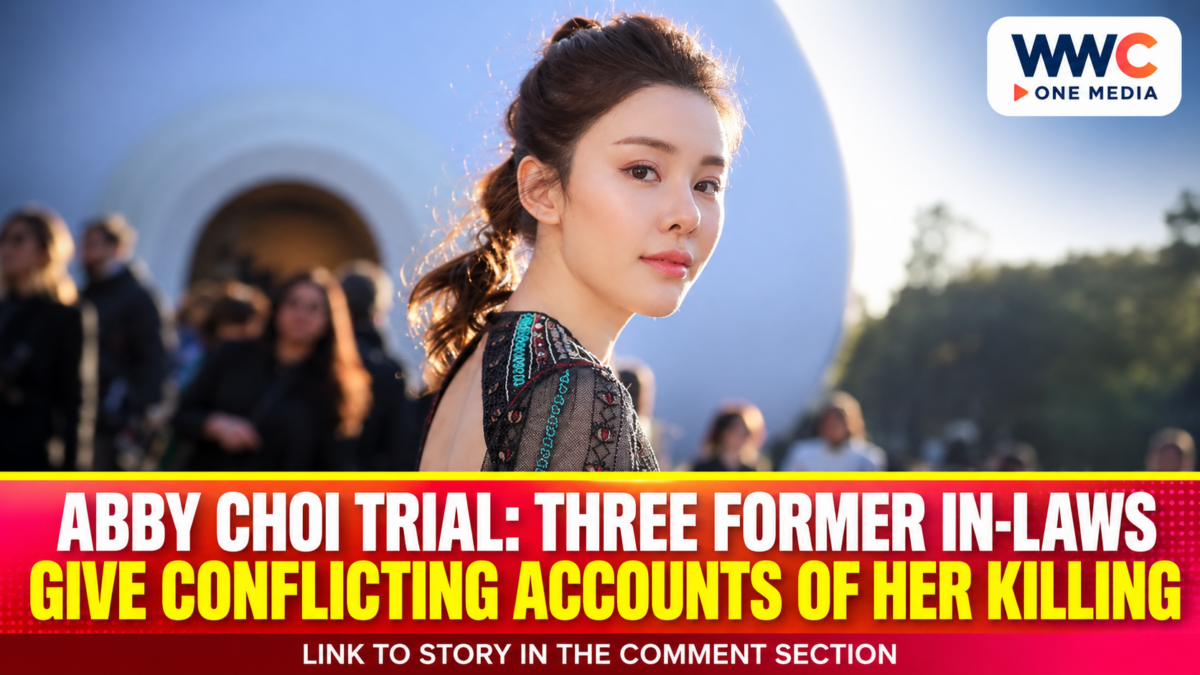
The murder trial of Hong Kong model and socialite Abby Choi has entered a critical stage, with three members of her former in-laws’ family giving accounts that place responsibility for her death on one another.
The testimony, reported during the High Court proceedings, has brought sharply different descriptions of the events surrounding Choi’s death into focus. Her former husband, Alex Kwong Kong-chi; his father, Kwong Kau; and his elder brother, Anthony Kwong Kong-kit, have each been reported as offering accounts that implicate another family member.
The competing versions do not amount to findings of guilt. The jury must assess the evidence presented in court, while the defendants remain entitled to the presumption of innocence on the murder charges. South China Morning Post+1
Three defendants, competing versions
The latest courtroom account describes testimony from the three men during the eighth week of proceedings. According to the South China Morning Post’s Nov. 21 report, Anthony Kwong and his father identified Alex Kwong as the person responsible for the killing. Alex Kwong, in turn, maintained that his father had delivered the fatal blow.
The accounts reportedly differed over who inflicted the fatal injury, even as the witnesses described the death as following a violent confrontation rather than a planned killing.
These are statements attributed to defendants while testifying, not independently established facts. Their significance will depend on how the jury evaluates each account alongside forensic evidence, other testimony and the prosecution’s case. South China Morning Post
What the prosecution previously alleged
The prosecution’s case, as reported during the opening stage of the trial, presented a different account. Prosecutors alleged that Choi’s killing was premeditated and involved preparations before the events of Feb. 21, 2023.
A report from public broadcaster RTHK on Oct. 2 described the prosecution’s allegations concerning purchases of items including a hammer, a chainsaw and gloves. It also reported that prosecutors presented CCTV footage and receipts as part of their account of the movements of the defendants and Choi.
Those details remain allegations to be tested against the defence evidence. The prosecution’s opening statement is not a verdict, and the jury must decide whether the evidence proves the charges beyond reasonable doubt. RTHK
Forensic testimony forms part of the evidence
Earlier proceedings included testimony from forensic pathologist Dr. Kwok Ka-ki. A Nov. 6 report from TVB News said the prosecution’s final witness had completed her testimony, with the defence case expected to begin the following week.
The report described evidence concerning injuries to Choi’s head and lower limb. It also said the pathologist cautioned that the precise size and shape of a blunt object could not be determined from the head wound alone.
Forensic testimony can help a jury understand the nature and possible causes of injuries. It does not, by itself, identify who inflicted them. That question must be considered with the full body of evidence and the competing testimony. 無綫新聞 TVB News+1
Trial continues with eight jurors
The proceedings also experienced a change in the jury panel. TVB News reported on Nov. 10 that one juror was discharged after requesting to withdraw on health grounds. The judge decided that the trial would continue with the remaining eight jurors.
The report also stated that the three defendants had denied the murder charges but admitted the separate charge of preventing the lawful burial of a body.
The jury change is a procedural development, not an indication of how the case will be decided. The remaining jurors must continue to consider the evidence and the judge’s directions before reaching a verdict. 無綫新聞 TVB News
Why the conflicting accounts matter
The central issue is not simply which defendant blames another. The jury must determine whether the prosecution has proved each defendant’s criminal responsibility through admissible evidence.
Conflicting testimony can raise questions about credibility, consistency and whether a witness’s account fits the physical and documentary evidence. A witness’s attempt to shift blame does not automatically make another person’s account true.
The distinction is especially important in a serious criminal trial. Public attention, the disturbing nature of the allegations and the emotional impact of the case cannot replace the legal standard of proof.
For readers following the proceedings, the most responsible approach is to separate three things: what prosecutors allege, what defendants say under oath, and what the jury ultimately finds.
What happens next
The defence evidence and any subsequent submissions will help determine how the case proceeds toward its conclusion. The jury will need to assess the testimony against the prosecution’s evidence, including forensic findings and other material presented during the trial.
Until a verdict is delivered, the competing accounts remain disputed evidence. Any final report should be updated against the court’s actual findings rather than treating one defendant’s testimony as the established explanation for Choi’s death.
Frequently asked questions
1. Who are the three defendants in the Abby Choi murder trial?
The defendants are Choi’s former husband, Alex Kwong Kong-chi; her former father-in-law, Kwong Kau; and her former brother-in-law, Anthony Kwong Kong-kit. 無綫新聞 TVB News
2. What are the defendants accused of?
They face murder charges relating to Choi’s death in February 2023. Courtroom reporting says the three have denied murder but admitted a separate charge of preventing the lawful burial of a body. 無綫新聞 TVB News
3. Why are the defendants’ accounts significant?
Their testimony reportedly differs over who inflicted the fatal injury. The jury must compare those accounts with the other evidence rather than accept any version automatically. South China Morning Post
4. What did the prosecution allege?
The prosecution previously alleged that the killing was planned and cited items purchased before the incident, as well as CCTV footage and receipts, in presenting its case. These remain allegations until determined by the court. RTHK
5. Has the jury reached a verdict?
The latest material available for this draft does not establish a verdict. The case should be treated as ongoing unless a subsequent official court record confirms otherwise.