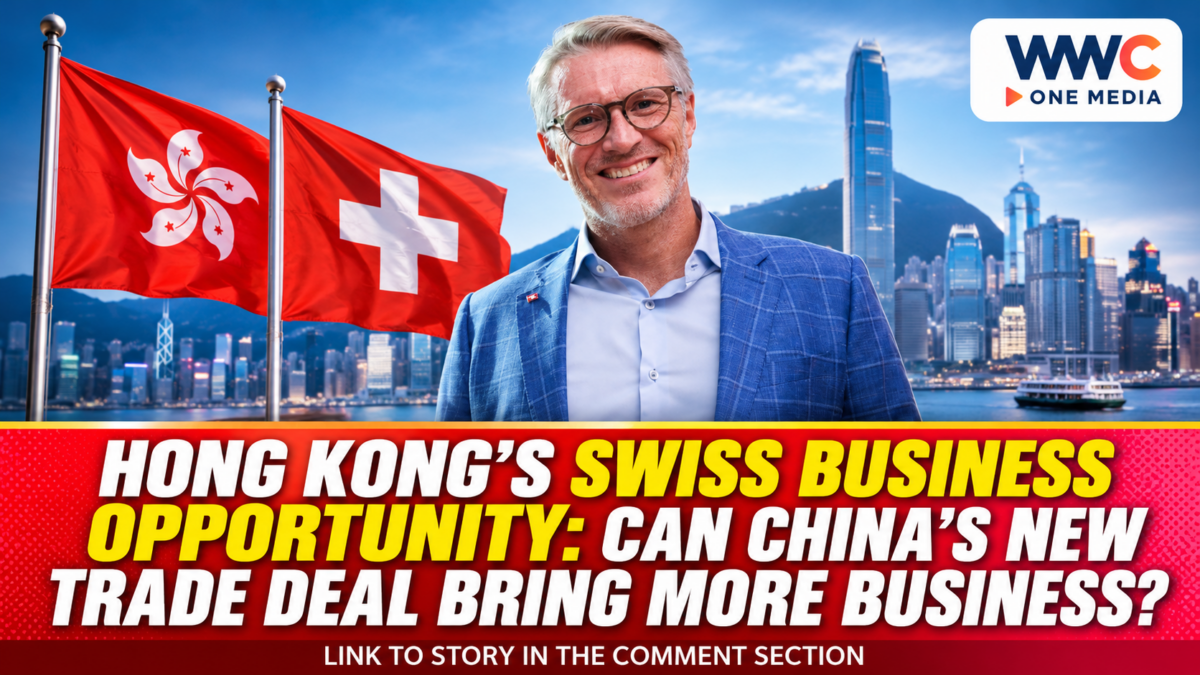
Hong Kong could gain new commercial opportunities as Switzerland and China move to expand their free-trade relationship, following the signing of an upgraded agreement protocol on Oct. 30, 2026. The arrangement is designed to give 99.8% of Switzerland’s current exports duty-free access to the Chinese market once the necessary domestic approval procedures are completed.
The potential benefits may extend beyond Swiss manufacturers and Chinese buyers. Hong Kong already has established financial, logistics and professional-services links with Swiss companies, giving the city a possible supporting role as cross-border trade and investment expand.
But the distinction is important: the agreement directly changes the trade relationship between Switzerland and China. It does not automatically grant Hong Kong-origin products new tariff preferences in China, nor does it guarantee additional business for companies based in the city.
Hong Kong trade could benefit from a wider Swiss-China business relationship
The Swiss government’s updated trade agreement aims to address an imbalance in the existing arrangement. Under the earlier agreement, almost all Chinese imports entering Switzerland were already duty-free, while only around half of Swiss exports to China received the same treatment.
The revised arrangement is intended to increase the share of Switzerland’s current exports eligible for duty-free entry into China to 99.8%. It also covers investment access, services, rules of origin, customs procedures, digital trade, competition and cooperation on economic and technical matters. DFAE+1
That broader scope matters to Hong Kong because the city is already connected to Swiss businesses through several commercial channels.
In an official speech delivered at Swiss Business Excellence Night on Nov. 5, Hong Kong Financial Secretary Paul Chan said bilateral trade between Hong Kong and Switzerland reached approximately HK$93 billion in 2025, an increase of around 9% from the previous year.
Chan also said about 320 Swiss companies operated in Hong Kong, including 70 regional headquarters. Their activities covered banking, insurance, pharmaceuticals, precision engineering, luxury goods and logistics. info.gov.hk
Those existing business relationships provide a foundation for potential cooperation if Swiss companies expand their activities in mainland China.
For Hong Kong, the opportunity may involve services that support international companies rather than simply the physical movement of Swiss products.
Finance, logistics and legal services have a possible role
A company exporting products into a larger market may need more than a customs clearance service. It can also require trade financing, foreign-exchange services, insurance, contract advice, supply-chain coordination and regional management support.
Hong Kong has established capabilities in several of these areas. Its government’s 2026–2030 development plan identifies international finance, maritime activity and trade as major strengths, while also setting out plans to expand the city’s role as a platform for offshore trade.
The plan specifically describes opportunities for manufacturing, technology and logistics companies to carry out international ordering, foreign-exchange transactions, trade finance and supply-chain management through Hong Kong. info.gov.hk
These functions could become relevant if more Swiss exporters and investors use Hong Kong to coordinate their Asian operations.
However, the commercial outcome will depend on individual company decisions. A wider tariff preference in China does not automatically mean that Swiss businesses will establish new offices, hire more staff or move their regional operations to Hong Kong.
The city will need to remain competitive in service quality, regulatory certainty, financing and cross-border business support.
The Northern Metropolis adds a technology and research dimension
The opportunity is not limited to traditional trade services.
Hong Kong is also developing the Northern Metropolis as part of its plans to expand research, innovation and technology-related industries. The government’s development plan identifies the area as a key part of its ambition to become an international innovation and technology centre.
In his Nov. 5 speech, Chan pointed to biotechnology as one possible area for cooperation with Swiss companies. He said Hong Kong and mainland authorities were working to facilitate cross-border flows of research data and biological samples, while increasing cooperation on clinical trials and drug approvals. info.gov.hk+1
This could create opportunities for companies involved in pharmaceuticals, medical research, laboratory services and technology development.
Switzerland has an established pharmaceutical and precision-engineering industry, while Hong Kong is positioning itself as a connection point between international research institutions and the Greater Bay Area.
Still, research collaboration requires more than a general expression of interest. It depends on institutional partnerships, regulatory requirements, funding, data protection and the ability to move research materials across borders under applicable rules.
The Northern Metropolis could become a useful platform, but its commercial contribution will depend on projects that actually proceed.
Hong Kong already has a separate trade agreement with Switzerland
The new China–Switzerland protocol should not be confused with Hong Kong’s own trade arrangements with Switzerland.
Hong Kong and the four members of the European Free Trade Association — Switzerland, Iceland, Liechtenstein and Norway — signed a comprehensive free-trade agreement on June 21, 2011.
The agreement entered into force between Hong Kong and Switzerland on Oct. 1, 2012. It covers goods, services, investment and other trade-related matters, including intellectual property protection. tid.gov.hk
The Hong Kong Trade and Industry Department said merchandise trade between Hong Kong and the EFTA group reached HK$95.2 billion in 2025. Bilateral services trade with the group totalled HK$15.5 billion in 2024.
Those figures cover all four EFTA economies, not Switzerland alone. They nevertheless show that Hong Kong already has a substantial trade framework and commercial relationship with the wider group.
The separate agreements also mean businesses must distinguish between the rules that apply to Hong Kong–Switzerland trade and those governing Swiss exports to mainland China.
Rules of origin, customs documentation and the destination market determine whether a particular shipment qualifies for preferential treatment. Simply passing goods through Hong Kong does not automatically make them Hong Kong-origin products or give them a different tariff status.
What the agreement does not guarantee
The upgraded agreement creates a more favourable framework for eligible Swiss exports to China, but it should not be interpreted as a guaranteed increase in Hong Kong’s trade revenue.
The benefit to Hong Kong depends on whether Swiss companies use the city for banking, insurance, legal services, regional management, logistics or research partnerships.
There is also a timing issue. Switzerland’s State Secretariat for Economic Affairs confirms that the protocol was signed on Oct. 30, but the parties must still complete their respective domestic legal approval procedures before it enters into force. China+1
The tariff schedules and rules of origin will be important for businesses deciding which products qualify and when the new treatment can be claimed.
For a broader regional comparison, WWC has examined how China–ASEAN trade growth is shaping commercial relationships across Asia. The Philippines is also pursuing its own market-access initiatives, including the Philippines–Chile trade agreement and the conclusion of Philippines–Canada free-trade negotiations.
These are separate arrangements, but they illustrate why businesses need to examine the actual commitments and implementation rules behind each trade announcement.
What happens next
The immediate next step is the completion of domestic approval procedures by Switzerland and China. Businesses will then need the applicable implementation information, including tariff schedules, origin requirements and customs procedures, before relying on the revised preferences.
For Hong Kong, the more important indicators will be whether Swiss companies expand their regional operations, establish new financial or logistics relationships, or develop research partnerships connected to the Northern Metropolis and the Greater Bay Area.
The city already has a substantial Swiss business presence and an established trade agreement with EFTA. The new China–Switzerland arrangement could strengthen the commercial case for using Hong Kong as a regional services centre, but the scale of any benefit will depend on actual investment and business activity.
The opportunity is real, but it is not automatic.
Frequently asked questions
What does the upgraded China–Switzerland trade agreement change?
It expands preferential market access for goods and updates provisions on services, investment, rules of origin, customs, digital trade, competition and sustainable development.
Will 99.8% of Swiss exports enter China duty-free immediately?
No. The revised protocol was signed on Oct. 30, 2026, but domestic approval procedures must be completed before it enters into force.
Why could Hong Kong benefit from the agreement?
Hong Kong has established financial, logistics and professional-services links with Swiss businesses. Greater Swiss commercial activity in mainland China could create demand for some of these services.
Does the new agreement give Hong Kong products duty-free access to China?
No new Hong Kong-origin tariff preference is established by the China–Switzerland protocol. Hong Kong has separate trade arrangements with mainland China and Switzerland.
What is the Northern Metropolis’ role in the opportunity?
Hong Kong plans to develop the Northern Metropolis as part of its international innovation and technology ambitions. It could support research and commercial partnerships, including potential cooperation with Swiss businesses.