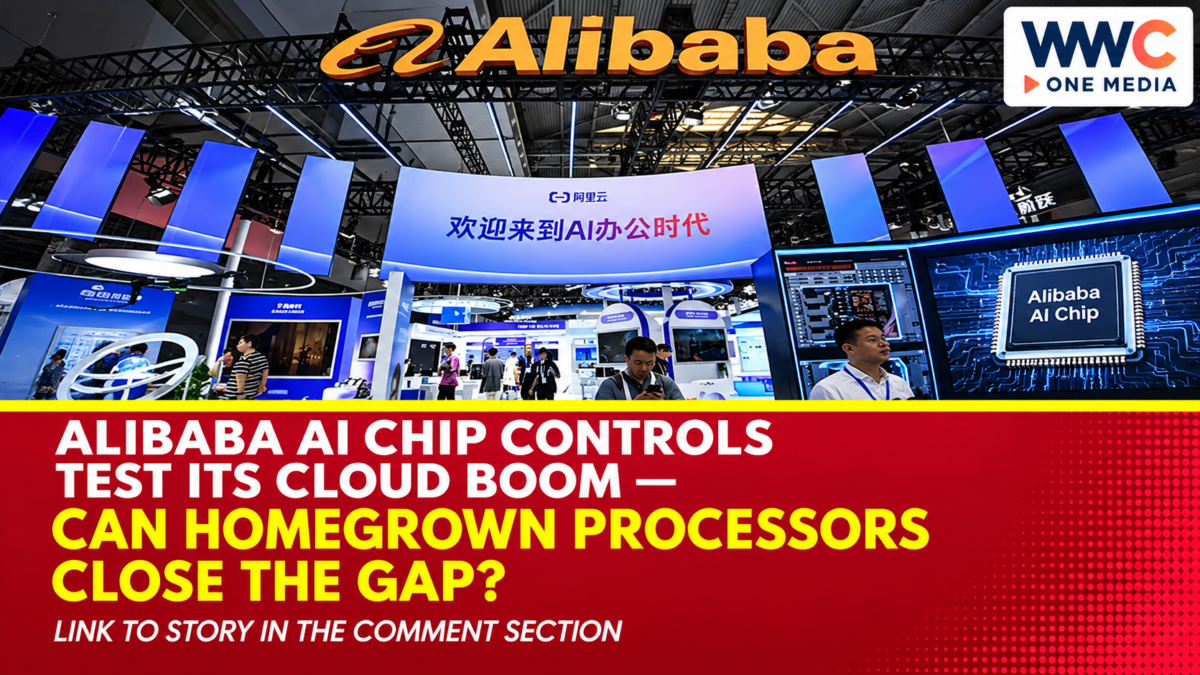
HONG KONG — Nov. 19, 2026. Alibaba’s artificial intelligence cloud business is expanding rapidly while new US restrictions target access to advanced computing, including certain arrangements involving data centres outside China. Alibaba’s latest published quarterly results document strong AI-related sales and rising investment, but neither those disclosures nor the US rules establish that the company has been cut off from every imported processor.
The commercial test is whether Alibaba can keep supplying competitive AI services while meeting applicable technology controls and scaling its own chips. Its financial filings reveal real momentum; the government’s latest rule shows why equipment location and customer access now matter alongside chip imports.
Alibaba AI Chip Controls: What Has Changed
On Nov. 16, the US Department of Commerce announced an interim final rule addressing remote access to advanced US computing capabilities. The department explained that data centres outside restricted jurisdictions can potentially provide computing power to customers subject to US restrictions, creating a regulatory challenge that cannot be addressed by checking physical shipments alone.
The measure expands scrutiny of remote computing arrangements and related compliance obligations. It should not be described as a universal ban on Alibaba Cloud’s services, an order to shut down existing facilities, or proof that Alibaba violated export law. Which transactions require authorisation depends on the equipment, customer, location, service and detailed regulations.
A separate Commerce decision on Jan. 13 shifted export licence applications for Nvidia H200, AMD MI325X and comparable processors bound for China to conditional case-by-case review. Licences are not automatic; applicants must meet security and compliance requirements. The decision does not mean every newer processor is approved for China.
Alibaba’s Cloud Revenue Shows Why Compute Access Matters
Alibaba reported on Aug. 20 that AI Cloud and Compute Services generated approximately US$7.1 billion in the June 2026 quarter, increasing 45% from a year earlier. AI-related product revenue reached approximately US$1.8 billion, extending triple-digit annual growth for the twelfth consecutive quarter.
The company said adjusted operating earnings before interest, taxes and amortisation in its cloud business rose 133% to approximately US$830 million. It reported nearly US$10 billion in quarterly capital expenditure, an increase of 75% year on year, reflecting heavy spending as AI demand rose.
These are company-reported figures for the quarter ended June 30, not newly published November-quarter results. Alibaba announced that it would release the September-quarter figures on Nov. 19 before the US market opened. Those results had not been independently confirmed in the primary records reviewed for this article.
WWC has separately examined Alibaba’s changing balance between commerce and AI cloud revenue. The additional question now is whether export-control compliance affects the cost and availability of the computing capacity behind that growth.
Alibaba’s Own Processors Offer an Alternative — Not a Guarantee
Alibaba’s August corporate update described a closer connection between its T-Head chip-design operation, Qwen models and cloud services. It said its Zhenwu M890 AI processor had been adopted through Alibaba Cloud by more than 650 external customers in over 20 industries.
That is evidence of reported commercial adoption, but not a disclosed independent benchmark demonstrating that the processor can replace every restricted overseas accelerator at the same performance, energy use or total cost. Different workloads require different combinations of computing capacity, memory and software tools.
Earlier in the year, Alibaba’s chairman and chief executive told shareholders that proprietary T-Head chips had achieved production at scale and were supplying its cloud and model-service infrastructure. The company has also reported more than 3 billion downloads of its Qwen model family; downloads are not equivalent to paying customers.
WWC’s earlier coverage of Alibaba’s processor and model announcements explores that product strategy. This new development raises a different issue: whether domestic hardware, legal import channels and cloud operating practices can be combined without compromising customer service or compliance.
Remote Computing Turns Compliance Into a Business Decision
A company does not need to own a particular processor to access its computing output. Cloud computing allows customers to rent capacity housed in another location. That commercial model can support international research and enterprise applications, but it also makes identifying users and permitted uses more important.
The November rule reflects a US policy concern that restricted computing can be reached indirectly. It does not follow that all cross-border AI applications are prohibited. Providers must analyse the precise equipment and end users involved instead of applying a single label to an entire country or cloud company.
This is relevant to Southeast Asia, where firms are developing data-centre services and serving customers across borders. WWC previously examined how US rules could affect regional AI data centres. A facility’s address alone may not answer questions about remote users, ownership and compliance.
What this could mean: Alibaba may have commercial incentives to expand domestic processor capacity and improve model efficiency, while continuing to assess lawful access to outside technology. None of the reviewed records measures the financial cost of the November rule specifically to Alibaba.
Investors Need to Separate Growth From Dependence
AI infrastructure economics involve more than the number of chips deployed. Costs include equipment, electricity, networking, software, maintenance and the utilisation of computing capacity. A proprietary processor could help some workloads while leaving other dependencies unresolved.
Alibaba’s disclosed sales growth suggests demand for its services, but it does not guarantee that capital expenditure will produce attractive long-term returns. Equally, stricter US rules do not establish that customer demand has disappeared. The relevant evidence will be margins, actual customer usage, equipment availability and documented compliance costs.
A balanced reading of the official record supports neither the claim that Alibaba’s AI strategy has failed nor the claim that its chips make all export restrictions irrelevant. Both outcomes require evidence beyond announcements.
What Happens Next
Alibaba’s next authenticated results and investor presentation should show how cloud revenue, spending and margins are developing. US rulemaking materials and any subsequent licensing decisions will help clarify the practical effect of restrictions on cross-border computing.
Investors should watch for disclosures about processor deployments, service availability and technology expenditure. Claims that specific Alibaba facilities, customers or shipments have been blocked require company-specific documents, which were not established in the records examined here.
Frequently Asked Questions
Has the United States banned every AI chip sale to Alibaba?
No such blanket company-specific finding was established by the primary records reviewed. US controls depend on chip specifications, destinations, end users and licensing requirements.
Is Alibaba already earning revenue from AI cloud services?
Yes. Alibaba reported approximately US$7.1 billion in AI Cloud and Compute Services revenue for the June 2026 quarter, up 45% year on year.
Does Alibaba design its own AI processors?
Yes. Alibaba has described its T-Head chips and reported adoption of the Zhenwu M890 through its cloud services, but it has not demonstrated that every imported chip can be replaced without trade-offs.
Why do US restrictions address remote data-centre access?
US officials say advanced computing housed outside a restricted jurisdiction can still be accessed remotely by restricted users. The November rule addresses certain arrangements of that kind; it does not prohibit all cloud services worldwide.